
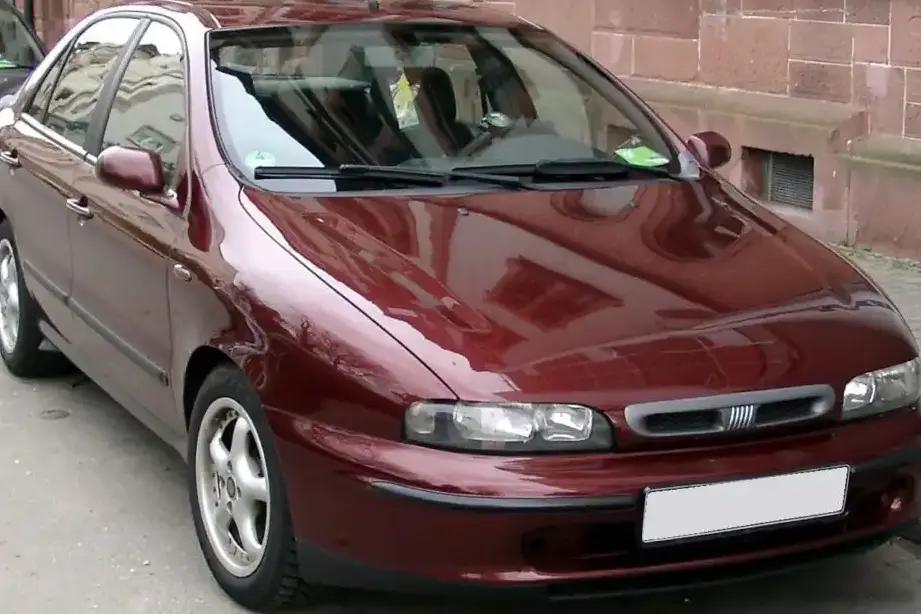
The Fiat Marea (185) 1.6 100 16V Bipower, produced between 1999 and 2000, represented a mid-range offering within the second generation Marea lineup. The Marea, a large family car produced by Fiat, was primarily aimed at the European market as a competitor to vehicles like the Ford Mondeo and Opel Vectra. This particular variant, with its 1.6-liter engine and 103 horsepower, was positioned as a balance between affordability and reasonable performance, appealing to buyers seeking a practical and spacious sedan. The “Bipower” designation refers to the engine’s capability to run on both gasoline and LPG (Liquefied Petroleum Gas), a common feature in some European markets for tax and fuel cost benefits.
Technical Specifications
| Brand | Fiat |
| Model | Marea |
| Generation | Marea (185) |
| Type (Engine) | 1.6 100 16V Bipower (103 Hp) |
| Start of production | 1999 |
| End of production | 2000 |
| Powertrain Architecture | Internal Combustion engine |
| Body type | Sedan |
| Seats | 5 |
| Doors | 4 |
| Fuel consumption (urban) | 11.8 l/100 km (19.9 US mpg, 23.9 UK mpg, 8.5 km/l) |
| Fuel consumption (extra urban) | 6.7 l/100 km (35.1 US mpg, 42.2 UK mpg, 14.9 km/l) |
| Fuel Type | Petrol (Gasoline) |
| Acceleration 0 – 100 km/h | 11.6 sec |
| Acceleration 0 – 62 mph | 11.6 sec |
| Acceleration 0 – 60 mph | 11 sec |
| Maximum speed | 187 km/h (116.2 mph) |
| Weight-to-power ratio | 12.2 kg/Hp, 81.7 Hp/tonne |
| Weight-to-torque ratio | 8.8 kg/Nm, 114.3 Nm/tonne |
| Power | 103 Hp @ 5750 rpm |
| Power per litre | 65.1 Hp/l |
| Torque | 144 Nm @ 4000 rpm (106.21 lb.-ft. @ 4000 rpm) |
| Engine layout | Front, Transverse |
| Engine Model/Code | 186.A4.000 |
| Engine displacement | 1581 cm3 (96.48 cu. in.) |
| Number of cylinders | 4 |
| Engine configuration | Inline |
| Cylinder Bore | 86.4 mm (3.4 in.) |
| Piston Stroke | 67.4 mm (2.65 in.) |
| Compression ratio | 10.5:1 |
| Number of valves per cylinder | 4 |
| Fuel injection system | Multi-port manifold injection |
| Engine aspiration | Naturally aspirated engine |
| Valvetrain | DOHC |
| Engine oil capacity | 3.8 l (4.02 US qt | 3.34 UK qt) |
| Coolant capacity | 6.7 l (7.08 US qt | 5.9 UK qt) |
| Kerb Weight | 1260 kg (2777.82 lbs.) |
| Max. weight | 1750 kg (3858.09 lbs.) |
| Max load | 490 kg (1080.27 lbs.) |
| Trunk (boot) space – minimum | 430 l (15.19 cu. ft.) |
| Fuel tank capacity | 63 l (16.64 US gal | 13.86 UK gal) |
| Length | 4390 mm (172.83 in.) |
| Width | 1740 mm (68.5 in.) |
| Height | 1420 mm (55.91 in.) |
| Wheelbase | 2540 mm (100 in.) |
| Front track | 1470 mm (57.87 in.) |
| Rear (Back) track | 1440 mm (56.69 in.) |
| Drivetrain Architecture | The Internal combustion engine (ICE) drives the front wheels of the vehicle. |
| Drive wheel | Front wheel drive |
| Number of gears and type of gearbox | 5 gears, manual transmission |
| Front suspension | Wishbone |
| Rear suspension | Coil spring |
| Front brakes | Disc |
| Rear brakes | Drum |
| Assisting systems | ABS (Anti-lock braking system) |
| Steering type | Steering rack and pinion |
| Power steering | Hydraulic Steering |
| Tires size | 185/65 R14 |
Powertrain & Engine Architecture
The heart of the Marea 1.6 16V Bipower is the 186.A4.000 engine, a 1.6-liter inline-four cylinder gasoline engine. This engine featured a double overhead camshaft (DOHC) valvetrain operating four valves per cylinder, contributing to its relatively high output for its displacement. The engine utilized a multi-port fuel injection system, providing precise fuel delivery for improved efficiency and performance. The “Bipower” system allowed the engine to seamlessly switch between gasoline and LPG, offering drivers the flexibility to choose their fuel source based on cost and availability. The LPG system typically involved a separate fuel tank and a regulator to adjust the gas pressure. The engine’s 103 horsepower and 144 Nm (106 lb-ft) of torque were respectable for its class, but not exceptional. The engine was paired with a five-speed manual transmission, which was the standard offering for this variant. While an automatic transmission was available on other Marea models, it wasn’t typically offered with the 1.6-liter engine.
Driving Characteristics
The Marea 1.6 16V Bipower offered a comfortable and predictable driving experience. The 103 horsepower engine provided adequate acceleration for everyday driving, but it wasn’t particularly sporty. The 0-100 km/h (0-62 mph) time of around 11.6 seconds reflects this. The five-speed manual transmission allowed drivers to keep the engine in its optimal power band, but the engine lacked the low-end torque of larger displacement engines. Compared to the more powerful Marea 2.0 16V or the diesel-powered versions, the 1.6 felt noticeably less responsive. However, the Bipower system, when running on LPG, could slightly reduce running costs, although it often came at the expense of a small power reduction. The suspension provided a good balance between comfort and handling, making it suitable for long journeys.
Equipment & Trim Levels
The Marea 1.6 16V Bipower typically came with a reasonable level of standard equipment. This included power steering, central locking, electric front windows, and an anti-lock braking system (ABS). Interior upholstery was usually cloth, and the dashboard featured a functional, if somewhat dated, design. Optional extras could include air conditioning, alloy wheels, a radio/cassette player, and upgraded interior trim. The Bipower variant didn’t necessarily have unique trim features beyond the LPG system components; it generally shared the same interior and exterior styling as other 1.6-liter Marea models.
Chassis & Braking
The Marea utilized a front-wheel-drive layout with a MacPherson strut front suspension and a coil spring rear suspension. The front brakes were disc brakes, providing good stopping power, while the rear brakes were drum brakes, a cost-saving measure common in this segment. The ABS system helped to maintain steering control during emergency braking. The chassis was designed to provide a comfortable ride and stable handling, but it wasn’t particularly sporty. The steering was hydraulic, making it relatively easy to maneuver at low speeds.
Market Reception & Comparison
The Fiat Marea 1.6 16V Bipower was generally well-received as a practical and affordable family car. Critics praised its spacious interior, comfortable ride, and the fuel-saving potential of the Bipower system. However, it was often criticized for its somewhat uninspired styling and its lack of sporting pretensions. Compared to the more powerful Marea variants, the 1.6 offered lower performance but better fuel economy. The diesel versions provided even better fuel economy but lacked the refinement of the gasoline engine. The Marea faced stiff competition from rivals like the Ford Mondeo, Opel Vectra, and Volkswagen Passat, all of which offered similar levels of practicality and performance.
Legacy
The Fiat Marea, while not a runaway sales success, remains a reasonably well-regarded car among enthusiasts. The 1.6 16V Bipower engine, while not known for exceptional reliability, is generally considered to be durable and relatively easy to maintain. Parts availability can be a challenge in some markets, as the Marea is now an older vehicle. Today, the Marea 1.6 16V Bipower can be found in the used car market at very affordable prices, making it an attractive option for budget-conscious buyers seeking a spacious and practical family car. The Bipower system, while requiring periodic maintenance, can still offer cost savings for those who frequently drive in areas where LPG is readily available and competitively priced.
