
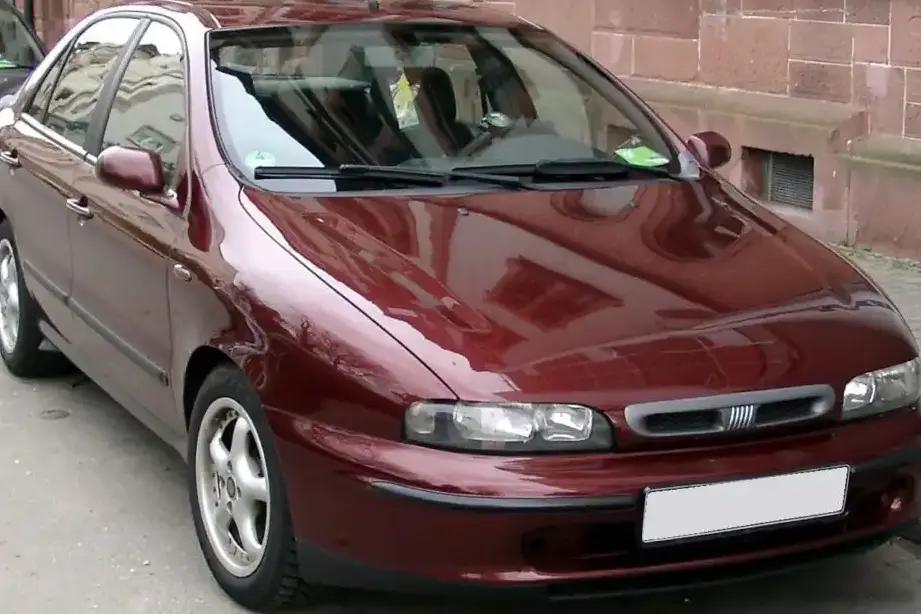
The Fiat Marea (185) 1.6 16V Automatic, produced between 1996 and 2000, represented a mid-range offering within the broader Marea lineup. The Marea, launched as a replacement for the aging Fiat Tempra, was a significant vehicle for Fiat, intended to compete in the competitive mid-size segment, primarily in Europe and Latin America. This particular variant, combining a 1.6-liter 16-valve engine with a four-speed automatic transmission, aimed to provide a balance of affordability, comfort, and reasonable performance for buyers prioritizing ease of driving over outright speed. It occupied a position between the base 1.4-liter models and the more powerful 2.0-liter versions, appealing to families and drivers seeking a practical and comfortable daily driver.
Technical Specifications
| Brand | Fiat |
| Model | Marea |
| Generation | Marea (185) |
| Type (Engine) | 1.6 16V (103 Hp) Automatic |
| Start of production | 1996 |
| End of production | 2000 |
| Powertrain Architecture | Internal Combustion engine |
| Body type | Sedan |
| Seats | 5 |
| Doors | 4 |
| Fuel consumption (urban) | 13.8 l/100 km (17 US mpg, 20.5 UK mpg) |
| Fuel consumption (extra urban) | 7.1 l/100 km (33.1 US mpg, 39.8 UK mpg) |
| Fuel Type | Petrol (Gasoline) |
| Acceleration 0 – 100 km/h | 10.7 sec |
| Acceleration 0 – 62 mph | 10.7 sec |
| Acceleration 0 – 60 mph | 10.2 sec |
| Maximum speed | 187 km/h (116.2 mph) |
| Weight-to-power ratio | 11.1 kg/Hp |
| Weight-to-torque ratio | 7.9 kg/Nm |
| Power | 103 Hp @ 5750 rpm |
| Torque | 144 Nm @ 4000 rpm (106.21 lb.-ft. @ 4000 rpm) |
| Engine layout | Front, Transverse |
| Engine Model/Code | 186.A4.000 |
| Engine displacement | 1581 cm3 (96.48 cu. in.) |
| Number of cylinders | 4 |
| Engine configuration | Inline |
| Cylinder Bore | 86.4 mm (3.4 in.) |
| Piston Stroke | 67.4 mm (2.65 in.) |
| Compression ratio | 10.5:1 |
| Number of valves per cylinder | 4 |
| Fuel injection system | Multi-port manifold injection |
| Engine aspiration | Naturally aspirated |
| Valvetrain | DOHC |
| Engine oil capacity | 4.5 l (4.76 US qt | 3.96 UK qt) |
| Coolant capacity | 6.4 l (6.76 US qt | 5.63 UK qt) |
| Kerb Weight | 1140 kg (2513.27 lbs.) |
| Max. weight | 1730 kg (3814 lbs.) |
| Max load | 590 kg (1300.73 lbs.) |
| Trunk (boot) space – minimum | 430 l (15.19 cu. ft.) |
| Fuel tank capacity | 63 l (16.64 US gal | 13.86 UK gal) |
| Length | 4390 mm (172.83 in.) |
| Width | 1740 mm (68.5 in.) |
| Height | 1420 mm (55.91 in.) |
| Wheelbase | 2540 mm (100 in.) |
| Front track | 1470 mm (57.87 in.) |
| Rear track | 1440 mm (56.69 in.) |
| Drivetrain Architecture | Front wheel drive |
| Number of gears | 4 |
| Gearbox type | Automatic transmission |
| Front suspension | Wishbone |
| Rear suspension | Coil spring |
| Front brakes | Disc |
| Rear brakes | Drum |
| Assisting systems | ABS (Anti-lock braking system) |
| Steering type | Steering rack and pinion |
| Power steering | Hydraulic |
| Tires size | 185/65 R14 |
| Wheel rims size | 14 |
Powertrain & Engine Architecture
The heart of this Marea variant is the Fiat 186.A4.000 1.6-liter inline-four engine. This engine, a member of Fiat’s 100-series family, featured a 16-valve dual overhead camshaft (DOHC) cylinder head. The engine utilized multi-point fuel injection, a common setup for the era, providing improved fuel atomization and more precise control over the air-fuel mixture compared to earlier single-point injection systems. The 1.6L engine was known for its relatively smooth operation and decent mid-range torque. Paired with this engine was a four-speed automatic transmission. This transmission, while providing convenience, wasn’t known for its particularly quick shifts or fuel efficiency compared to manual counterparts. It was a conventional hydraulic automatic, lacking the electronic controls found in more modern transmissions.
Driving Characteristics
The 1.6 16V Automatic Marea offered a comfortable, if not particularly exhilarating, driving experience. With 103 horsepower and 144 Nm (106 lb-ft) of torque, acceleration from 0-60 mph took around 10.2 seconds, and 0-100 km/h in 10.7 seconds. The automatic transmission, while smooth, did sap some power, resulting in a noticeable difference in performance compared to the five-speed manual version. Gear ratios were geared towards fuel economy and relaxed cruising rather than sporty acceleration. The car felt most at home on the highway, where its comfortable ride and adequate power made for a pleasant journey. In city driving, the automatic transmission proved convenient, but the engine could feel strained when attempting quick overtaking maneuvers.
Equipment & Trim Levels
The 1.6 16V Automatic Marea typically came equipped with features considered standard for a mid-range vehicle in the late 1990s. These included power steering, central locking, electric front windows, and an AM/FM radio. Higher trim levels, often denoted by suffixes like “SX” or “HL”, added features such as alloy wheels, air conditioning, a sunroof, and upgraded interior upholstery. Interior materials were generally durable but not luxurious, with cloth seats being standard. The dashboard layout was functional and straightforward, prioritizing ease of use over aesthetic flair.
Chassis & Braking
The Marea utilized a front-wheel-drive layout with independent wishbone suspension at the front and a coil spring rear suspension. This setup provided a reasonable balance of ride comfort and handling. Braking was accomplished via disc brakes at the front and drum brakes at the rear. Anti-lock Braking System (ABS) was often included as standard equipment, enhancing safety. The suspension was tuned for comfort, resulting in a slightly softer ride compared to sportier rivals. Stabilizer bars were present, but their thickness was modest, reflecting the car’s focus on everyday usability.
Market Reception & Comparison
The Fiat Marea 1.6 16V Automatic received mixed reviews. Critics praised its comfortable ride, spacious interior, and reasonable price point. However, the automatic transmission was often criticized for its sluggishness and impact on fuel economy. Compared to the 2.0-liter versions, the 1.6 offered less power and performance, but it was significantly more affordable to purchase and operate. The 1.9 TDI diesel variant, while offering superior fuel economy, was more expensive and lacked the refinement of the gasoline engine. The Marea generally competed with vehicles like the Ford Mondeo, Opel/Vauxhall Vectra, and Peugeot 406.
Legacy
The Fiat Marea, while not a runaway sales success, remains a fondly remembered vehicle for many European and Latin American drivers. The 1.6 16V Automatic powertrain, while not known for exceptional reliability, proved generally durable with proper maintenance. Common issues included occasional sensor failures and wear on the automatic transmission. Today, well-maintained examples are becoming increasingly rare, appealing to enthusiasts seeking a classic European sedan. The Marea’s comfortable ride and practical design continue to endear it to those who appreciate a simple, honest, and affordable vehicle.
