
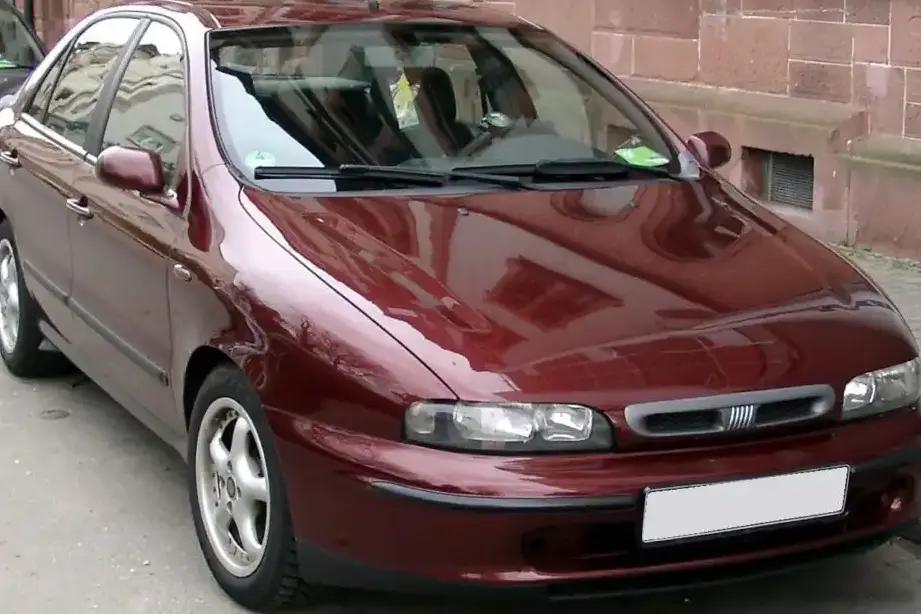
The Fiat Marea (185) 1.9 JTD 105, produced between 1999 and 2000, represented a significant offering in the mid-size sedan segment, particularly within European markets. Positioned as a practical and efficient option, this variant utilized a modern direct-injection diesel engine to deliver a balance of performance and fuel economy. The Marea itself was Fiat’s replacement for the aging Tipo, aiming to provide a more contemporary and spacious vehicle. This 1.9 JTD 105 model sat in the middle of the Marea range, offering a step up in performance from the lower-powered petrol engines while remaining more affordable than the higher-output JTD variants.
Technical Specifications
| Brand | Fiat |
| Model | Marea |
| Generation | Marea (185) |
| Type (Engine) | 1.9 JTD 105 (105 Hp) |
| Start of production | 1999 |
| End of production | 2000 |
| Powertrain Architecture | Internal Combustion engine |
| Body type | Sedan |
| Seats | 5 |
| Doors | 4 |
| Fuel consumption (urban) | 7.4 l/100 km (31.8 US mpg) |
| Fuel consumption (extra urban) | 4.6 l/100 km (51.1 US mpg) |
| Fuel Type | Diesel |
| Acceleration 0 – 100 km/h | 10.8 sec |
| Acceleration 0 – 62 mph | 10.8 sec |
| Acceleration 0 – 60 mph | 10.3 sec |
| Maximum speed | 185 km/h (114.95 mph) |
| Weight-to-power ratio | 11.6 kg/Hp |
| Weight-to-torque ratio | 6.1 kg/Nm |
| Power | 105 Hp @ 4000 rpm |
| Power per litre | 55 Hp/l |
| Torque | 200 Nm @ 1500 rpm (147.51 lb.-ft. @ 1500 rpm) |
| Engine layout | Front, Transverse |
| Engine Model/Code | 182 B4.000 |
| Engine displacement | 1910 cm3 (116.56 cu. in.) |
| Number of cylinders | 4 |
| Engine configuration | Inline |
| Cylinder Bore | 82 mm (3.23 in.) |
| Piston Stroke | 90.4 mm (3.56 in.) |
| Compression ratio | 18.5:1 |
| Number of valves per cylinder | 2 |
| Fuel injection system | Diesel Commonrail |
| Engine aspiration | Turbocharger, Intercooler |
| Valvetrain | OHC |
| Engine oil capacity | 4.5 l (4.76 US qt | 3.96 UK qt) |
| Coolant | 5.6 l (5.92 US qt | 4.93 UK qt) |
| Kerb Weight | 1215 kg (2678.62 lbs.) |
| Max. weight | 1800 kg (3968.32 lbs.) |
| Max load | 585 kg (1289.7 lbs.) |
| Trunk (boot) space – minimum | 430 l (15.19 cu. ft.) |
| Fuel tank capacity | 63 l (16.64 US gal | 13.86 UK gal) |
| Length | 4390 mm (172.83 in.) |
| Width | 1740 mm (68.5 in.) |
| Height | 1420 mm (55.91 in.) |
| Wheelbase | 2540 mm (100 in.) |
| Front track | 1470 mm (57.87 in.) |
| Rear (Back) track | 1440 mm (56.69 in.) |
| Drivetrain Architecture | The Internal combustion engine (ICE) drives the front wheels of the vehicle. |
| Drive wheel | Front wheel drive |
| Number of gears and type of gearbox | 5 gears, manual transmission |
| Front suspension | Wishbone |
| Rear suspension | Coil spring |
| Front brakes | Disc |
| Rear brakes | Drum |
| Assisting systems | ABS (Anti-lock braking system) |
| Steering type | Steering rack and pinion |
| Power steering | Hydraulic Steering |
| Tires size | 185/65 R14 |
Introduction
The Fiat Marea (185) 1.9 JTD 105, launched in 1999, was a key component of Fiat’s mid-size lineup. Built on the Tipo-derived 185 platform, the Marea aimed to offer a more refined and spacious alternative to competitors like the Ford Mondeo and Opel/Vauxhall Vectra. The 1.9 JTD 105 variant was introduced as Fiat embraced direct-injection diesel technology, offering a compelling blend of performance, fuel efficiency, and relatively low emissions. This model was primarily sold in European markets, where diesel engines held a significant share of the family car segment.
Powertrain & Engine Architecture
At the heart of the Marea 1.9 JTD 105 lies the 182 B4.000 engine, a 1910cc inline-four cylinder diesel. This engine was a product of Fiat’s collaboration with Bosch, utilizing a second-generation common rail direct injection system. This system allowed for precise control of fuel delivery, resulting in improved combustion efficiency, reduced noise, and lower emissions compared to earlier diesel designs. The engine featured an overhead camshaft (OHC) valvetrain with two valves per cylinder. A turbocharger with an intercooler was employed to boost power output, delivering 105 horsepower at 4000 rpm and 200 Nm (147.51 lb-ft) of torque at a low 1500 rpm. The engine’s high compression ratio of 18.5:1 was typical for direct-injection diesels of the era. The Marea 1.9 JTD 105 was exclusively offered with a five-speed manual transmission, optimized for the engine’s torque characteristics.
Driving Characteristics
The Marea 1.9 JTD 105 offered a distinctly different driving experience compared to the petrol-powered versions. The abundant low-end torque made it a relaxed and easy car to drive in everyday conditions. While not particularly quick – 0-60 mph took around 10.3 seconds – the engine provided ample power for overtaking and cruising on highways. The five-speed manual transmission was well-matched to the engine, allowing drivers to keep the engine in its optimal torque band. Compared to the higher-output JTD variants (typically 125-140 hp), the 105 hp version felt less stressed and potentially more durable. The gear ratios were geared towards fuel efficiency, prioritizing comfortable long-distance driving over outright acceleration.
Equipment & Trim Levels
The Marea 1.9 JTD 105 typically came with a reasonable level of standard equipment. This included central locking, power windows, power steering, and an anti-lock braking system (ABS). Interior upholstery was generally cloth, with a functional and durable design. Optional extras included air conditioning, alloy wheels, a sunroof, and a radio/cassette player. Trim levels varied slightly depending on the market, but generally focused on adding comfort and convenience features. The dashboard layout was typical of Fiat designs from the period, with a clear instrument cluster and logically arranged controls.
Chassis & Braking
The Marea 185 utilized a front-wheel-drive layout with independent wishbone suspension at the front and a coil spring rear suspension. This setup provided a comfortable ride, although it wasn’t particularly sporty in handling. The front brakes were ventilated discs, while the rear brakes were drums. This configuration was common for vehicles in this class and weight category at the time. ABS was standard, enhancing braking performance and safety. The steering was a hydraulic rack and pinion system, providing reasonable feedback and precision.
Market Reception & Comparison
The Fiat Marea 1.9 JTD 105 was generally well-received by automotive critics as a practical and economical family car. It was praised for its fuel efficiency, comfortable ride, and spacious interior. However, some critics noted that the interior materials weren’t as high quality as those found in some competitors. Compared to the petrol-powered Marea variants, the 1.9 JTD 105 offered significantly better fuel economy and a more relaxed driving experience. Against other diesel-powered rivals, such as the Volkswagen Passat TDI, the Marea offered a competitive price point and a comparable level of performance. Reliability was generally considered good, although common rail diesel systems could be susceptible to issues with injectors and the high-pressure fuel pump.
Legacy
The Fiat Marea 1.9 JTD 105, while not a groundbreaking vehicle, played an important role in popularizing common rail diesel technology in Europe. The 182 B4.000 engine proved to be a robust and reliable unit when properly maintained. Today, surviving examples are relatively rare, and well-maintained cars are sought after by enthusiasts and those looking for a classic, economical, and practical vehicle. The common rail diesel system, while requiring careful maintenance, offered a significant step forward in diesel engine technology, paving the way for the modern diesel engines found in today’s vehicles. The Marea, in its various forms, remains a fondly remembered car for many European drivers.
