
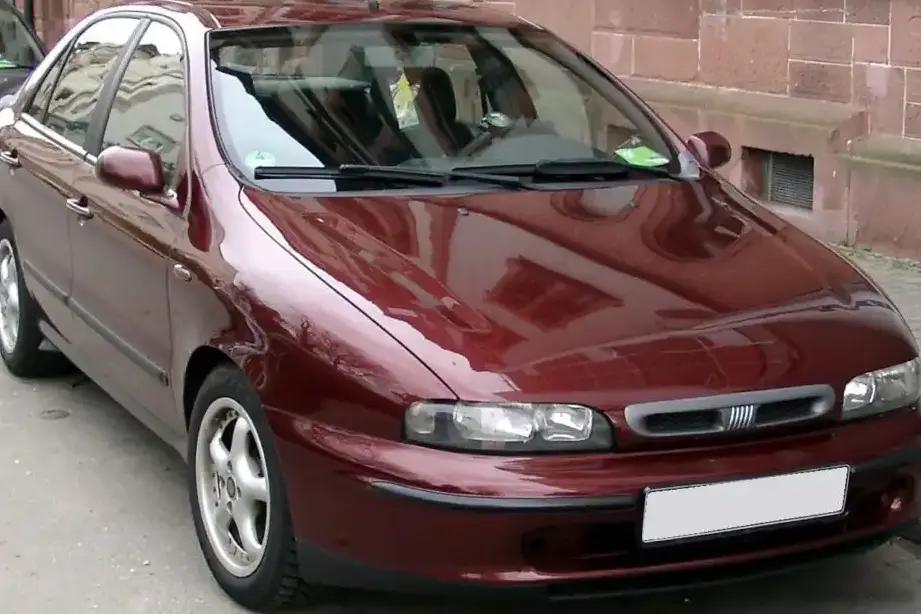
The Fiat Marea (185) 2.4 TD 125, produced between 1996 and 1999, represented a significant offering in the mid-size segment, particularly within European markets. Positioned as a more premium and spacious alternative to the smaller Fiat Tipo, the Marea aimed to compete with established rivals like the Ford Mondeo and Opel Vectra. This specific 2.4-liter turbodiesel variant, delivering 125 horsepower, occupied a middle ground in the Marea lineup, offering a balance between fuel efficiency, performance, and cost. It was designed to appeal to drivers needing a comfortable and practical family sedan with the added benefit of diesel economy for long distances.
Technical Specifications
| Brand | Fiat |
| Model | Marea |
| Generation | Marea (185) |
| Type (Engine) | 2.4 TD 125 (125 Hp) |
| Start of production | 1996 |
| End of production | 1999 |
| Powertrain Architecture | Internal Combustion engine |
| Body type | Sedan |
| Seats | 5 |
| Doors | 4 |
| Fuel consumption (urban) | 10.2 l/100 km (23.1 US mpg) |
| Fuel consumption (extra urban) | 6 l/100 km (39.2 US mpg) |
| Fuel Type | Diesel |
| Acceleration 0 – 100 km/h | 9.9 sec |
| Acceleration 0 – 62 mph | 9.9 sec |
| Acceleration 0 – 60 mph | 9.4 sec |
| Maximum speed | 195 km/h (121.17 mph) |
| Weight-to-power ratio | 10.2 kg/Hp |
| Weight-to-torque ratio | 4.8 kg/Nm |
| Power | 125 Hp @ 4000 rpm |
| Power per litre | 52.4 Hp/l |
| Torque | 265 Nm @ 2250 rpm (195.45 lb.-ft. @ 2250 rpm) |
| Engine layout | Front, Transverse |
| Engine Model/Code | 185A2000 |
| Engine displacement | 2387 cm3 (145.66 cu. in.) |
| Number of cylinders | 5 |
| Engine configuration | Inline |
| Cylinder Bore | 82 mm (3.23 in.) |
| Piston Stroke | 90.4 mm (3.56 in.) |
| Compression ratio | 20.7:1 |
| Number of valves per cylinder | 2 |
| Fuel injection system | Precombustion chamber injection |
| Engine aspiration | Turbocharger |
| Valvetrain | OHC |
| Engine oil capacity | 5.3 l (5.6 US qt | 4.66 UK qt) |
| Coolant capacity | 6.5 l (6.87 US qt | 5.72 UK qt) |
| Kerb Weight | 1280 kg (2821.92 lbs.) |
| Max. weight | 1870 kg (4122.64 lbs.) |
| Max load | 590 kg (1300.73 lbs.) |
| Trunk (boot) space – minimum | 430 l (15.19 cu. ft.) |
| Fuel tank capacity | 63 l (16.64 US gal | 13.86 UK gal) |
| Length | 4378 mm (172.36 in.) |
| Width | 1741 mm (68.54 in.) |
| Height | 1415 mm (55.71 in.) |
| Wheelbase | 2540 mm (100 in.) |
| Front track | 1461 mm (57.52 in.) |
| Rear track | 1432 mm (56.38 in.) |
| Drivetrain Architecture | Front wheel drive |
| Number of gears | 5 |
| Gearbox type | Manual transmission |
| Front suspension | Wishbone |
| Rear suspension | Coil spring |
| Front brakes | Ventilated discs |
| Rear brakes | Disc |
| Assisting systems | ABS (Anti-lock braking system) |
| Steering type | Steering rack and pinion |
| Power steering | Hydraulic |
| Tires size | 195/55 R15 |
Powertrain & Engine Architecture
The heart of the Marea 2.4 TD 125 is the 185A2000 engine, a 2.4-liter inline-five cylinder diesel. This engine utilized a precombustion chamber injection system, a common technology for diesel engines of the era, designed to improve combustion efficiency and reduce noise. The turbocharger significantly boosted power output, allowing for a respectable 125 horsepower and 265 Nm (195 lb-ft) of torque. The engine featured a single overhead camshaft (OHC) valvetrain, operating two valves per cylinder. The five-cylinder configuration, while less common than four-cylinder diesels, contributed to a smoother power delivery and reduced vibrations. The engine was transversely mounted in the front of the vehicle, driving the front wheels. The standard transmission for this variant was a five-speed manual gearbox, chosen for its efficiency and driver engagement.
Driving Characteristics
The Marea 2.4 TD 125 offered a comfortable and capable driving experience. The 265 Nm of torque, available from a relatively low 2250 rpm, provided ample pulling power for everyday driving and overtaking maneuvers. While not a sports car, the 0-60 mph time of around 9.4 seconds was respectable for a diesel sedan of the late 1990s. The five-speed manual transmission allowed drivers to effectively manage the engine’s powerband. Compared to the lower-powered 1.8-liter gasoline versions, the 2.4 TD offered significantly more torque and better fuel economy. However, it lacked the outright acceleration of the higher-spec gasoline engines. The suspension provided a good balance between comfort and handling, making it suitable for both city driving and long highway journeys.
Equipment & Trim Levels
The Marea 2.4 TD 125 typically came equipped with a reasonable level of standard features. These included power steering, central locking, electric front windows, and an anti-lock braking system (ABS). Interior upholstery was generally cloth, with options for upgraded materials available. Dashboard design was functional and straightforward, prioritizing usability over flashy aesthetics. Optional extras included air conditioning, a sunroof, and upgraded audio systems. The trim level often dictated the availability of these options, with higher trims offering more standard features.
Chassis & Braking
The Marea utilized a front-engine, front-wheel-drive layout. The front suspension employed a wishbone design, while the rear suspension featured coil springs. This setup provided a comfortable ride and predictable handling. Braking duties were handled by ventilated discs at the front and solid discs at the rear. The ABS system enhanced braking performance and stability, particularly in adverse conditions. The chassis was designed to provide a good balance between rigidity and weight, contributing to the car’s overall handling characteristics.
Market Reception & Comparison
The Fiat Marea 2.4 TD 125 was generally well-received by automotive critics as a practical and economical family sedan. The diesel engine was praised for its fuel efficiency and torque, making it a popular choice for drivers covering long distances. However, some critics noted that the interior styling was somewhat dated compared to its rivals. Compared to the gasoline-powered Marea variants, the 2.4 TD offered superior fuel economy and torque, but at the expense of some outright performance. The Marea’s spacious interior and comfortable ride were also highlighted as key strengths.
Legacy
The Fiat Marea, while not a massive sales success in all markets, established a reputation for reliability and practicality. The 185A2000 2.4-liter turbodiesel engine, when properly maintained, proved to be a durable and long-lasting unit. Today, the Marea 2.4 TD 125 can be found in the used car market, often appealing to those seeking an affordable and economical classic car. Parts availability can be a challenge in some regions, but the engine’s robust design and relatively simple mechanics make it a viable option for enthusiasts and those seeking a dependable workhorse vehicle. Its status as a somewhat overlooked gem of the 1990s continues to attract a dedicated following.
