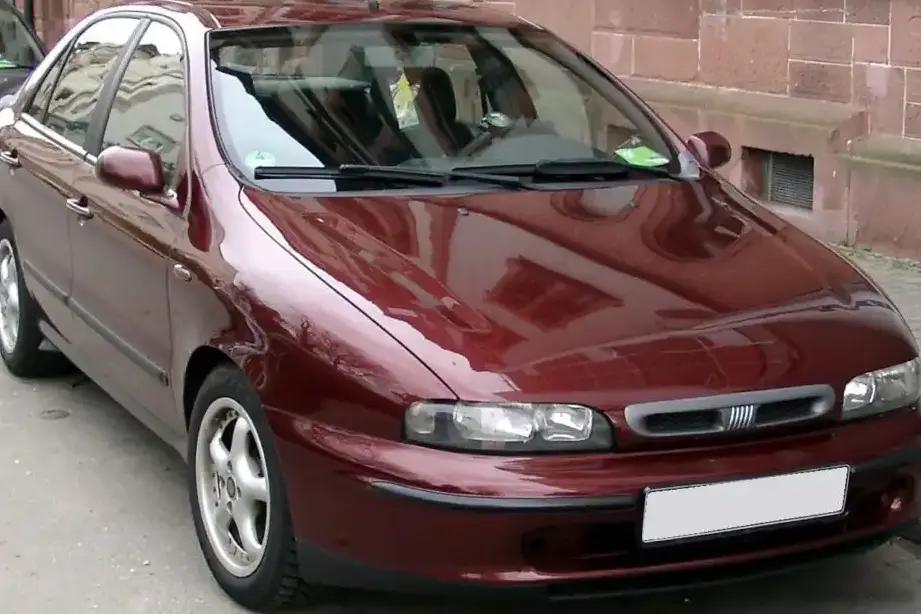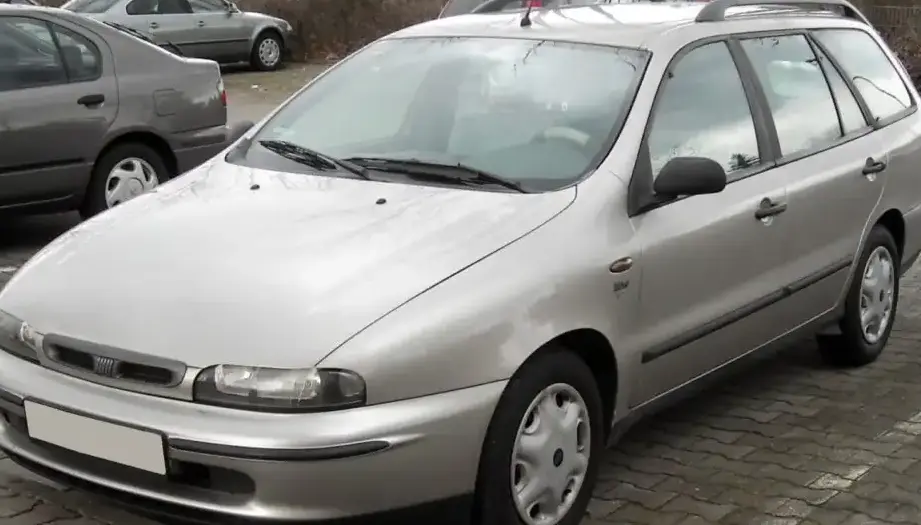
The Fiat Marea Weekend 2.0 150 20V, produced between 1996 and 1999, represented a significant offering in the European mid-size station wagon segment. Part of the 185 series, this variant occupied a performance-oriented niche within the Marea Weekend lineup, positioned above the base models and below any potential high-performance versions. The Marea, in general, was designed to replace the aging Fiat Tipo, aiming to provide a more modern and spacious vehicle for families and those requiring substantial cargo capacity. The Weekend body style, specifically, catered to buyers prioritizing practicality and versatility.
Technical Specifications
| Brand | Fiat |
| Model | Marea |
| Generation | Marea Weekend (185) |
| Type (Engine) | 2.0 150 20V (147 Hp) |
| Start of production | 1996 |
| End of production | 1999 |
| Powertrain Architecture | Internal Combustion engine |
| Body type | Station wagon (estate) |
| Seats | 5 |
| Doors | 5 |
| Fuel consumption (urban) | 14.3 l/100 km (16.4 US mpg, 19.8 UK mpg) |
| Fuel consumption (extra urban) | 7.4 l/100 km (31.8 US mpg, 38.2 UK mpg) |
| Fuel Type | Petrol (Gasoline) |
| Acceleration 0 – 100 km/h | 9.5 sec |
| Acceleration 0 – 62 mph | 9.5 sec |
| Acceleration 0 – 60 mph | 9 sec |
| Maximum speed | 205 km/h (127.38 mph) |
| Weight-to-power ratio | 8.9 kg/Hp |
| Weight-to-torque ratio | 7 kg/Nm |
| Power | 147 Hp @ 5800 rpm |
| Power per litre | 73.6 Hp/l |
| Torque | 187 Nm @ 4400 rpm (137.92 lb.-ft. @ 4400 rpm) |
| Engine layout | Front, Transverse |
| Engine Model/Code | 182A1000 |
| Engine displacement | 1998 cm3 (121.93 cu. in.) |
| Number of cylinders | 5 |
| Engine configuration | Inline |
| Cylinder Bore | 82 mm (3.23 in.) |
| Piston Stroke | 75.7 mm (2.98 in.) |
| Compression ratio | 10.1:1 |
| Number of valves per cylinder | 4 |
| Fuel injection system | Multi-port manifold injection |
| Engine aspiration | Naturally aspirated |
| Valvetrain | DOHC |
| Engine oil capacity | 5 l (5.28 US qt | 4.4 UK qt) |
| Coolant capacity | 7.2 l (7.61 US qt | 6.34 UK qt) |
| Kerb Weight | 1315 kg (2899.08 lbs.) |
| Max. weight | 1895 kg (4177.76 lbs.) |
| Max load | 580 kg (1278.68 lbs.) |
| Trunk (boot) space – minimum | 500 l (17.66 cu. ft.) |
| Trunk (boot) space – maximum | 1500 l (52.97 cu. ft.) |
| Fuel tank capacity | 63 l (16.64 US gal | 13.86 UK gal) |
| Length | 4484 mm (176.54 in.) |
| Width | 1741 mm (68.54 in.) |
| Height | 1495 mm (58.86 in.) |
| Wheelbase | 2540 mm (100 in.) |
| Front track | 1461 mm (57.52 in.) |
| Rear track | 1432 mm (56.38 in.) |
| Drivetrain Architecture | Front wheel drive |
| Number of gears | 5 |
| Gearbox type | Manual transmission |
| Front suspension | Wishbone |
| Rear suspension | Coil spring |
| Front brakes | Ventilated discs |
| Rear brakes | Disc |
| Assisting systems | ABS (Anti-lock braking system) |
| Steering type | Steering rack and pinion |
| Power steering | Hydraulic |
| Tires size | 195/55 R15 |
Powertrain & Engine Architecture
The heart of the Marea Weekend 2.0 150 20V was the 182A1000 engine, a 1998cc inline five-cylinder gasoline engine. This engine was a key component of Fiat’s engineering efforts in the 1990s, offering a balance of performance and refinement. The “20V” designation indicates the engine’s five valves per cylinder (four intake, one exhaust) configuration, a feature intended to enhance volumetric efficiency and improve power output across the rev range. Fuel delivery was managed by a multi-port fuel injection system, providing precise control over the air-fuel mixture. The engine utilized a double overhead camshaft (DOHC) valvetrain, further contributing to its breathing capabilities. The five-speed manual transmission was the standard offering for this variant, providing drivers with full control over the engine’s power. The engine’s transverse mounting within the front-wheel-drive chassis contributed to a compact engine bay layout.
Driving Characteristics
The 147 horsepower and 187 Nm (138 lb-ft) of torque delivered by the 2.0-liter engine provided the Marea Weekend with respectable performance for its class. Acceleration from 0 to 60 mph was achieved in approximately 9.5 seconds, and it could reach a top speed of around 127 mph. Compared to lower-powered Marea Weekend models (such as the 1.6L variants), the 2.0 150 20V offered a noticeably more responsive driving experience. The five-speed manual transmission allowed drivers to keep the engine in its optimal power band, enhancing both acceleration and fuel efficiency. While not a sports car, the Marea Weekend 2.0 provided ample power for highway cruising and overtaking maneuvers. The gear ratios were well-matched to the engine’s characteristics, providing a smooth and predictable power delivery. Compared to the diesel options, the petrol engine offered a more refined and quieter driving experience, albeit with higher fuel consumption.
Equipment & Trim Levels
The Marea Weekend 2.0 150 20V typically came equipped with a reasonable level of standard features. These included power windows, central locking, power steering, and an anti-lock braking system (ABS). Interior upholstery was generally cloth, with options for upgraded materials available. The dashboard layout was functional and straightforward, prioritizing usability over extravagant design. Optional extras could include air conditioning, a sunroof, alloy wheels, and a more advanced audio system. The trim level often dictated the availability of these options, with higher-spec versions offering a more comprehensive list of standard equipment.
Chassis & Braking
The Marea Weekend featured a front-wheel-drive chassis with independent wishbone suspension at the front and a coil spring rear suspension. This setup provided a good balance of ride comfort and handling. The ventilated front disc brakes and rear disc brakes offered adequate stopping power for the vehicle’s weight and performance. The hydraulic power steering provided light and precise steering feel. Stabilizer bars were fitted to both the front and rear axles to reduce body roll during cornering.
Market Reception & Comparison
The Fiat Marea Weekend 2.0 150 20V was generally well-received by automotive critics as a practical and capable family car. It was praised for its spacious interior, comfortable ride, and respectable performance. However, some critics noted that the interior design was somewhat dated compared to some of its rivals. Fuel economy was considered average for a vehicle in its class. Compared to competitors like the Ford Mondeo and Volkswagen Passat, the Marea Weekend offered a slightly more affordable price point, but lacked the brand prestige of some of its rivals. The 2.0-liter engine offered a good compromise between performance and fuel economy, making it a popular choice for buyers who wanted a versatile and efficient station wagon.
Legacy
The Fiat Marea Weekend 2.0 150 20V has developed a reputation for being a relatively reliable vehicle, particularly when properly maintained. The inline five-cylinder engine is known for its durability, although regular servicing is essential to prevent potential issues. In the used car market, these models are often sought after by enthusiasts who appreciate their practicality and unique engine configuration. Parts availability can be a challenge in some regions, but a dedicated community of Marea owners helps to keep these vehicles on the road. The Marea Weekend, in general, represents a significant chapter in Fiat’s history, showcasing the company’s commitment to building spacious and versatile family cars.