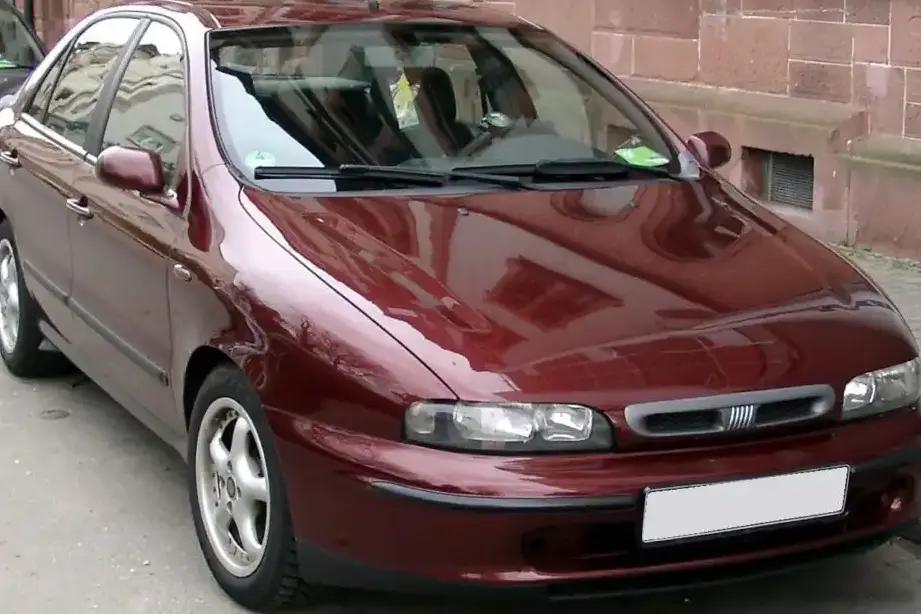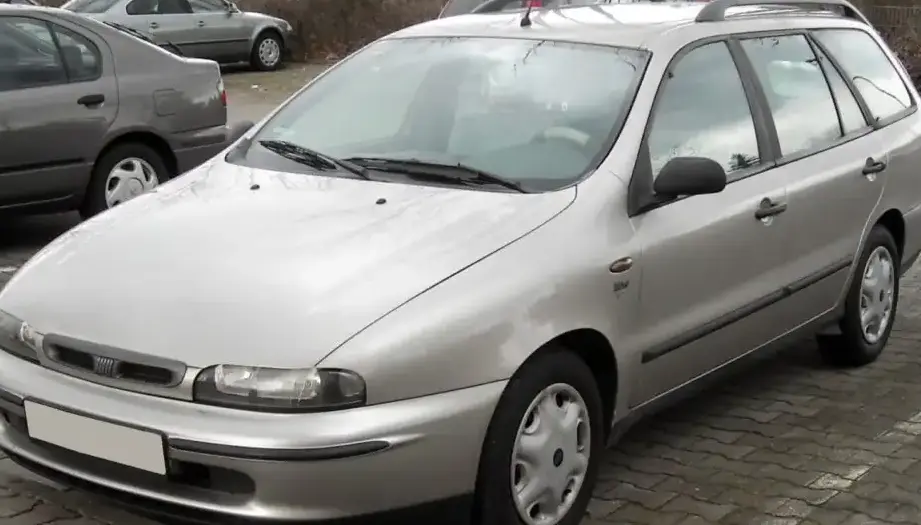
The Fiat Marea Weekend 2.0 155 20V, produced between 1999 and 2000, represented a performance-oriented variant within the Marea Weekend (Project 185) lineup. Positioned as a more engaging alternative to the diesel and lower-powered gasoline engines available, this model aimed to provide a blend of practicality from the station wagon body style with a spirited driving experience. It was primarily sold in European markets, where larger family cars with a focus on driving dynamics were popular. The Marea Weekend itself was a derivative of the Marea sedan, offering increased cargo capacity and versatility.
Technical Specifications
| Brand | Fiat |
| Model | Marea |
| Generation | Marea Weekend (185) |
| Type (Engine) | 2.0 155 20V (154 Hp) |
| Start of production | 1999 |
| End of production | 2000 |
| Powertrain Architecture | Internal Combustion engine |
| Body type | Station wagon (estate) |
| Seats | 5 |
| Doors | 5 |
| Fuel consumption (urban) | 14.3 l/100 km (16.4 US mpg, 19.8 UK mpg) |
| Fuel consumption (extra urban) | 7.4 l/100 km (31.8 US mpg, 38.2 UK mpg) |
| Fuel Type | Petrol (Gasoline) |
| Acceleration 0 – 100 km/h | 9.2 sec |
| Acceleration 0 – 62 mph | 9.2 sec |
| Acceleration 0 – 60 mph | 8.7 sec |
| Maximum speed | 208 km/h (129.25 mph) |
| Weight-to-power ratio | 8.4 kg/Hp |
| Weight-to-torque ratio | 6.9 kg/Nm |
| Power | 154 Hp @ 6700 rpm |
| Power per litre | 77.1 Hp/l |
| Torque | 186 Nm @ 3750 rpm (137.19 lb.-ft. @ 3750 rpm) |
| Engine layout | Front, Transverse |
| Engine Model/Code | 182.B7.000 |
| Engine displacement | 1998 cm3 (121.93 cu. in.) |
| Number of cylinders | 5 |
| Engine configuration | Inline |
| Cylinder Bore | 82 mm (3.23 in.) |
| Piston Stroke | 75.65 mm (2.98 in.) |
| Compression ratio | 10:1 |
| Number of valves per cylinder | 4 |
| Fuel injection system | Multi-port manifold injection |
| Engine aspiration | Naturally aspirated engine |
| Valvetrain | DOHC |
| Engine oil capacity | 5 l (5.28 US qt | 4.4 UK qt) |
| Coolant capacity | 7.2 l (7.61 US qt | 6.34 UK qt) |
| Kerb Weight | 1290 kg (2843.96 lbs.) |
| Max. weight | 1895 kg (4177.76 lbs.) |
| Max load | 605 kg (1333.8 lbs.) |
| Trunk (boot) space – minimum | 500 l (17.66 cu. ft.) |
| Trunk (boot) space – maximum | 1500 l (52.97 cu. ft.) |
| Fuel tank capacity | 63 l (16.64 US gal | 13.86 UK gal) |
| Length | 4485 mm (176.57 in.) |
| Width | 1740 mm (68.5 in.) |
| Height | 1510 mm (59.45 in.) |
| Wheelbase | 2540 mm (100 in.) |
| Front track | 1475 mm (58.07 in.) |
| Rear track | 1430 mm (56.3 in.) |
| Drivetrain Architecture | Front wheel drive |
| Number of gears | 5 |
| Gearbox type | Manual transmission |
| Front suspension | Wishbone |
| Rear suspension | Coil spring |
| Front brakes | Ventilated discs |
| Rear brakes | Disc |
| Assisting systems | ABS (Anti-lock braking system) |
| Steering type | Steering rack and pinion |
| Power steering | Hydraulic |
| Tires size | 195/60 R15 |
Powertrain & Engine Architecture
The heart of the Marea Weekend 2.0 155 20V was the 182.B7.000 engine, a 1998cc inline-five cylinder gasoline engine. This engine was a key feature of several Fiat and Lancia models during the late 1990s and early 2000s. The five-cylinder configuration offered a unique engine note and a smoother power delivery compared to traditional four-cylinder engines. It featured a double overhead camshaft (DOHC) valvetrain with four valves per cylinder, contributing to its relatively high specific output. Fuel delivery was handled by a multi-port fuel injection system. The engine’s 10:1 compression ratio was typical for the era, balancing performance and fuel efficiency. The five-speed manual transmission was the only gearbox option for this variant, chosen to maximize the engine’s potential and appeal to drivers seeking a more involved driving experience.
Driving Characteristics
The 154 horsepower and 186 Nm (137 lb-ft) of torque provided by the 2.0-liter engine translated into respectable performance for a family station wagon. Acceleration from 0 to 60 mph took approximately 8.7 seconds, and it could achieve a top speed of around 129 mph. While not a sports car, the Marea Weekend 2.0 offered a noticeably more responsive and engaging driving experience than versions equipped with smaller engines. The five-speed manual transmission allowed drivers to keep the engine in its optimal power band, providing good acceleration in most situations. The gear ratios were well-matched for both highway cruising and spirited driving on winding roads. Compared to the 1.8L versions, the 2.0L offered a significant power boost, making it feel more confident when fully loaded or tackling uphill climbs.
Equipment & Trim Levels
The Marea Weekend 2.0 155 20V typically came with a reasonably well-equipped specification, reflecting its position as a higher-end trim level. Standard features often included power windows, central locking, power steering, and an anti-lock braking system (ABS). Interior upholstery was usually cloth, although leather options were sometimes available. Dashboard design was functional and straightforward, typical of Italian cars of the period. Optional extras could include air conditioning, a sunroof, and upgraded audio systems. The trim level often dictated the quality of the interior materials and the availability of certain convenience features.
Chassis & Braking
The Marea Weekend featured independent suspension at the front, utilizing a wishbone setup, and a coil spring arrangement at the rear. This suspension configuration aimed to provide a balance between ride comfort and handling. Braking duties were handled by ventilated discs at the front and solid discs at the rear, providing adequate stopping power for the vehicle’s weight and performance. The hydraulic power steering offered a reasonable level of assistance, making the car easy to maneuver in urban environments. Stabilizer bars were fitted to both the front and rear axles to reduce body roll during cornering.
Market Reception & Comparison
The Marea Weekend 2.0 155 20V was generally well-received by automotive critics, who praised its performance and spacious interior. However, some reviewers noted that the interior quality wasn’t quite up to the standards of some of its German and Japanese competitors. Fuel economy was reasonable for a car of its size and performance, but not exceptional. Compared to the lower-powered Marea Weekend variants, the 2.0L offered a significant improvement in driving enjoyment, but at the cost of slightly higher fuel consumption and potentially increased maintenance costs. The 2.0L was often seen as a more appealing alternative to the diesel models for drivers who prioritized performance over fuel economy.
Legacy
The Fiat Marea Weekend 2.0 155 20V has developed a modest following among enthusiasts, particularly those who appreciate its unique five-cylinder engine and practical station wagon body style. The 182.B7.000 engine is generally considered to be a reliable unit, although regular maintenance is essential to prevent issues. Parts availability can be a challenge in some regions, as the Marea is no longer in production. Today, well-maintained examples of the Marea Weekend 2.0 can be found on the used car market, offering a relatively affordable and distinctive alternative to more common family cars. Its blend of performance, practicality, and Italian flair continues to appeal to a niche group of drivers.