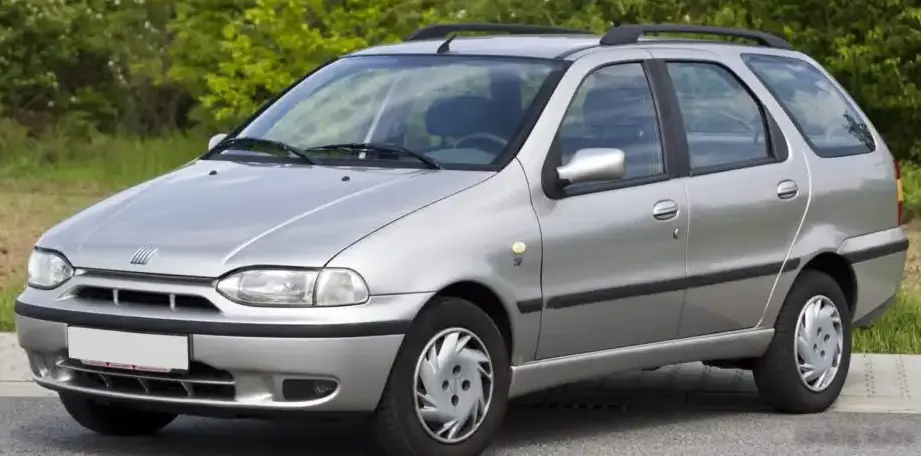
The Fiat Palio Weekend 1.7 TD (Type 178) was a practical and economical station wagon produced by Fiat between 1997 and 2002. Positioned as a budget-friendly option within the Palio range, it offered increased cargo capacity compared to the standard Palio hatchback, appealing to families and those requiring versatile load-lugging capabilities. This variant, powered by a turbocharged diesel engine, was primarily aimed at the European and South American markets where diesel fuel was more prevalent and fuel efficiency was highly valued. It represented a key offering in the small estate car segment, competing with vehicles like the Peugeot 205 Break and the Renault Clio Estate.
Technical Specifications
| Brand | Fiat |
| Model | Palio |
| Generation | Palio Weekend (178) |
| Type (Engine) | 1.7 TD (69 Hp) |
| Start of production | 1997 |
| End of production | 2002 |
| Powertrain Architecture | Internal Combustion engine |
| Body type | Station wagon (estate) |
| Seats | 5 |
| Doors | 5 |
| Fuel consumption (urban) | 8.6 l/100 km (27.4 US mpg) |
| Fuel consumption (extra urban) | 5.1 l/100 km (46.1 US mpg) |
| Fuel Type | Diesel |
| Acceleration 0 – 100 km/h | 14.9 sec |
| Acceleration 0 – 62 mph | 14.9 sec |
| Acceleration 0 – 60 mph | 14.2 sec |
| Maximum speed | 164 km/h (101.9 mph) |
| Weight-to-power ratio | 16.1 kg/Hp |
| Weight-to-torque ratio | 8.3 kg/Nm |
| Power | 69 Hp @ 4500 rpm |
| Torque | 134 Nm @ 2500 rpm (98.83 lb.-ft. @ 2500 rpm) |
| Engine layout | Front, Transverse |
| Engine Model/Code | 176 A3.000 |
| Engine displacement | 1698 cm3 (103.62 cu. in.) |
| Number of cylinders | 4 |
| Engine configuration | Inline |
| Cylinder Bore | 82.6 mm (3.25 in.) |
| Piston Stroke | 79.2 mm (3.12 in.) |
| Compression ratio | 20.3:1 |
| Number of valves per cylinder | 2 |
| Fuel injection system | Precombustion chamber injection |
| Engine aspiration | Turbocharger |
| Engine oil capacity | 4.8 l (5.07 US qt | 4.22 UK qt) |
| Coolant capacity | 7.1 l (7.5 US qt | 6.25 UK qt) |
| Kerb Weight | 1110 kg (2447.13 lbs.) |
| Max. weight | 1705 kg (3758.88 lbs.) |
| Max load | 595 kg (1311.75 lbs.) |
| Trunk (boot) space – minimum | 460 l (16.24 cu. ft.) |
| Trunk (boot) space – maximum | 1540 l (54.38 cu. ft.) |
| Fuel tank capacity | 51 l (13.47 US gal | 11.22 UK gal) |
| Length | 4130 mm (162.6 in.) |
| Width | 1626 mm (64.02 in.) |
| Height | 1515 mm (59.65 in.) |
| Wheelbase | 2420 mm (95.28 in.) |
| Front track | 1390 mm (54.72 in.) |
| Rear track | 1390 mm (54.72 in.) |
| Drivetrain Architecture | Front wheel drive |
| Number of gears | 5 |
| Gearbox type | Manual transmission |
| Front suspension | Spring Strut |
| Rear suspension | Trailing arm |
| Front brakes | Disc |
| Rear brakes | Drum |
| Steering type | Steering rack and pinion |
| Power steering | Hydraulic |
| Tires size | 175/65 R14 |
Powertrain & Engine Architecture
The heart of the Palio Weekend 1.7 TD was the 176 A3.000 engine, a 1.7-liter inline-four cylinder diesel. This engine utilized a precombustion chamber injection system, a common technology for diesel engines of the era. This system involved injecting fuel into a precombustion chamber connected to the main cylinder, promoting more complete combustion and reducing noise. The addition of a turbocharger significantly boosted power output for its displacement, bringing it to 69 horsepower. The engine featured a relatively low compression ratio of 20.3:1, typical for turbocharged diesels. The five-speed manual transmission was the only gearbox option available with this engine, prioritizing fuel economy over outright performance. The engine was mounted transversely at the front of the vehicle, driving the front wheels.
Driving Characteristics
The 1.7 TD Palio Weekend was not designed for spirited driving. With 69 horsepower and 134 Nm (98.83 lb-ft) of torque, acceleration was modest, taking around 14.9 seconds to reach 100 km/h (62 mph). However, the turbocharger provided a noticeable boost in mid-range power, making it reasonably capable for overtaking on highways. The manual transmission, while not particularly sporty, offered precise shifts and allowed drivers to make the most of the available power. Compared to the gasoline-powered Palio Weekend variants, the 1.7 TD offered significantly better fuel economy, but at the expense of performance. The gear ratios were optimized for fuel efficiency and relaxed cruising, rather than rapid acceleration.
Equipment & Trim Levels
The 1.7 TD Palio Weekend typically came with a fairly basic level of equipment, reflecting its position as an affordable option. Standard features generally included power steering, central locking, and a basic audio system. Interior upholstery was typically cloth, and the dashboard featured a functional, if somewhat spartan, design. Optional extras included air conditioning, electric windows, and upgraded audio systems. Trim levels varied depending on the market, but generally focused on adding convenience features rather than significantly altering the mechanical specifications. The emphasis was on providing a practical and reliable vehicle at a competitive price point.
Chassis & Braking
The Palio Weekend 1.7 TD utilized a simple yet effective chassis design. Front suspension consisted of MacPherson strut coil springs, while the rear employed a trailing arm setup. This configuration provided a comfortable ride, although handling was not particularly sharp. Braking was handled by disc brakes at the front and drum brakes at the rear. The hydraulic power steering provided light and easy steering, making it maneuverable in urban environments. Stabilizer bars were typically fitted to improve body roll during cornering, but the overall focus was on providing a safe and predictable driving experience rather than sporty handling.
Market Reception & Comparison
The Fiat Palio Weekend 1.7 TD was generally well-received in markets where diesel station wagons were popular. Critics praised its fuel efficiency, practicality, and affordability. However, it was often criticized for its lack of power and relatively basic interior. Compared to the gasoline-powered Palio Weekend variants, the 1.7 TD offered superior fuel economy but inferior performance. Against competitors like the Peugeot 205 Break and Renault Clio Estate, the Palio Weekend 1.7 TD offered a competitive package, particularly in terms of price and cargo capacity. Its reliability was generally considered good, although maintenance costs could be higher due to the diesel engine and its associated components.
Legacy
The Fiat Palio Weekend 1.7 TD has become a relatively sought-after vehicle in the used car market, particularly among those seeking an affordable and economical station wagon. The 176 A3.000 diesel engine, while not known for its refinement, is generally considered to be durable and reliable if properly maintained. Parts availability can be a challenge in some regions, but the engine’s simplicity makes it relatively easy to repair. Today, the Palio Weekend 1.7 TD represents a practical and affordable option for those seeking a classic European station wagon with a focus on fuel efficiency and load-carrying capacity. It remains a testament to Fiat’s ability to produce functional and reliable vehicles for the mass market.