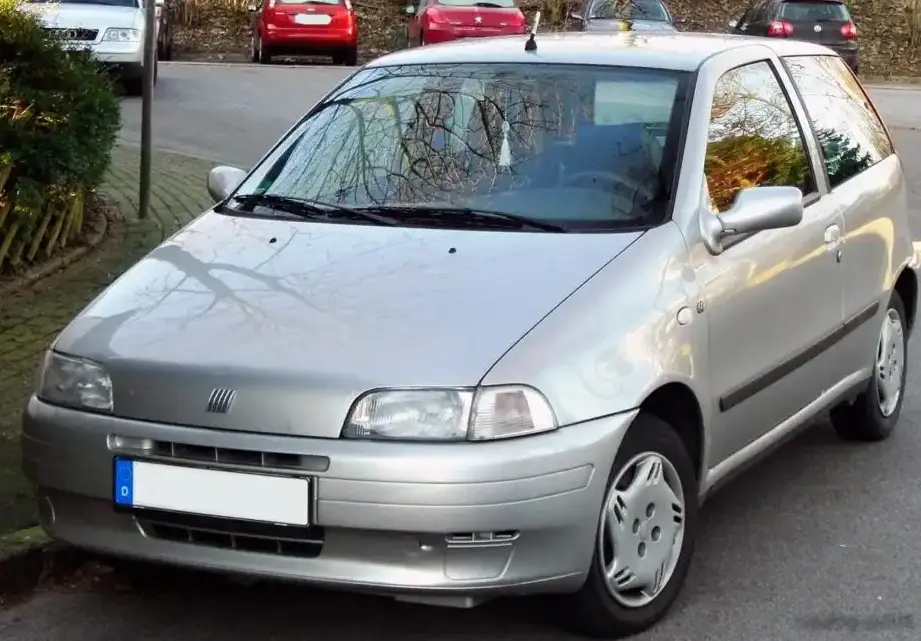
Technical Specifications
| Brand | Fiat |
| Model | Punto |
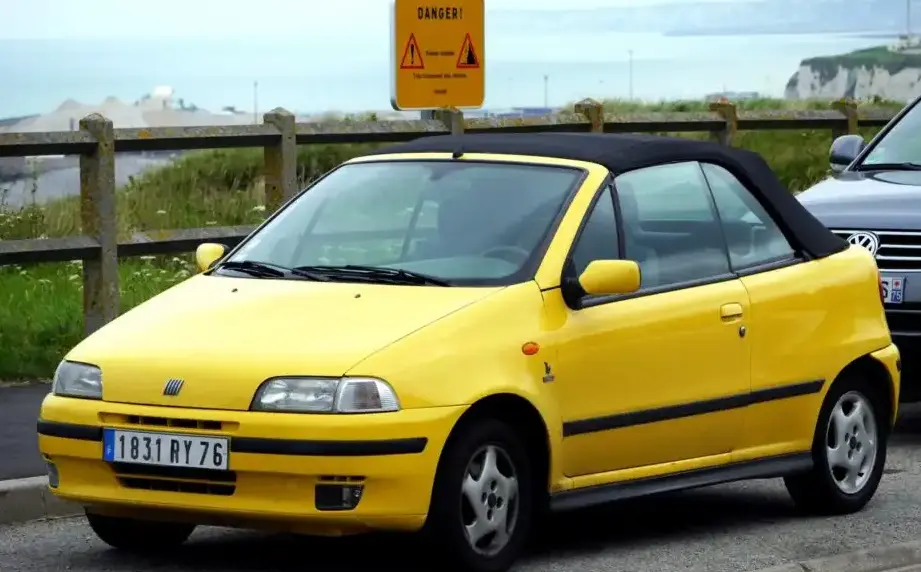
| Generation | Punto I (176, facelift 1997) |
| Type (Engine) | 55 1.1 (54 Hp) |
| Start of production | 1997 |
| End of production | 1999 |
| Powertrain Architecture | Internal Combustion engine |
| Body type | Hatchback |
| Seats | 5 |
| Doors | 3-5 |
| Fuel consumption (urban) | 8.6 l/100 km (27.4 US mpg, 32.8 UK mpg, 11.6 km/l) |
| Fuel consumption (extra urban) | 5.4 l/100 km (43.6 US mpg, 52.3 UK mpg, 18.5 km/l) |
| Fuel consumption (combined) | 6.6 l/100 km (35.6 US mpg, 42.8 UK mpg, 15.2 km/l) |
| Fuel Type | Petrol (Gasoline) |
| Acceleration 0 – 100 km/h | 16 sec |
| Acceleration 0 – 62 mph | 16 sec |
| Acceleration 0 – 60 mph | 15.2 sec |
| Maximum speed | 150 km/h (93.21 mph) |
| Weight-to-power ratio | 15.6 kg/Hp, 64.3 Hp/tonne |
| Weight-to-torque ratio | 9.9 kg/Nm, 101.2 Nm/tonne |
| Power | 54 Hp @ 5500 rpm |
| Power per litre | 48.7 Hp/l |
| Torque | 85 Nm @ 3500 rpm (62.69 lb.-ft. @ 3500 rpm) |
| Engine layout | Front, Transverse |
| Engine Model/Code | 176A6000, 176B2.000 |
| Engine displacement | 1108 cm3 (67.61 cu. in.) |
| Number of cylinders | 4 |
| Engine configuration | Inline |
| Cylinder Bore | 70 mm (2.76 in.) |
| Piston Stroke | 72 mm (2.83 in.) |
| Compression ratio | 9.6:1 |
| Number of valves per cylinder | 2 |
| Fuel injection system | Single-point injection |
| Engine aspiration | Naturally aspirated engine |
| Valvetrain | OHC |
| Engine oil capacity | 3.5 l (3.7 US qt | 3.08 UK qt) |
| Coolant | 4.6 l (4.86 US qt | 4.05 UK qt) |
| Kerb Weight | 840 kg (1851.88 lbs.) |
| Max. weight | 1300 kg (2866.01 lbs.) |
| Max load | 460 kg (1014.13 lbs.) |
| Trunk (boot) space – minimum | 275 l (9.71 cu. ft.) |
| Trunk (boot) space – maximum | 1080 l (38.14 cu. ft.) |
| Fuel tank capacity | 47 l (12.42 US gal | 10.34 UK gal) |
| Length | 3760 mm (148.03 in.) |
| Width | 1625 mm (63.98 in.) |
| Height | 1460 mm (57.48 in.) |
| Wheelbase | 2450 mm (96.46 in.) |
| Front track | 1395 mm (54.92 in.) |
| Rear (Back) track | 1377 mm (54.21 in.) |
| Drag coefficient (Cd) | 0.31 |
| Minimum turning circle | 10.2 m (33.46 ft.) |
| Drivetrain Architecture | Front wheel drive |
| Drive wheel | Front wheel drive |
| Number of gears and type of gearbox | 5 gears, manual transmission |
| Front suspension | Wishbone |
| Rear suspension | Trailing arm |
| Front brakes | Disc |
| Rear brakes | Drum |
| Steering type | Steering rack and pinion |
| Tires size | 155/70 R13 |
| Wheel rims size | 13 |
The Fiat Punto I 55 1.1, produced from 1997 to 1999, represents an entry-level variant within the refreshed (facelift) first generation of the Punto, designated the 176 series. Introduced as a more affordable option, this model aimed to provide economical transportation for a broad customer base, particularly in European markets where small, fuel-efficient hatchbacks were highly sought after. It sat below the more powerful 75 and 90 horsepower versions in the Punto lineup, and was primarily targeted at first-time car buyers, city commuters, and those prioritizing low running costs over outright performance.
Powertrain & Engine Architecture
The heart of the Punto 55 1.1 is the Fiat 176A6.000 or 176B2.000 engine, a 1.1-liter inline-four cylinder gasoline engine. This engine utilizes a single-point fuel injection system, a relatively simple and cost-effective technology for the time. The engine features an overhead camshaft (OHC) valvetrain with two valves per cylinder. Its modest output of 54 horsepower at 5500 rpm and 85 Nm (63 lb-ft) of torque at 3500 rpm was sufficient for urban driving and shorter trips, but limited its capabilities on highways or when fully loaded. The engine’s design prioritized fuel efficiency and reliability over high performance. The five-speed manual transmission was the standard offering, providing adequate gear ratios for maximizing fuel economy and keeping the engine within its optimal operating range.
Driving Characteristics
The driving experience in the Punto 55 1.1 is best described as utilitarian. Acceleration is leisurely, taking approximately 16 seconds to reach 62 mph. The engine feels strained at higher speeds, and overtaking maneuvers require careful planning. The five-speed gearbox helps to mitigate some of the engine’s limitations, allowing drivers to select the appropriate gear for the situation. Compared to the higher-output 75 and 90 horsepower versions, the 55 1.1 feels significantly slower and less refined. However, its lighter weight and simpler mechanicals contribute to a nimble feel in city traffic. The steering is light and responsive, making it easy to maneuver in tight spaces.
Equipment & Trim Levels
The Punto 55 1.1 was typically equipped with basic, but functional features. Standard equipment generally included power steering, central locking, and a basic audio system. Interior upholstery was typically cloth, with a simple dashboard layout. Optional extras included air conditioning, electric windows, and alloy wheels. The trim level was generally considered the base model, focusing on affordability and practicality. The interior plastics were durable but lacked the aesthetic appeal of higher-spec models.
Chassis & Braking
The Punto I utilized a relatively simple chassis design. Front suspension consisted of wishbones, while the rear employed a trailing arm setup. This configuration provided a comfortable ride, but didn’t offer particularly sporty handling characteristics. The front brakes were discs, providing adequate stopping power, while the rear brakes were drums, a cost-saving measure common in this segment. The steering system was a rack and pinion type, offering reasonable precision and feedback.
Market Reception & Comparison
The Punto 55 1.1 was well-received as an affordable and economical city car. Critics praised its fuel efficiency and low running costs, but noted its lack of performance. Compared to the more powerful Punto variants, the 55 1.1 offered significantly less driving enjoyment. However, its lower price point made it an attractive option for budget-conscious buyers. The 1.1-liter engine proved to be reliable, and maintenance costs were relatively low. Competitors in this segment included the Renault Clio, Peugeot 206, and Volkswagen Polo, all of which offered similar levels of practicality and affordability.
Legacy
The Fiat Punto 55 1.1, while not a performance icon, remains a popular choice among classic car enthusiasts and those seeking a reliable and affordable used car. The 1.1-liter engine is known for its durability, and parts availability is generally good. Today, these Puntos are often found as inexpensive transportation or as project cars for those interested in classic Italian motoring. While not particularly collectible, well-maintained examples are becoming increasingly rare, and represent a piece of automotive history from the late 1990s.