
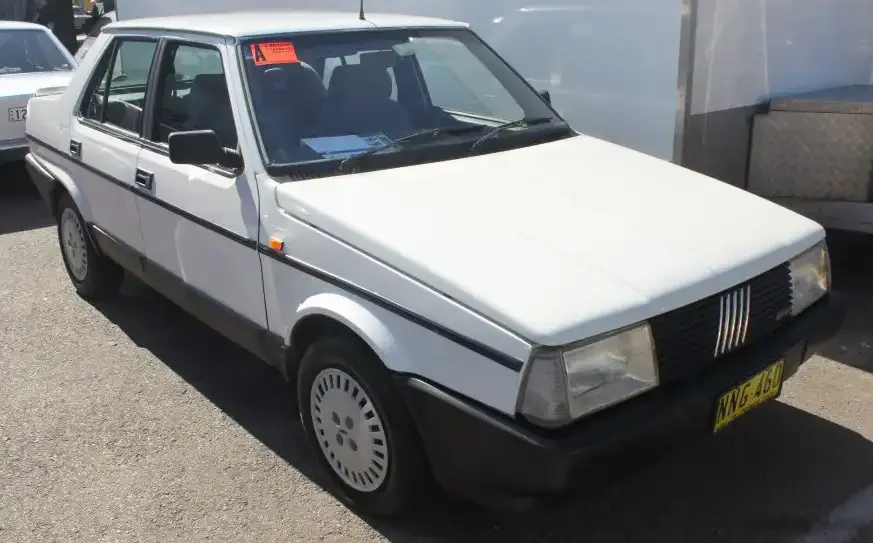
The Fiat Regata 80 Turbo Diesel 1.9, produced between 1986 and 1989, represented a unique offering within the Regata (Type 138) lineup. Positioned as a fuel-efficient and relatively affordable option, it catered to drivers prioritizing economy and practicality over outright performance. The Regata itself was designed as a replacement for the Fiat 134, aiming to provide a modern, comfortable, and spacious sedan for the European market. This particular diesel variant, with its turbocharged engine, aimed to bridge the gap between basic transportation and a more refined driving experience, offering a reasonable level of performance for long-distance travel.
Technical Specifications
| Brand | Fiat |
| Model | Regata |
| Generation | Regata (138) |
| Type (Engine) | 80 Turbo Diesel 1.9 (80 Hp) |
| Start of production | 1986 |
| End of production | 1989 |
| Powertrain Architecture | Internal Combustion engine |
| Body type | Sedan |
| Seats | 5 |
| Doors | 4 |
| Fuel Type | Diesel |
| Power | 80 Hp |
| Engine Model/Code | 831 D1.000 |
| Engine aspiration | Turbocharger |
| Engine oil capacity | 5 l (5.28 US qt | 4.4 UK qt) |
| Coolant capacity | 7.5 l (7.93 US qt | 6.6 UK qt) |
| Trunk (boot) space – minimum | 513 l (18.12 cu. ft.) |
| Fuel tank capacity | 55 l (14.53 US gal | 12.1 UK gal) |
| Length | 4260 mm (167.72 in.) |
| Width | 1650 mm (64.96 in.) |
| Height | 1410 mm (55.51 in.) |
| Front overhang | 820 mm (32.28 in.) |
| Rear overhang | 992 mm (39.06 in.) |
Powertrain & Engine Architecture
The heart of the Regata 80 Turbo Diesel was the 831 D1.000 engine, a 1.9-liter inline-four cylinder diesel. This engine was a significant step up from the naturally aspirated diesel options available in the Regata range. The key feature was the addition of a turbocharger, which forced more air into the cylinders, increasing power output. The engine utilized indirect injection, a common practice for diesel engines of the era, employing a Bosch rotary injection pump. This system, while not as refined as direct injection, offered good reliability and fuel efficiency. The engine featured a single overhead camshaft operating two valves per cylinder. The turbocharger itself was a Garrett unit, providing approximately 7.5 psi of boost. The engine was mated to a three-speed automatic transmission, a relatively uncommon pairing with a diesel engine at the time, and designed to provide comfortable cruising.
Driving Characteristics
The Regata 80 Turbo Diesel Automatic offered a surprisingly relaxed driving experience. While not a sports car by any means, the turbocharger provided a noticeable boost in acceleration compared to the non-turbocharged diesel models. The three-speed automatic transmission, while lacking the efficiency of a manual gearbox or a more modern automatic, was well-suited to the engine’s torque characteristics. Gear ratios were optimized for comfortable highway cruising, with the engine settling into a relatively low RPM at typical highway speeds. However, overtaking maneuvers required careful planning, as the engine lacked the immediate response of higher-horsepower gasoline engines. The automatic transmission did detract somewhat from fuel economy compared to the manual versions, but the convenience factor was a major selling point for many buyers. The suspension was tuned for comfort, providing a reasonably smooth ride, although it could feel somewhat wallowy in corners.
Equipment & Trim Levels
The Regata 80 Turbo Diesel Automatic typically came with a moderate level of equipment. Standard features included cloth upholstery, a basic instrument cluster, and manual windows and door locks. Air conditioning was often an optional extra, as were power windows and central locking. The interior design was functional and straightforward, reflecting the car’s focus on practicality. Trim levels were relatively simple, with the 80 Turbo Diesel often positioned as a mid-range offering. Higher trim levels might have included upgraded upholstery, a more comprehensive instrument panel, and additional exterior trim. The dashboard layout was typical of Italian cars of the period, with a focus on ergonomics and ease of use.
Chassis & Braking
The Regata utilized a relatively conventional chassis design, with a front independent suspension and a rear solid axle. The front suspension employed MacPherson struts, while the rear featured leaf springs. Braking was typically accomplished with disc brakes on the front wheels and drum brakes on the rear. The braking system was adequate for the car’s weight and performance, but lacked the stopping power of more modern systems. Stabilizer bars were fitted to both the front and rear axles to reduce body roll during cornering. The steering was a recirculating ball system, providing a reasonably direct feel, although it lacked the precision of rack-and-pinion steering.
Market Reception & Comparison
The Regata 80 Turbo Diesel Automatic was generally well-received by European buyers seeking a fuel-efficient and comfortable family sedan. Critics praised the engine’s torque and the car’s spacious interior. However, the automatic transmission was sometimes criticized for its lack of responsiveness and its impact on fuel economy. Compared to the naturally aspirated diesel Regatas, the 80 Turbo Diesel offered a significant performance improvement. Compared to the gasoline-powered Regatas, it provided superior fuel economy, albeit with less overall power. The 80 Turbo Diesel competed with other European sedans such as the Peugeot 305 and the Volkswagen Jetta, offering a compelling combination of value and practicality.
Legacy
The Fiat Regata 80 Turbo Diesel, while not a particularly rare or collectible car today, holds a certain appeal for enthusiasts of classic Italian automobiles. The 831 D1.000 engine, when properly maintained, proved to be a durable and reliable unit. However, like all older diesel engines, it is susceptible to wear and tear, and finding replacement parts can sometimes be challenging. The automatic transmission, while offering convenience, is often the first component to fail. In the used car market, these Regatas are typically found in well-preserved condition, often owned by enthusiasts who appreciate their unique character and fuel efficiency. The Regata 80 Turbo Diesel represents a snapshot of automotive engineering from the 1980s, showcasing a blend of Italian design and practical engineering.
