
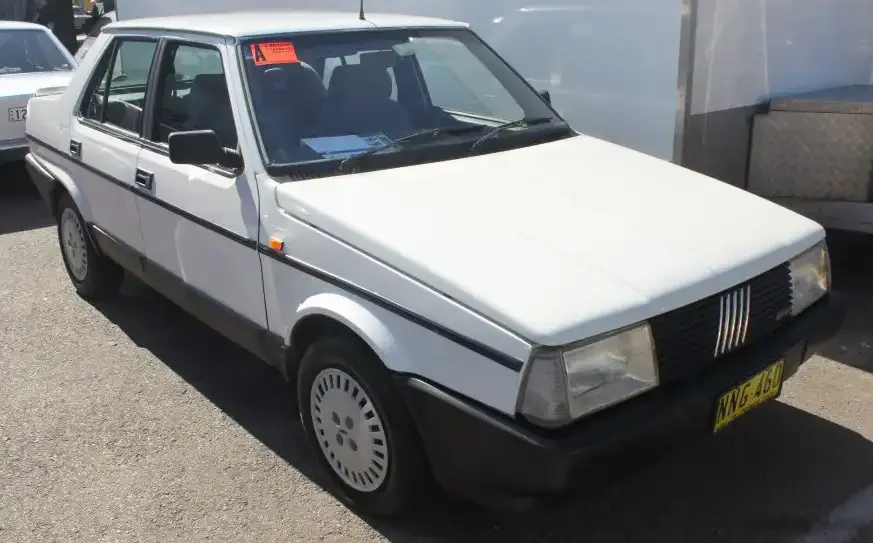
The Fiat Regata 85 1.6, produced between 1983 and 1985, was a significant variant within the Fiat 138 series, representing a mainstream offering in Fiat’s European lineup. Positioned as a practical and affordable family sedan, the Regata aimed to modernize Fiat’s offerings, replacing the aging Fiat 132 with a more efficient and contemporary design. This specific 82 horsepower, 1.6-liter version with a five-speed manual transmission proved popular with buyers seeking a balance between performance and economy. Built on the Type Two platform, the Regata was designed to appeal to a broad customer base, competing with other European compacts like the Volkswagen Jetta and Opel Ascona.
Technical Specifications
| Brand | Fiat |
| Model | Regata |
| Generation | Regata (138) |
| Type (Engine) | 85 1.6 (82 Hp) |
| Start of production | 1983 |
| End of production | 1985 |
| Powertrain Architecture | Internal Combustion engine |
| Body type | Sedan |
| Seats | 5 |
| Doors | 4 |
| Fuel consumption (extra urban) | 5.4 l/100 km (43.6 US mpg, 52.3 UK mpg, 18.5 km/l) |
| Fuel Type | Petrol (Gasoline) |
| Acceleration 0 – 100 km/h | 11 sec |
| Acceleration 0 – 62 mph | 11 sec |
| Acceleration 0 – 60 mph | 10.5 sec |
| Maximum speed | 180 km/h (111.85 mph) |
| Weight-to-power ratio | 12.2 kg/Hp, 82 Hp/tonne |
| Power | 82 Hp @ 5500 rpm |
| Power per litre | 51.7 Hp/l |
| Engine layout | Front, Transverse |
| Engine Model/Code | 149 A.000 |
| Engine displacement | 1585 cm3 (96.72 cu. in.) |
| Number of cylinders | 4 |
| Engine configuration | Inline |
| Number of valves per cylinder | 2 |
| Fuel injection system | Carburettor |
| Engine aspiration | Naturally aspirated engine |
| Engine oil capacity | 4.1 l (4.33 US qt, 3.61 UK qt) |
| Coolant | 7 l (7.4 US qt, 6.16 UK qt) |
| Kerb Weight | 1000 kg (2204.62 lbs) |
| Trunk (boot) space – minimum | 513 l (18.12 cu. ft) |
| Fuel tank capacity | 55 l (14.53 US gal, 12.1 UK gal) |
| Length | 4260 mm (167.72 in) |
| Width | 1650 mm (64.96 in) |
| Height | 1410 mm (55.51 in) |
| Front overhang | 820 mm (32.28 in) |
| Rear overhang | 992 mm (39.06 in) |
| Drivetrain Architecture | The Internal combustion engine (ICE) drives the front wheels of the vehicle. |
| Drive wheel | Front wheel drive |
| Number of gears and type of gearbox | 5 gears, manual transmission |
| Front brakes | Disc |
| Rear brakes | Drum |
| Steering type | Worm-reduction unit |
Powertrain & Engine Architecture
The heart of the Regata 85 1.6 was the Fiat 149 A.000 engine, a 1.6-liter inline-four cylinder unit. This engine featured a relatively simple design, utilizing a single overhead camshaft (SOHC) and two valves per cylinder. Fuel delivery was managed by a Weber or Solex carburetor, a common setup for European cars of this era. The engine produced 82 horsepower at 5500 rpm and 98.1 lb-ft of torque. The engine’s transverse mounting and front-wheel drive configuration were typical for compact European cars of the 1980s, maximizing interior space and improving packaging. The five-speed manual transmission offered a reasonable spread of gears, allowing for both efficient cruising and adequate acceleration. The transmission was known for its relatively light shift feel, though it wasn’t particularly sporty. The engine block itself was constructed from cast iron, contributing to its durability, while the cylinder head was made of aluminum alloy to reduce weight.
Driving Characteristics
The Regata 85 1.6 offered a comfortable, if not particularly exciting, driving experience. Acceleration from 0 to 60 mph took around 10.5 seconds, and top speed was approximately 112 mph. The carburetor-fed engine delivered smooth, predictable power, but lacked the responsiveness of fuel-injected alternatives. The five-speed gearbox allowed drivers to keep the engine in its optimal power band, but the gear ratios were spaced to prioritize fuel economy over outright performance. Compared to the more powerful Regata 100, which featured a slightly larger engine and higher compression ratio, the 85 1.6 felt noticeably less spirited. However, it offered a significant improvement in fuel economy, making it a more practical choice for everyday driving. Steering was relatively light, making it easy to maneuver in city traffic, but lacked significant feedback. The suspension absorbed bumps reasonably well, providing a comfortable ride on most road surfaces.
Equipment & Trim Levels
The Regata 85 1.6 was generally equipped with basic, but functional, features. Standard equipment included cloth upholstery, a basic instrument cluster, and manual windows and door locks. The interior was designed with practicality in mind, offering ample space for passengers and luggage. Optional extras included a sunroof, upgraded stereo system, and metallic paint. The Regata wasn’t positioned as a luxury vehicle, so the focus was on providing a reliable and affordable mode of transportation. Trim levels were relatively simple, with the 85 1.6 representing a mid-range offering, positioned above the base models but below the more powerful and better-equipped variants. Higher trim levels might have included features like a rear window wiper, upgraded seat fabrics, and a more comprehensive instrument panel.
Chassis & Braking
The Regata utilized a MacPherson strut front suspension and a twist-beam rear suspension. This setup provided a comfortable ride, but didn’t offer particularly sharp handling. The front brakes were disc brakes, while the rear brakes were drums, a common configuration for cars in this price range. Steering was accomplished via a worm-reduction unit, which provided a relatively heavy, but precise, feel. The Regata’s suspension was tuned for comfort rather than performance, prioritizing a smooth ride over sporty handling. The relatively light curb weight of around 2200 lbs helped to offset the limitations of the suspension and braking system. The braking system, while adequate for normal driving conditions, lacked the stopping power of more modern systems.
Market Reception & Comparison
The Fiat Regata 85 1.6 was generally well-received by automotive critics as a practical and affordable family sedan. It was praised for its spacious interior, comfortable ride, and reasonable fuel economy. However, it was also criticized for its relatively bland styling and lack of performance. Compared to other cars in its class, such as the Volkswagen Jetta and Opel Ascona, the Regata offered a competitive price point and a good level of practicality. The 85 1.6 variant struck a good balance between performance and economy, making it a popular choice for buyers who didn’t need the extra power of the 100 model. Fuel economy was a strong point, averaging around 44 mpg on the highway. The Regata offered a more affordable alternative to the Jetta, while providing similar levels of practicality and comfort. The Ascona, while offering a slightly more refined driving experience, was generally more expensive.
Legacy
The Fiat Regata, and specifically the 85 1.6 variant, has become a relatively sought-after classic car among enthusiasts. The simple engine design and readily available parts make it relatively easy to maintain. While not known for exceptional performance, the Regata’s reliability and practicality have ensured its survival. Today, well-maintained examples are increasingly rare and command a modest premium in the used car market. The 149 A.000 engine, while not a technological marvel, proved to be durable and long-lasting, contributing to the Regata’s enduring appeal. The Regata represents a significant chapter in Fiat’s history, bridging the gap between the older, rear-wheel-drive models and the more modern, front-wheel-drive designs that would follow. Its simple construction and robust mechanicals have made it a favorite among those seeking a classic European car that is relatively easy to own and maintain.
