
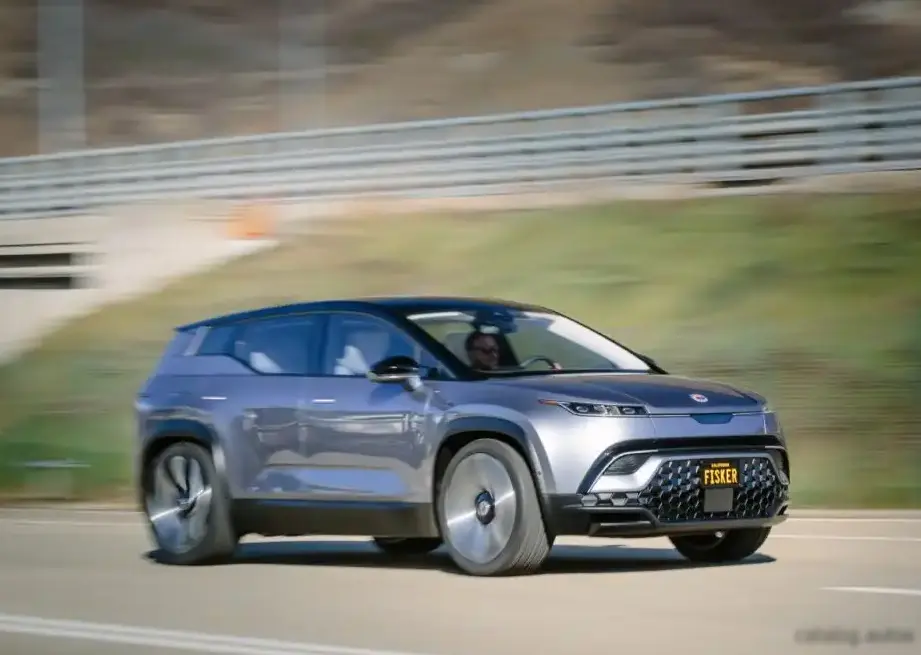
The Fisker Ocean Extreme/One 100 kWh Hyper Range, producing 558 horsepower, represents the top-tier performance variant of the Fisker Ocean, an all-electric compact SUV. Production commenced in February 2022 and continued through 2024, positioning the Ocean as Fisker’s initial foray into the burgeoning electric vehicle market. The Extreme/One trim, distinguished by its extended range and high output, aimed to compete with established players like the Tesla Model Y and Ford Mustang Mach-E, offering a blend of sustainable technology, luxury features, and performance. It was built on a dedicated electric vehicle platform, emphasizing space efficiency and a low center of gravity for enhanced handling.
Technical Specifications
| Brand | Fisker |
| Model | Ocean |
| Generation | Ocean |
| Type (Engine) | Extreme/One 100 kWh Hyper Range (558 Hp) AWD |
| Start of production | February, 2022 |
| End of production | 2024 |
| Powertrain Architecture | BEV (Electric Vehicle) |
| Body type | SUV |
| Seats | 5 |
| Doors | 5 |
| Fuel Type | Electricity |
| Acceleration 0 – 100 km/h | 3.9 sec |
| Acceleration 0 – 62 mph | 3.9 sec |
| Acceleration 0 – 60 mph | 3.6 sec |
| Gross battery capacity | 100 kWh |
| Battery technology | Lithium nickel manganese cobalt oxides (Li-NMC) |
| Battery location | Below the floor |
| All-electric range (WLTP) | 630 km (391.46 mi) |
| All-electric range (EPA) | 627.6 km (389.97 mi) |
| Electric motor 1 location | Front axle, Transverse |
| Electric motor 2 location | Rear axle, Transverse |
| System power | 558 Hp |
| Permitted trailer load with brakes (12%) | 1814 kg (3999.19 lbs.) |
| Length | 4775 mm (187.99 in.) |
| Width | 1994 mm (78.5 in.) |
| Height | 1631 mm (64.21 in.) |
| Wheelbase | 2921 mm (115 in.) |
| Drivetrain Architecture | One electric motor drives the front wheels, one electric motor drives the rear wheels. |
| Drive wheel | All wheel drive (4×4) |
| Number of gears and type of gearbox | 1 gears, automatic transmission |
| Front suspension | Independent type McPherson |
| Rear suspension | Independent multi-link suspension |
| Front brakes | Ventilated discs |
| Rear brakes | Ventilated discs |
| Assisting systems | ABS (Anti-lock braking system) |
| Steering type | Steering rack and pinion |
| Power steering | Electric Steering |
| Tires size | 255/50 R20; 255/45 R22 |
| Wheel rims size | 7.5J x 20; 8.5J x 22 |
Powertrain & Engine Architecture
The Fisker Ocean Extreme/One utilizes a dual-motor, all-wheel-drive (AWD) powertrain. Each axle is powered by an independently controlled electric motor, enabling sophisticated torque vectoring for improved handling and stability. The system operates on a high-voltage 100 kWh lithium-nickel-manganese-cobalt oxide (Li-NMC) battery pack positioned low in the vehicle’s chassis, contributing to a lower center of gravity. The combined output of the two motors delivers 558 horsepower. The single-speed automatic transmission, inherent to electric vehicle drivetrains, provides seamless acceleration. The battery management system (BMS) is crucial for optimizing battery life, performance, and safety, monitoring cell voltages, temperatures, and overall health. The charging system supports both AC and DC fast charging, allowing for significant range replenishment in relatively short periods.
Driving Characteristics
The Ocean Extreme/One delivers brisk acceleration, achieving 0-60 mph in approximately 3.6 seconds. The dual-motor AWD system provides excellent traction in various conditions. The single-speed transmission offers immediate torque delivery, characteristic of electric vehicles. Compared to lower-trim Ocean models with less powerful motors and potentially smaller battery packs, the Extreme/One offers a significantly more engaging driving experience. The instant torque and responsive handling differentiate it from the base models. The weight distribution, aided by the low-mounted battery pack, contributes to a stable and confident feel, particularly during cornering. Regenerative braking is adjustable, allowing drivers to customize the level of deceleration when lifting off the accelerator.
Equipment & Trim Levels
The Extreme/One trim represents the highest specification level for the Fisker Ocean. Standard features include a large central touchscreen infotainment system, a digital instrument cluster, premium interior materials (often incorporating sustainable and recycled materials), a panoramic sunroof, and advanced driver-assistance systems (ADAS) such as adaptive cruise control, lane keeping assist, and automatic emergency braking. Optional extras included features like a head-up display, premium audio system, and various interior customization options. The interior design emphasizes a minimalist aesthetic with a focus on technology integration. The Ocean’s interior also features a “SolarSky” roof, an optional feature that harvests solar energy to supplement the battery charge.
Chassis & Braking
The Fisker Ocean utilizes an independent suspension system at all four wheels. The front suspension employs a McPherson strut design, while the rear features a multi-link setup. This configuration aims to balance ride comfort with handling precision. Ventilated disc brakes are fitted on all wheels, providing ample stopping power. The electronic stability control (ESC) system works in conjunction with the ABS (Anti-lock Braking System) to maintain vehicle control during emergency braking maneuvers. The steering system is an electric power-assisted rack and pinion, offering precise and responsive steering feel. Tire sizes vary depending on the wheel option, with 20-inch and 22-inch wheels available.
Market Reception & Comparison
The Fisker Ocean Extreme/One received generally positive reviews from automotive critics, praising its performance, range, and innovative features. However, some criticisms focused on build quality issues and software glitches reported during the initial production run. Compared to competitors like the Tesla Model Y, the Ocean offered a unique design aesthetic and a strong emphasis on sustainability. The Ocean’s range was competitive with other EVs in its class, and its acceleration performance was comparable to or exceeded that of many rivals. Fuel economy, expressed as MPGe (miles per gallon equivalent), was also competitive, reflecting the efficiency of the electric powertrain. Reliability data is still emerging, given the relatively short production run and the novelty of the Fisker brand.
Legacy
The Fisker Ocean Extreme/One represents a significant step for Fisker as a brand, demonstrating its ability to bring a competitive electric SUV to market. While the company faced challenges during its initial production phase, the Ocean established a foundation for future electric vehicle development. The long-term reliability of the powertrain remains to be fully assessed, but the Li-NMC battery technology is well-established and generally considered durable. On the used car market, the Ocean Extreme/One is likely to hold its value relatively well, given its performance capabilities and the growing demand for electric vehicles. Its innovative features and sustainable design elements may also appeal to environmentally conscious buyers.
