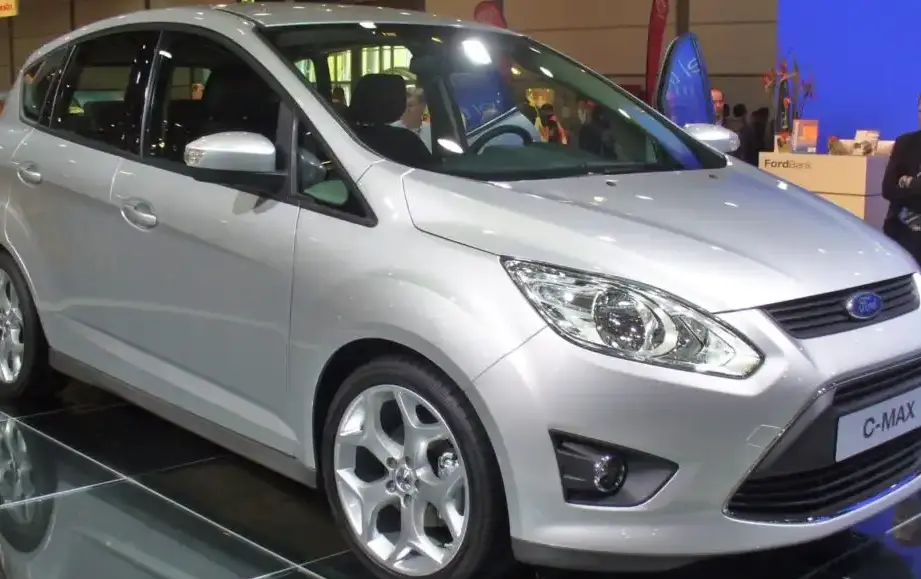
Technical Specifications
| Brand | Ford |
| Model | C-MAX |
| Generation | C-MAX II |
| Type (Engine) | 2.0 Duratorq TDCi (140 Hp) DPF |
| Start of production | 2010 |
| End of production | 2015 |
| Powertrain Architecture | Internal Combustion engine |
| Body type | MPV |
| Seats | 5 |
| Doors | 5 |
| Fuel consumption (urban) | 6.1 l/100 km (38.6 US mpg, 46.3 UK mpg, 16.4 km/l) |
| Fuel consumption (extra urban) | 4.2 l/100 km (56 US mpg, 67.3 UK mpg, 23.8 km/l) |
| Fuel consumption (combined) | 4.9 l/100 km (48 US mpg, 57.6 UK mpg, 20.4 km/l) |
| CO2 emissions | 129 g/km |
| Fuel Type | Diesel |
| Acceleration 0 – 100 km/h | 9.6 sec |
| Acceleration 0 – 62 mph | 9.6 sec |
| Acceleration 0 – 60 mph | 9.1 sec |
| Maximum speed | 201 km/h (124.9 mph) |
| Emission standard | Euro 5 |
| Weight-to-power ratio | 10.1 kg/Hp, 99.1 Hp/tonne |
| Weight-to-torque ratio | 4.4 kg/Nm, 226.5 Nm/tonne |
| Power | 140 Hp @ 3750 rpm |
| Power per litre | 70.1 Hp/l |
| Torque | 320 Nm @ 1750-2750 rpm (236.02 lb.-ft. @ 1750-2750 rpm) |
| Engine layout | Front, Transverse |
| Engine Model/Code | UFDB |
| Engine displacement | 1997 cm3 (121.86 cu. in.) |
| Number of cylinders | 4 |
| Engine configuration | Inline |
| Cylinder Bore | 85 mm (3.35 in.) |
| Piston Stroke | 88 mm (3.46 in.) |
| Compression ratio | 16:1 |
| Number of valves per cylinder | 4 |
| Fuel injection system | Diesel Commonrail |
| Engine aspiration | Turbocharger, Intercooler |
| Valvetrain | DOHC |
| Engine oil capacity | 5.7 l (6.02 US qt | 5.02 UK qt) |
| Coolant | 8.5 l (8.98 US qt | 7.48 UK qt) |
| Kerb Weight | 1413 kg (3115.13 lbs.) |
| Max. weight | 2050 kg (4519.48 lbs.) |
| Max load | 637 kg (1404.34 lbs.) |
| Trunk (boot) space – minimum | 432 l (15.26 cu. ft.) |
| Trunk (boot) space – maximum | 1723 l (60.85 cu. ft.) |
| Fuel tank capacity | 60 l (15.85 US gal | 13.2 UK gal) |
| Max. roof load | 75 kg (165.35 lbs.) |
| Permitted trailer load with brakes (12%) | 1500 kg (3306.93 lbs.) |
| Permitted trailer load without brakes | 740 kg (1631.42 lbs.) |
| Permitted towbar download | 75 kg (165.35 lbs.) |
| Length | 4380 mm (172.44 in.) |
| Width | 1828 mm (71.97 in.) |
| Width with mirrors folded | 1858 mm (73.15 in.) |
| Width including mirrors | 2067 mm (81.38 in.) |
| Height | 1626 mm (64.02 in.) |
| Wheelbase | 2648 mm (104.25 in.) |
| Front track | 1544-1559 mm (60.79 – 61.38 in.) |
| Rear (Back) track | 1554-1569 mm (61.18 – 61.77 in.) |
| Minimum turning circle | 10.7 m (35.1 ft.) |
| Drivetrain Architecture | The Internal combustion engine (ICE) drives the front wheels of the vehicle. |
| Drive wheel | Front wheel drive |
| Number of gears and type of gearbox | 6 gears, manual transmission |
| Front suspension | Independent, type McPherson with coil spring and anti-roll bar |
| Rear suspension | Independent multi-link spring suspension with stabilizer |
| Front brakes | Ventilated discs |
| Rear brakes | Disc |
| Assisting systems | ABS (Anti-lock braking system) |
| Steering type | Steering rack and pinion |
| Power steering | Electric Steering |
| Tires size | 205/55 R16; 215/55 R16 |
| Wheel rims size | 6.5J x 16; 7.0J x 16 |
The Ford C-MAX II 2.0 Duratorq TDCi (140 hp) DPF, produced between 2010 and 2015, was a key component of Ford’s compact multi-purpose vehicle (MPV) lineup in Europe. Positioned as a mid-range trim, it aimed to strike a balance between fuel efficiency, practicality, and performance for family transportation. This variant played a crucial role in Ford’s strategy to offer a diverse range of C-MAX models, directly competing with vehicles like the Volkswagen Touran and Opel/Vauxhall Meriva. The C-MAX II was built on the Ford C1 platform, shared with the Focus Mk III, providing a solid foundation for a versatile and modern MPV.
Powertrain & Engine Architecture
The 2.0-liter Duratorq TDCi diesel engine, bearing the UFDB engine code, powers this C-MAX variant. This engine is a four-cylinder, inline configuration, employing a common-rail direct fuel injection system. The Duratorq series was recognized for its robust construction and relatively straightforward design, contributing to its longevity. The UFDB version benefits from a turbocharger with an intercooler, resulting in 140 horsepower at 3750 rpm and 320 Nm (236 lb-ft) of torque between 1750 and 2750 rpm. The engine features a double overhead camshaft (DOHC) valvetrain with four valves per cylinder, optimizing gas flow for improved efficiency and power. Its 16:1 compression ratio is typical for a diesel engine, aiding in efficient combustion. The engine is transversely mounted in the front of the vehicle, driving the front wheels. A six-speed manual transmission was standard, offering a good balance between fuel economy and drivability.
Driving Characteristics
The 2.0 Duratorq TDCi with the six-speed manual transmission in the C-MAX II provides a practical and reasonably engaging driving experience. While not a performance-focused model, the 140 hp and 320 Nm of torque deliver adequate power for daily driving and highway cruising. Acceleration from 0-60 mph takes approximately 9.1 seconds, with a top speed around 125 mph. The engine’s torque curve is relatively flat, providing usable power across a broad rev range. The six-speed gearbox allows for efficient highway cruising, keeping engine speeds low and contributing to good fuel economy. Compared to the lower-powered 1.6-liter TDCi versions, the 2.0-liter offers a noticeable performance increase, especially when carrying passengers or navigating inclines. However, it doesn’t quite match the responsiveness of higher-performance C-MAX variants equipped with the 2.3-liter EcoBoost petrol engine.
Equipment & Trim Levels
The 2.0 Duratorq TDCi (140 hp) typically came in mid-range trim levels, often designated as ‘Titanium’ or similar. Standard equipment generally included air conditioning, a CD/radio system with an auxiliary input, power windows and mirrors, remote central locking, and alloy wheels. Safety features such as ABS, electronic stability control (ESP), and multiple airbags were also standard. Optional extras included a panoramic sunroof, parking sensors, upgraded audio systems, and leather upholstery. Interior upholstery was typically cloth, with a functional and durable design. The dashboard layout was modern for its time, featuring a clear instrument cluster and logically arranged controls.
Chassis & Braking
The C-MAX II utilizes an independent front suspension with McPherson struts and a multi-link independent rear suspension, providing a comfortable ride and good handling. Stabilizer bars are fitted to both the front and rear axles to minimize body roll during cornering. The braking system consists of ventilated discs on the front wheels and solid discs on the rear. ABS (Anti-lock Braking System) is standard, enhancing braking performance and stability, particularly on slippery surfaces. The steering is electrically assisted, offering a light and precise feel.
Market Reception & Comparison
The Ford C-MAX II 2.0 Duratorq TDCi (140 hp) received generally positive reviews from automotive critics. It was praised for its practicality, fuel efficiency, and comfortable ride. The engine was considered a good compromise between performance and economy. Some reviewers noted that the interior plastics could feel somewhat basic. Compared to the 1.6-liter TDCi versions, the 2.0-liter offered a significant performance improvement, making it a more suitable choice for those who frequently carry passengers or luggage. Fuel economy was competitive, averaging around 48 US mpg on the combined cycle. Reliability was generally good, although some owners reported issues with the diesel particulate filter (DPF) system, a common concern with modern diesel engines.
Legacy
The Ford C-MAX II 2.0 Duratorq TDCi (140 hp) remains a popular choice in the used car market. The Duratorq engine is known for its durability, and with regular maintenance, it can provide many years of reliable service. However, potential buyers should be aware of the possibility of DPF issues and ensure the vehicle has been properly maintained. The C-MAX II’s practical design and comfortable interior continue to appeal to families seeking a versatile and affordable MPV. While newer models offer more advanced technology and features, the C-MAX II 2.0 Duratorq TDCi represents a solid and dependable option for those seeking a well-rounded compact MPV.