Technical Specifications
| Brand | Ford |
| Model | C-MAX |
| Generation | C-MAX II (facelift 2015) |
| Type (Engine) | 2.0 (188 Hp) Atkinson Energi Plug-in Hybrid eCVT |
| Start of production | 2015 |
| End of production | 2017 |
| Powertrain Architecture | PHEV (Plug-in Hybrid Electric Vehicle) |
| Body type | MPV |
| Seats | 5 |
| Doors | 5 |
| Fuel consumption (urban) | 5.9 l/100 km (39.9 US mpg, 47.9 UK mpg, 16.9 km/l) |
| Fuel consumption (extra urban) | 6.5 l/100 km (36.2 US mpg, 43.5 UK mpg, 15.4 km/l) |
| Fuel consumption (combined) | 6.2 l/100 km (37.9 US mpg, 45.6 UK mpg, 16.1 km/l) |
| Fuel Type | Petrol / electricity |
| Maximum speed | 164 km/h (101.9 mph) |
| Emission standard | AT-PZEV |
| Weight-to-power ratio | 9.4 kg/Hp, 106.3 Hp/tonne |
| Weight-to-torque ratio | 10.1 kg/Nm, 98.9 Nm/tonne |
| Gross battery capacity | 7.6 kWh |
| Battery voltage | 240 V |
| Battery technology | Lithium-ion (Li-Ion) |
| All-electric range | 31 km (19.26 mi) |
| Electric motor power | 120 Hp @ 6000 rpm |
| Electric motor Torque | 240 Nm (177.01 lb.-ft.) |
| Electric motor location | Integrated into the transmission |
| Electric motor type | Synchronous |
| System power | 188 Hp |
| Internal combustion engine power | 141 Hp |
| Power per litre | 70.5 Hp/l |
| Torque | 175 Nm (129.07 lb.-ft.) |
| Engine layout | Front, Transverse |
| Engine Model/Code | UADA |
| Engine displacement | 1999 cm3 (121.99 cu. in.) |
| Number of cylinders | 4 |
| Engine configuration | Inline |
| Cylinder Bore | 87.55 mm (3.45 in.) |
| Piston Stroke | 83.1 mm (3.27 in.) |
| Compression ratio | 12.3:1 |
| Number of valves per cylinder | 4 |
| Fuel injection system | Multi-port manifold injection |
| Engine aspiration | Naturally aspirated engine |
| Valvetrain | DOHC, IVCT |
| Engine oil capacity | 4.3 l (4.54 US qt | 3.78 UK qt) |
| Coolant | 8.3 l (8.77 US qt | 7.3 UK qt) |
| Kerb Weight | 1769 kg (3899.98 lbs.) |
| Trunk (boot) space – minimum | 544 l (19.21 cu. ft.) |
| Trunk (boot) space – maximum | 1212 l (42.8 cu. ft.) |
| Fuel tank capacity | 53 l (14 US gal | 11.66 UK gal) |
| Length | 4409 mm (173.58 in.) |
| Width | 1828 mm (71.97 in.) |
| Width including mirrors | 2085 mm (82.09 in.) |
| Height | 1621 mm (63.82 in.) |
| Wheelbase | 2648 mm (104.25 in.) |
| Front track | 1537 mm (60.51 in.) |
| Rear (Back) track | 1534 mm (60.39 in.) |
| Ride height (ground clearance) | 140 mm (5.51 in.) |
| Drivetrain Architecture | The Internal combustion engine (ICE) and electric motor drive the front wheels of the car with the ability to work in full electric or mixed mode. |
| Drive wheel | Front wheel drive |
| Number of gears and type of gearbox | automatic transmission eCVT |
| Front suspension | Independent, type McPherson with coil spring and anti-roll bar |
| Rear suspension | Independent multi-link spring suspension with stabilizer |
| Front brakes | Ventilated discs, 300×25 mm |
| Rear brakes | Disc, 280×11 mm |
| Assisting systems | ABS (Anti-lock braking system) |
| Steering type | Steering rack and pinion |
| Power steering | Electric Steering |
| Tires size | 225/50 R17 |
| Wheel rims size | 17 |
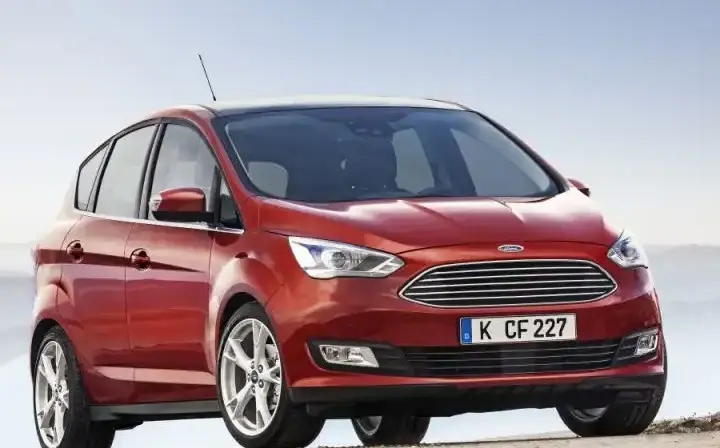
The Ford C-MAX II (facelift 2015) 2.0 Atkinson Energi Plug-in Hybrid eCVT, produced from 2015 to 2017, represented Ford’s foray into the growing plug-in hybrid market in North America and Europe. Positioned as a premium trim within the C-MAX lineup, it offered a blend of fuel efficiency and practicality, appealing to environmentally conscious buyers seeking a versatile compact multi-purpose vehicle (MPV). This variant utilized a unique powertrain combining a 2.0-liter Atkinson cycle gasoline engine with an electric motor and lithium-ion battery pack, offering both all-electric driving capability and extended range through hybrid operation. It was built on the C2 platform, also known as the 1HX0/A3 platform, shared with the Ford Focus.
Powertrain & Engine Architecture
The heart of the C-MAX Energi is its sophisticated plug-in hybrid powertrain. The 2.0-liter UADA inline-four engine utilizes Atkinson cycle technology, prioritizing fuel efficiency over outright power. This cycle delays the closing of the intake valves, allowing for more complete combustion and reducing pumping losses. The engine produces 141 horsepower and 175 Nm (129.07 lb.-ft.) of torque. It’s paired with a 120 horsepower electric motor, drawing power from a 7.6 kWh lithium-ion battery pack. The electric motor delivers 240 Nm (177.01 lb.-ft.) of instant torque. The combined system output is 188 horsepower. Power is delivered to the front wheels via a continuously variable transmission (eCVT), optimized for smooth and efficient operation. The eCVT lacks traditional gears, using a belt and pulley system to provide a seamless power delivery. The battery pack can be charged via a standard 120V outlet or a 240V charging station.
Driving Characteristics
The C-MAX Energi’s driving experience is heavily influenced by its hybrid nature. In all-electric mode, the vehicle offers quiet and smooth acceleration, suitable for short commutes and city driving. The 31 km (19.26 mi) all-electric range allowed for significant fuel savings for drivers with shorter daily trips. When the battery is depleted, or when additional power is needed, the gasoline engine seamlessly kicks in. The eCVT provides smooth, linear acceleration, but doesn’t offer the sporty feel of a traditional automatic transmission. Compared to the standard C-MAX models with a 1.6L EcoBoost engine, the Energi variant prioritized efficiency over performance. While the 1.6L offered quicker acceleration, the Energi excelled in fuel economy and provided the benefit of electric-only driving.
Equipment & Trim Levels
The C-MAX Energi typically came well-equipped, reflecting its position as a premium trim. Standard features included automatic climate control, a touchscreen infotainment system with Ford’s SYNC connectivity, keyless entry, and a suite of safety features like ABS, traction control, and multiple airbags. Interior upholstery was typically cloth, with available upgrades to leather. Optional extras included a navigation system, premium sound system, and parking sensors. The Energi trim also featured unique exterior styling cues, such as distinctive badging and aerodynamic enhancements.
Chassis & Braking
The C-MAX Energi utilized a McPherson strut front suspension and a multi-link rear suspension, providing a comfortable and controlled ride. The suspension was tuned to balance ride quality with handling. Braking duties were handled by ventilated discs at the front and solid discs at the rear. ABS (Anti-lock Braking System) was standard. Due to the added weight of the battery pack, the Energi variant had a slightly higher curb weight (1769 kg / 3899.98 lbs.) compared to non-hybrid C-MAX models. This weight difference did slightly impact handling, but the overall driving experience remained pleasant and predictable.
Market Reception & Comparison
The Ford C-MAX Energi was generally well-received by critics, who praised its fuel efficiency and practicality. However, some reviewers noted that its performance was not as engaging as some of its competitors. Compared to other plug-in hybrids on the market, such as the Toyota Prius Plug-in, the C-MAX Energi offered a more conventional driving experience and a more spacious interior. Its fuel economy figures were competitive, but not class-leading. Reliability reports were generally positive, with few major issues reported.
Legacy
The Ford C-MAX Energi, while discontinued in 2017, remains a viable option in the used car market for buyers seeking an affordable and fuel-efficient plug-in hybrid. The powertrain has proven to be relatively reliable, with the battery pack maintaining good capacity over time. The C-MAX Energi paved the way for Ford’s continued development of hybrid and electric vehicles, and its technology influenced subsequent models like the Ford Fusion Energi and the Ford Escape Hybrid. Its combination of practicality, fuel efficiency, and affordability made it a popular choice for environmentally conscious consumers.