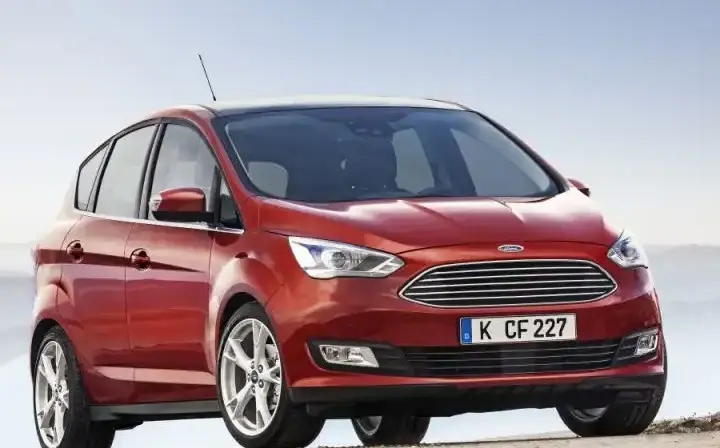
The Ford C-MAX II, specifically the 2.0 TDCi 170 horsepower variant equipped with the PowerShift automatic transmission and Start/Stop system, was a popular compact multi-purpose vehicle (MPV) produced from April 2015 to June 2019. This version represented a mid-cycle refresh of the second-generation C-MAX, designated internally as the facelift model. Positioned as a practical and fuel-efficient family vehicle, it aimed to bridge the gap between smaller hatchbacks and larger, more expensive people carriers within the European market. While not officially sold in the United States, the C-MAX was designed to compete with vehicles like the Volkswagen Touran and Opel/Vauxhall Meriva.
Technical Specifications
| Brand | Ford |
| Model | C-MAX |
| Generation | C-MAX II (facelift 2015) |
| Type (Engine) | 2.0 TDCi (170 Hp) PowerShift S&S |
| Start of production | April, 2015 |
| End of production | June, 2019 |
| Powertrain Architecture | Internal Combustion engine |
| Body type | MPV |
| Seats | 5 |
| Doors | 5 |
| Fuel consumption (urban) | 5.5 l/100 km (42.8 US mpg, 51.4 UK mpg, 18.2 km/l) |
| Fuel consumption (extra urban) | 4.4 l/100 km (53.5 US mpg, 64.2 UK mpg, 22.7 km/l) |
| Fuel consumption (combined) | 4.8 l/100 km (49 US mpg, 58.9 UK mpg, 20.8 km/l) |
| CO2 emissions | 124 g/km |
| Fuel Type | Diesel |
| Acceleration 0 – 100 km/h | 8.5 sec |
| Acceleration 0 – 62 mph | 8.5 sec |
| Acceleration 0 – 60 mph | 8.1 sec |
| Maximum speed | 212 km/h (131.73 mph) |
| Emission standard | Euro 6 |
| Weight-to-power ratio | 8.5 kg/Hp, 117.7 Hp/tonne |
| Weight-to-torque ratio | 3.6 kg/Nm, 277 Nm/tonne |
| Power | 170 Hp @ 3500 rpm |
| Power per litre | 85.1 Hp/l |
| Torque | 400 Nm @ 2000-2500 rpm (295.02 lb.-ft. @ 2000-2500 rpm) |
| Engine layout | Front, Transverse |
| Engine Model/Code | T8DE, T8DF |
| Engine displacement | 1997 cm3 (121.86 cu. in.) |
| Number of cylinders | 4 |
| Engine configuration | Inline |
| Cylinder Bore | 85 mm (3.35 in.) |
| Piston Stroke | 88 mm (3.46 in.) |
| Compression ratio | 16:1 |
| Number of valves per cylinder | 4 |
| Fuel injection system | Diesel Commonrail |
| Engine aspiration | Turbocharger, Intercooler |
| Valvetrain | DOHC |
| Engine oil capacity | 6.1 l (6.45 US qt | 5.37 UK qt) |
| Coolant | 8 l (8.45 US qt | 7.04 UK qt) |
| Kerb Weight | 1444 kg (3183.48 lbs.) |
| Max. weight | 2050 kg (4519.48 lbs.) |
| Max load | 606 kg (1336 lbs.) |
| Trunk (boot) space – minimum | 432 l (15.26 cu. ft.) |
| Trunk (boot) space – maximum | 1684 l (59.47 cu. ft.) |
| Fuel tank capacity | 60 l (15.85 US gal | 13.2 UK gal) |
| Max. roof load | 75 kg (165.35 lbs.) |
| Permitted trailer load with brakes (12%) | 1500 kg (3306.93 lbs.) |
| Permitted trailer load without brakes | 750 kg (1653.47 lbs.) |
| Length | 4379 mm (172.4 in.) |
| Width | 1828 mm (71.97 in.) |
| Width with mirrors folded | 1858 mm (73.15 in.) |
| Width including mirrors | 2067 mm (81.38 in.) |
| Height | 1610 mm (63.39 in.) |
| Wheelbase | 2648 mm (104.25 in.) |
| Front track | 1543-1557 mm (60.75 – 61.3 in.) |
| Rear (Back) track | 1554-1569 mm (61.18 – 61.77 in.) |
| Minimum turning circle | 11.1 m (36.42 ft.) |
| Drivetrain Architecture | The Internal combustion engine (ICE) drives the front wheels of the vehicle. |
| Drive wheel | Front wheel drive |
| Number of gears and type of gearbox | 6 gears, automatic transmission PowerShift |
| Front suspension | Independent, type McPherson with coil spring and anti-roll bar |
| Rear suspension | Independent multi-link spring suspension with stabilizer |
| Front brakes | Ventilated discs, 300×25 mm |
| Rear brakes | Disc, 280×11 mm |
| Assisting systems | ABS (Anti-lock braking system) |
| Steering type | Steering rack and pinion |
| Power steering | Electric Steering |
| Tires size | 205/55 R16; 215/55 R16; 215/50 R17; 235/40 R18 |
| Wheel rims size | 6.5J x 16; 7J x 16; 7J x 17; 8J x 18 |
INTRODUCTION
The Ford C-MAX II facelift, launched in 2015, represented a significant update to the original C-MAX introduced in 2007. Built on the Ford C-car platform (Mk2 Focus underpinnings – 1HX0/A3), the C-MAX aimed to provide a more spacious and versatile alternative to traditional hatchbacks. The 2.0 TDCi 170 PS PowerShift model was a key offering, positioned as a strong all-rounder for families needing both practicality and reasonable performance. It sat above the lower-powered diesel variants (like the 1.6 TDCi) and below the more expensive and sporty ST trim level. The Start/Stop system was included as standard, enhancing fuel efficiency in urban driving conditions.
Powertrain & Engine Architecture
The heart of this C-MAX variant is the Ford 2.0-liter TDCi diesel engine, specifically the T8DE or T8DF engine code depending on the specific market and emissions regulations. This engine is a four-cylinder, inline configuration, utilizing a common-rail direct fuel injection system. Peak power of 170 horsepower (125 kW) is achieved at 3500 rpm, while a substantial 400 Nm (295 lb-ft) of torque is available between 2000 and 2500 rpm. The engine features a turbocharger with an intercooler to improve efficiency and power output. The valvetrain employs a double overhead camshaft (DOHC) design with four valves per cylinder. Paired with this engine is the Ford PowerShift six-speed dual-clutch transmission (DCT). This transmission, while offering smooth and quick shifts, has been subject to some reliability concerns (discussed later). The PowerShift utilizes a wet clutch design, which generally provides better heat dissipation than dry clutch systems.
Driving Characteristics
The 2.0 TDCi 170 PS PowerShift C-MAX delivers a respectable driving experience. Acceleration from 0-62 mph (0-100 km/h) takes around 8.5 seconds, making it feel adequately brisk for everyday driving. The PowerShift transmission contributes to this, providing seamless gear changes during normal driving. However, compared to the manual transmission versions, the PowerShift can sometimes feel slightly less responsive, particularly during aggressive acceleration. The torque band is broad, offering good pulling power for overtaking maneuvers. The gear ratios are tuned for a balance between fuel efficiency and performance, with a relatively long sixth gear for highway cruising. Compared to the lower-powered 1.6 TDCi, the 2.0 TDCi offers a noticeable improvement in performance, while not quite matching the sportier feel of the C-MAX ST.
Equipment & Trim Levels
The 2.0 TDCi 170 PS PowerShift C-MAX typically came well-equipped, although specific features varied depending on the market and optional packages selected. Standard equipment generally included air conditioning, power windows, power mirrors, a basic audio system with USB connectivity, and alloy wheels. Higher trim levels, such as Titanium, added features like automatic climate control, a larger touchscreen infotainment system with navigation, rear parking sensors, and upgraded interior upholstery. Optional extras included a panoramic sunroof, leather seats, and advanced driver-assistance systems like adaptive cruise control and lane-keeping assist.
Chassis & Braking
The C-MAX II utilizes an independent suspension setup on both the front and rear axles. The front suspension employs a McPherson strut design with a coil spring and anti-roll bar, while the rear features a multi-link setup, also with a stabilizer bar. This configuration provides a comfortable ride quality and good handling characteristics. Braking duties are handled by ventilated discs on the front wheels (300x25mm) and solid discs on the rear wheels (280x11mm). Anti-lock Braking System (ABS) is standard. The steering is electrically assisted, providing a light and precise feel.
Market Reception & Comparison
The Ford C-MAX II 2.0 TDCi 170 PS PowerShift was generally well-received by automotive critics. It was praised for its spacious interior, comfortable ride, and fuel efficiency. The PowerShift transmission, however, was a point of contention, with some reviewers noting occasional hesitation or jerky shifts. Compared to rivals like the Volkswagen Touran, the C-MAX offered a more engaging driving experience, but the Touran often had a reputation for slightly higher build quality. Fuel economy was competitive, averaging around 49 US mpg on the combined cycle. Reliability was a mixed bag, with the engine itself proving generally robust, but the PowerShift transmission being prone to issues in some cases.
Legacy
The Ford C-MAX II, including the 2.0 TDCi 170 PS PowerShift variant, remains a relatively common sight on used car markets. The engine is generally considered reliable, but potential buyers should be aware of the potential issues with the PowerShift transmission. Common problems include clutch wear, mechatronic unit failures, and software glitches. Regular maintenance, including fluid changes, is crucial for ensuring the longevity of the transmission. Despite these potential issues, the C-MAX II offers a practical and affordable option for families seeking a versatile MPV. Its spacious interior, good fuel economy, and comfortable ride continue to make it a popular choice in the used car market.