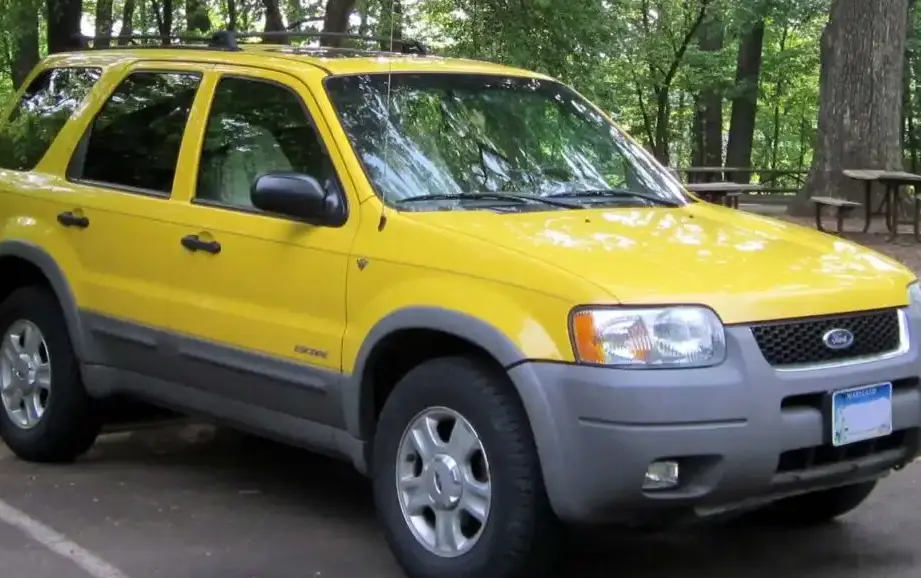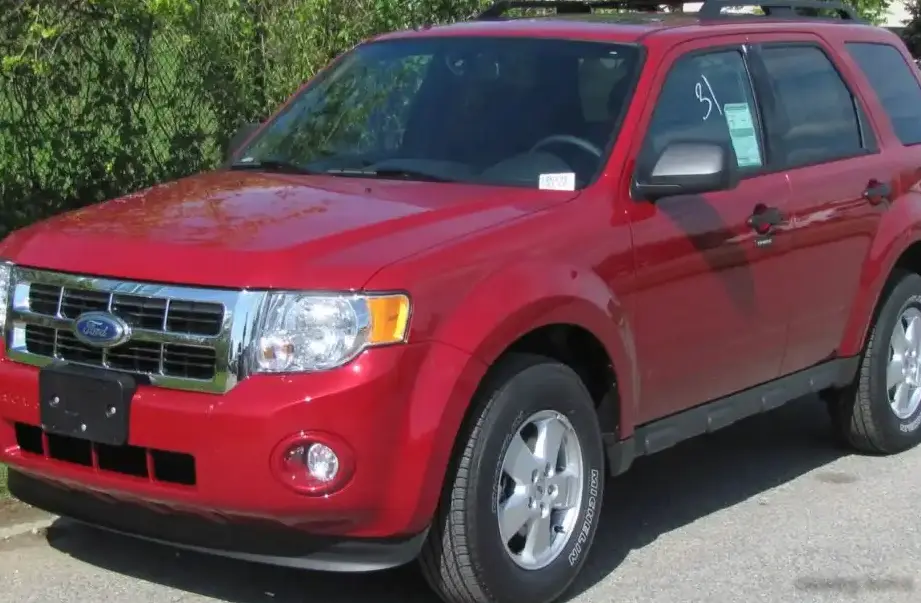
Technical Specifications
| Brand | Ford |
| Model | Escape |
| Generation | Escape II |
| Type (Engine) | 2.5 (177 Hp) Hybrid 4WD eCVT |
| Start of production | 2008 |
| End of production | 2012 |
| Powertrain Architecture | FHEV (Full Hybrid Electric Vehicle) |
| Body type | SUV |
| Seats | 5 |
| Doors | 5 |
| Fuel consumption (urban) | 8.1 l/100 km (29 US mpg) |
| Fuel consumption (extra urban) | 8.7 l/100 km (27 US mpg) |
| Fuel Type | Petrol (Gasoline) |
| Emission standard | Euro 4 |
| Weight-to-power ratio | 9.1 kg/Hp |
| Weight-to-torque ratio | 8.7 kg/Nm |
| Battery voltage | 330 V |
| Battery technology | Nickel-metal hydride (NiMH) |
| Electric motor power | 94 Hp @ 5000 rpm |
| Electric motor type | Synchronous |
| System power | 177 Hp |
| Engine power | 153 Hp @ 6000 rpm |
| Power per litre | 61.3 Hp/l |
| Torque | 184 Nm @ 4500 rpm (135.71 lb.-ft. @ 4500 rpm) |
| Engine layout | Front, Transverse |
| Engine displacement | 2495 cm3 (152.25 cu. in.) |
| Number of cylinders | 6 |
| Engine configuration | V-engine |
| Cylinder Bore | 81.6 mm (3.21 in.) |
| Piston Stroke | 79.5 mm (3.13 in.) |
| Compression ratio | 9.8:1 |
| Number of valves per cylinder | 4 |
| Fuel injection system | Multi-port manifold injection |
| Engine aspiration | Naturally aspirated engine |
| Valvetrain | DOHC |
| Engine oil capacity | 5 l (5.28 US qt | 4.4 UK qt) |
| Coolant capacity | 7 l (7.4 US qt | 6.16 UK qt) |
| Kerb Weight | 1605 kg (3538.42 lbs.) |
| Max. weight | 1986 kg (4378.38 lbs.) |
| Max load | 381 kg (839.96 lbs.) |
| Trunk (boot) space – minimum | 787 l (27.79 cu. ft.) |
| Trunk (boot) space – maximum | 1872 l (66.11 cu. ft.) |
| Fuel tank capacity | 61 l (16.11 US gal | 13.42 UK gal) |
| Length | 4437 mm (174.69 in.) |
| Width | 1806 mm (71.1 in.) |
| Width with mirrors folded | 1979 mm (77.91 in.) |
| Width including mirrors | 2065 mm (81.3 in.) |
| Height | 1778 mm (70 in.) |
| Wheelbase | 2620 mm (103.15 in.) |
| Front track | 1545 mm (60.83 in.) |
| Rear track | 1535 mm (60.43 in.) |
| Front overhang | 856 mm (33.7 in.) |
| Rear overhang | 960 mm (37.8 in.) |
| Ride height (ground clearance) | 211 mm (8.31 in.) |
| Approach angle | 19.6° |
| Departure angle | 27.7° |
| Ramp-over angle | 18.7° |
| Drivetrain Architecture | ICE and electric motor drive front wheels, rear wheels engaged via clutch |
| Drive wheel | All wheel drive (4×4) |
| Number of gears | automatic transmission eCVT |
The Ford Escape II 2.5 Hybrid 4WD eCVT, produced from 2008 to 2012, represented Ford’s second-generation entry into the increasingly popular compact SUV market. This variant held a significant position within the Escape II lineup, offering a fuel-efficient, all-wheel-drive option for American consumers who were becoming more interested in hybrid technology. Built on the global Ford C-platform (also known as the 1HX0 platform, shared with the Mazda Tribute and Mercury Mariner), the 2.5 Hybrid aimed to balance practicality, fuel economy, and all-weather capability. It was positioned as a mid-range offering, bridging the gap between the base 2.3L four-cylinder models and the more powerful 3.0L V6 options.
Powertrain & Engine Architecture
The heart of the Escape II Hybrid is a 2.5-liter Duratec V6 engine (internally designated as the 302 engine code), paired with an electric motor and a continuously variable transmission (eCVT). The Duratec engine utilizes multi-port fuel injection and a double overhead camshaft (DOHC) valvetrain. This engine produces 153 horsepower at 6000 rpm and 184 lb-ft of torque at 4500 rpm. The electric motor contributes an additional 94 horsepower at 5000 rpm, bringing the total system output to 177 horsepower. The nickel-metal hydride (NiMH) battery pack, operating at 330 volts, provides energy storage for the electric motor. The eCVT, unlike traditional automatic transmissions, doesn’t have fixed gear ratios. Instead, it employs a belt-and-pulley system to provide a seamless and continuously variable gear ratio, optimizing engine efficiency and responsiveness. The hybrid system allows for electric-only driving at low speeds and assists the gasoline engine during acceleration, improving fuel economy.
Driving Characteristics
The 2.5L Hybrid 4WD Escape offered a noticeably different driving experience compared to its gasoline-only counterparts. While not designed for high performance, the combined output of the engine and electric motor provided adequate acceleration for everyday driving. The eCVT, while efficient, could sometimes feel less responsive than a traditional automatic transmission, exhibiting a “rubber band” effect during hard acceleration. The all-wheel-drive system provided enhanced traction in inclement weather, making it a practical choice for regions with snow or rain. The hybrid system’s regenerative braking also contributed to a unique feel, with a slightly different pedal response compared to conventional brakes. Fuel economy was a key selling point, with EPA estimates of 29 mpg in the city and 27 mpg on the highway.
Equipment & Trim Levels
The 2.5 Hybrid 4WD typically came standard with features such as air conditioning, power windows and locks, a CD player with an auxiliary input, and keyless entry. Safety features included anti-lock brakes, stability control, and multiple airbags. Higher trim levels, such as the Limited, added features like leather upholstery, heated front seats, a premium sound system, and a sunroof. Optional extras included a navigation system and a rear entertainment system.
Chassis & Braking
The Escape II Hybrid utilized an independent McPherson strut front suspension and a double wishbone rear suspension. The suspension was tuned for a comfortable ride, prioritizing smoothness over sporty handling. Front brakes were ventilated discs, while rear brakes were solid discs. The electric power steering provided light and easy steering effort. The 4WD system was an on-demand system, automatically engaging the rear wheels when traction was needed.
Market Reception & Comparison
The Ford Escape Hybrid was generally well-received by automotive critics, who praised its fuel efficiency and practicality. However, some reviewers noted the eCVT’s lack of responsiveness and the relatively high price compared to non-hybrid models. Compared to the 2.3L four-cylinder Escape, the Hybrid offered significantly better fuel economy but came at a higher cost. Compared to the 3.0L V6 Escape, the Hybrid offered comparable performance with superior fuel efficiency. The Toyota RAV4 Hybrid was a direct competitor, often praised for its refinement and reliability.
Legacy
The Ford Escape II Hybrid represented an important step in Ford’s development of hybrid technology. While early hybrid systems were often complex and prone to issues, the Escape Hybrid proved to be relatively reliable, with the NiMH battery packs generally lasting for many years. Today, used Escape II Hybrids are often sought after by buyers looking for a fuel-efficient and practical SUV. The powertrain, while not groundbreaking, provided a solid foundation for Ford’s future hybrid offerings, paving the way for more advanced hybrid and electric vehicles.