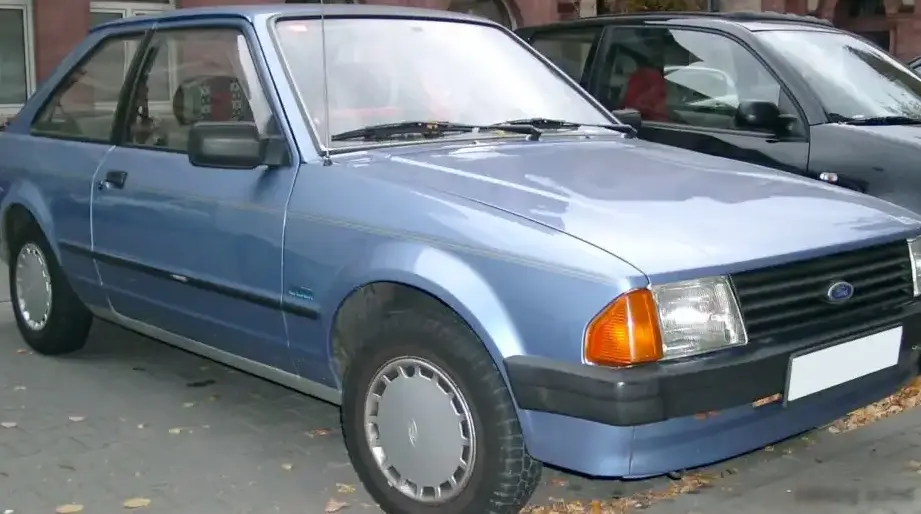
The Ford Escort III, produced between 1985 and 1990, represented a significant evolution of Ford of Europe’s popular compact car. Within the Escort III range (chassis codes GAA, AWA, ABFT, and AVA), the 1.6-liter (GAA) engine producing 90 horsepower was a mainstay, particularly in the early years of production. This variant occupied a middle-ground position in the lineup, offering a balance between affordability, fuel economy, and acceptable performance for everyday driving. It served as a step up from the base 1.3L models, while remaining more accessible than the sportier 1.6L CVH and later 1.8L versions. The Escort III was crucial for Ford in maintaining its market share in the competitive European small family car segment, facing rivals like the Opel/Vauxhall Astra, Volkswagen Golf, and Peugeot 205.
Technical Specifications
| Brand | Ford |
| Model | Escort |
| Generation | Escort III (GAA, AWA, ABFT, AVA) |
| Type (Engine) | 1.6 (GAA) (90 Hp) |
| Start of Production | 1985 |
| End of Production | 1985 |
| Powertrain Architecture | Internal Combustion Engine |
| Body Type | Hatchback |
| Fuel Type | Petrol (Gasoline) |
| Power | 90 Hp |
| Engine Aspiration | Naturally Aspirated |
Powertrain & Engine Architecture
The 1.6-liter GAA engine was a naturally aspirated, inline-four cylinder unit. It was part of the Ford Valencia engine family, known for its relatively simple design and durability. While not a particularly high-tech engine by modern standards, it was a reliable workhorse. The GAA featured a single overhead camshaft (SOHC) operating two valves per cylinder. Fuel delivery was managed by a Bosch fuel injection system, a significant upgrade from the carburetors used in earlier Escort models. This injection system contributed to improved fuel efficiency and reduced emissions. The engine produced 90 horsepower at approximately 5,500 rpm and 98 lb-ft of torque at 3,000 rpm. The transmission paired with this engine was typically a four-speed automatic, although a five-speed manual was also available. The automatic transmission, while offering convenience, was not known for its sporty performance and was geared towards smooth, comfortable driving. It was a Ford-sourced unit, designed to handle the engine’s torque output without issue.
Driving Characteristics
The Escort III 1.6 Automatic offered a comfortable, if not particularly exhilarating, driving experience. The automatic transmission, while smooth, resulted in noticeable acceleration lag compared to the manual versions. The 90 horsepower engine provided adequate power for everyday driving, including commuting and highway cruising, but overtaking maneuvers required careful planning. The gear ratios in the automatic transmission were optimized for fuel economy rather than outright performance. The car’s weight, typically around 2,200-2,300 pounds depending on trim level, contributed to a feeling of being somewhat underpowered, especially when fully loaded. Compared to the manual transmission versions, the automatic Escort felt noticeably slower. The higher-output 1.6 CVH engine, available in some Escort III models, offered a significant performance boost, while the 1.8-liter versions provided even more power. However, these came at a higher price point.
Equipment & Trim Levels
The 1.6-liter automatic Escort III typically came equipped as a mid-range model. Standard features generally included cloth upholstery, a basic stereo system, and manual windows and door locks. The dashboard layout was functional and straightforward, with clearly marked gauges for speed, fuel level, coolant temperature, and battery voltage. Optional extras included a sunroof, upgraded stereo systems, and central locking. Higher trim levels, such as the Ghia, offered more luxurious appointments, including upgraded upholstery, woodgrain trim, and additional features like power windows and alloy wheels. The base models were more spartan, focusing on affordability. The 1.6 automatic often found itself positioned as a comfortable and well-equipped option for buyers who prioritized convenience over outright performance.
Chassis & Braking
The Escort III utilized a MacPherson strut front suspension and a semi-independent twist beam rear suspension. This setup provided a reasonable balance between ride comfort and handling. The front suspension featured coil springs and an anti-roll bar, while the rear suspension relied on leaf springs. Braking systems varied depending on the trim level. The 1.6-liter models typically featured disc brakes on the front wheels and drum brakes on the rear. Higher-spec models often received disc brakes all around. The braking system was adequate for the car’s weight and performance, but lacked the stopping power of more modern vehicles. Steering was rack and pinion, providing precise and responsive handling. Stabilizer bar thickness was relatively modest, contributing to a comfortable ride but limiting cornering performance.
Market Reception & Comparison
The Escort III 1.6 Automatic was generally well-received by critics as a practical and reliable family car. It was praised for its fuel efficiency, comfortable ride, and spacious interior. However, the automatic transmission was often criticized for its sluggish performance. Compared to the manual transmission versions, the automatic offered less driver engagement and slower acceleration. Fuel economy was respectable for the time, averaging around 28-32 mpg in mixed driving conditions. Reliability was generally good, with the GAA engine proving to be a durable unit. The 1.6-liter automatic offered a compelling alternative to rivals like the Opel Astra and Volkswagen Golf, particularly for buyers who valued convenience and affordability. The 1.9 TDI versions of the Golf, introduced later, offered significantly better fuel economy, but at a higher purchase price.
Legacy
The Ford Escort III 1.6 Automatic has become a popular choice among classic car enthusiasts. The GAA engine is known for its reliability and relatively simple maintenance requirements. Parts availability is generally good, although some components may be becoming increasingly difficult to find. The automatic transmission, while not particularly sought after by performance enthusiasts, remains a reliable unit when properly maintained. Today, these Escorts are often found in good condition, having been well-cared for by their owners. They represent a nostalgic reminder of a bygone era of automotive design and engineering. The 1.6 automatic variant, while not the most powerful or sporty Escort III, remains a practical and enjoyable classic car, offering a comfortable and affordable entry point into the world of vintage motoring. Its enduring appeal lies in its simplicity, reliability, and the fond memories it evokes for many drivers.