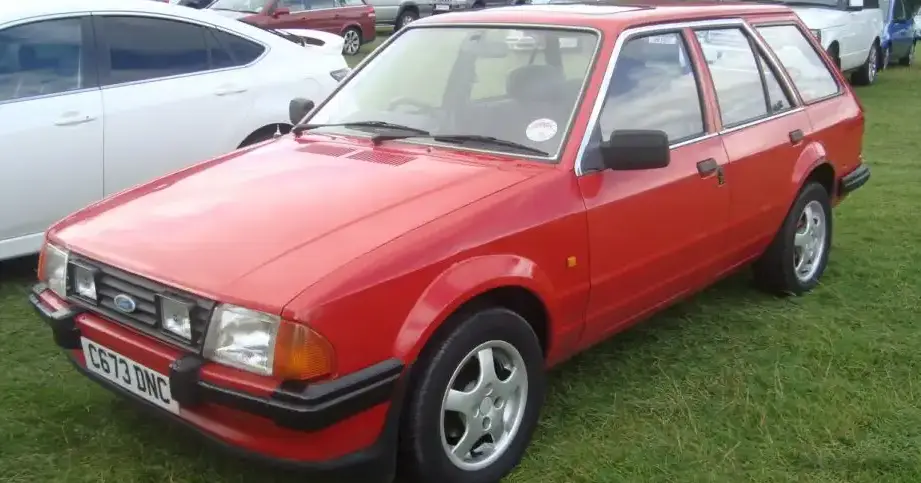
The Ford Escort III Turnier 1.3, produced between 1981 and 1985, represented the entry-level powertrain option for Ford’s popular estate car in the European market. Part of the Mk III Escort range (internally designated AWA), the Turnier – Ford’s term for its station wagon – offered practical family transport with a focus on affordability and fuel economy. This 1.3-liter variant occupied the base trim level, providing a more economical alternative to the higher-specification engines available, such as the 1.6-liter. It was designed to appeal to buyers prioritizing practicality and low running costs over outright performance.
Technical Specifications
| Brand | Ford |
| Model | Escort |
| Generation | Escort III Turnier (AWA) |
| Type (Engine) | 1.3 (69 Hp) |
| Start of production | 1981 |
| End of production | 1985 |
| Powertrain Architecture | Internal Combustion engine |
| Body type | Station wagon (estate) |
| Fuel Type | Petrol (Gasoline) |
| Power | 69 Hp |
| Engine aspiration | Naturally aspirated engine |
Powertrain & Engine Architecture
The Escort III Turnier 1.3 was powered by the Ford CVH (Compound Valve angle Hemispherical) engine, specifically the 1297cc version. This engine, introduced in the late 1970s, was a significant departure from Ford’s previous overhead valve designs. The CVH featured an overhead camshaft, two valves per cylinder, and a belt-driven system. While relatively simple in design, it offered improved efficiency and smoother operation compared to its predecessors. The 1.3-liter version utilized a single downdraft carburetor – typically a Ford 32/36 DGV – for fuel delivery. This carburetor, while reliable, wasn’t known for precise fuel metering, contributing to the engine’s modest power output and relatively high fuel consumption by modern standards.
The engine was mated to a four-speed manual transmission as standard, although a three-speed automatic transmission was offered as an optional extra. The automatic, a Ford-built unit, was a relatively basic design, prioritizing durability and simplicity over performance. It featured a torque converter and planetary gearsets, providing smooth but somewhat sluggish gear changes. The automatic transmission was a popular choice for drivers prioritizing ease of use, particularly in urban environments.
Driving Characteristics
The 1.3-liter Escort Turnier was not a performance-oriented vehicle. With 69 horsepower and approximately 84 lb-ft of torque, acceleration was leisurely. 0-60 mph times were typically in the 14-16 second range. The engine felt strained when fully loaded or climbing hills, requiring frequent downshifts, especially with the automatic transmission. The four-speed manual offered a more engaging driving experience, allowing the driver to keep the engine in its optimal power band. However, even with the manual, the Escort 1.3 was best suited for relaxed cruising and everyday commuting.
The automatic transmission, while convenient, further diminished performance. The gear ratios were spaced to prioritize fuel economy, resulting in noticeable delays during acceleration. The transmission also lacked a kickdown feature, requiring the driver to manually shift down for overtaking maneuvers. Handling was typical of Escorts of the era – competent but not particularly sporty. The suspension, consisting of MacPherson struts at the front and a leaf spring rear suspension, provided a comfortable ride, but body roll was noticeable in corners.
Equipment & Trim Levels
The 1.3-liter Escort Turnier occupied the base trim level, meaning it came with a relatively sparse equipment list. Standard features typically included cloth upholstery, a basic instrument cluster with speedometer and fuel gauge, and manually operated windows and door locks. Central locking and electric windows were not available on this trim level. The interior was functional and durable, but lacked the refinement of higher-specification models. Optional extras included a radio, heated rear window, and upgraded seat fabrics. The Turnier’s defining feature was its spacious cargo area, accessible through a large rear tailgate. The rear seats could be folded down to create a larger, flat load floor, enhancing its practicality.
Chassis & Braking
The Escort III Turnier 1.3 utilized a relatively simple chassis design. The front suspension featured MacPherson struts with anti-roll bar, while the rear suspension employed a leaf spring setup. This configuration provided a comfortable ride but wasn’t particularly sophisticated. Braking was initially provided by front disc brakes and rear drum brakes. Later models sometimes featured rear disc brakes as standard, depending on the market. The braking system was adequate for the vehicle’s weight and performance, but lacked the stopping power of more modern cars. Power steering was not standard on the 1.3-liter model, requiring more effort at low speeds.
Market Reception & Comparison
The Escort III Turnier 1.3 was generally well-received as an affordable and practical family car. Critics praised its spacious interior, large cargo area, and low running costs. However, it was often criticized for its lack of performance and basic interior. Compared to the 1.6-liter Escort Turnier, the 1.3-liter model offered significantly less power and refinement. The 1.6-liter provided a more enjoyable driving experience and was better suited for long journeys or carrying heavy loads. The diesel-powered Escort Turnier, while slower, offered superior fuel economy. The 1.3-liter model appealed to buyers who prioritized affordability and fuel efficiency above all else.
Legacy
The Ford Escort III Turnier 1.3, while not a particularly exciting vehicle, played an important role in providing affordable family transport during the early 1980s. The CVH engine, despite its limitations, proved to be relatively durable and reliable. Today, these cars are relatively rare, and well-maintained examples are sought after by classic car enthusiasts. The automatic transmission versions, while less desirable to driving purists, are appreciated for their ease of use. Parts availability is generally good, although some trim-specific components can be difficult to find. The Escort III Turnier 1.3 remains a testament to Ford’s ability to produce practical and affordable cars that met the needs of a wide range of buyers.