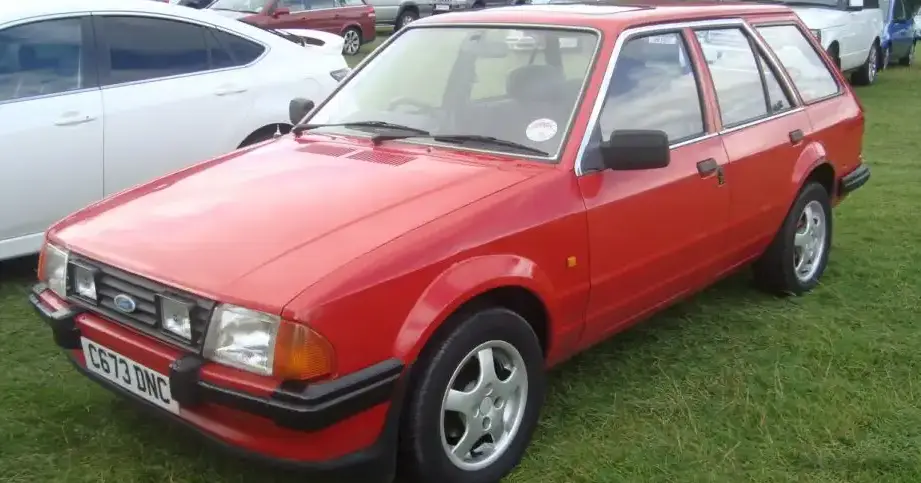
The Ford Escort III Turnier 1.6 D, produced between 1984 and 1985, represents a practical and economical variant within the broader Escort Mk III (AWA) range. Positioned as the entry-level diesel option in the Turnier (estate) body style, it catered to buyers prioritizing fuel efficiency and load-carrying capacity over outright performance. This model played a significant role in Ford of Europe’s strategy to offer a diverse lineup appealing to a wide range of customers, particularly those in rural areas or with commercial needs. The Escort Mk III, launched in 1983, was a significant update to the hugely successful Escort Mk II, offering improved aerodynamics, interior space, and refinement. The Turnier estate version, introduced shortly after the saloon, expanded the Escort’s practicality, and the 1.6 D engine provided a cost-effective solution for those requiring a workhorse vehicle.
Technical Specifications
| Brand | Ford |
| Model | Escort |
| Generation | Escort III Turnier (AWA) |
| Type (Engine) | 1.6 D (54 Hp) |
| Start of production | 1984 |
| End of production | 1985 |
| Powertrain Architecture | Internal Combustion engine |
| Body type | Station wagon (estate) |
| Fuel Type | Diesel |
| Power | 54 Hp |
| Engine aspiration | Naturally aspirated engine |
Powertrain & Engine Architecture
The Escort III Turnier 1.6 D was powered by Ford’s 1.6-liter, naturally aspirated diesel engine. This engine, internally designated as the DV6, was a four-cylinder unit with an indirect injection system. Unlike modern common-rail diesels, the DV6 utilized a pre-chamber combustion system. Fuel was first injected into a small pre-chamber, where it ignited, and then transferred to the main combustion chamber via a connecting passage. This system helped improve combustion efficiency and reduce noise, common issues with early diesel engines. The engine featured a single overhead camshaft operating two valves per cylinder. The 54 horsepower output was achieved at 4,200 rpm, while peak torque of approximately 85 lb-ft was delivered at 1,700 rpm. The engine was mated to a four-speed manual transmission as standard, although a three-speed automatic transmission was available as an option, albeit less common. The automatic transmission was a Ford-sourced unit, designed for smooth, if not particularly rapid, gear changes. The engine’s relatively simple design contributed to its robustness and longevity, but also limited its performance potential.
Driving Characteristics
The driving experience in the Escort III Turnier 1.6 D was characterized by its practicality and economy rather than excitement. With only 54 horsepower propelling a relatively heavy estate car, acceleration was modest. 0-60 mph times were likely in the region of 18-20 seconds. The engine’s torque, however, provided reasonable pulling power at lower speeds, making it suitable for hauling loads or navigating hilly terrain. The four-speed manual transmission offered a decent spread of gears, allowing the driver to keep the engine within its optimal operating range. The optional automatic transmission, while providing convenience, further diminished performance and increased fuel consumption. The suspension, consisting of MacPherson struts at the front and a leaf spring rear suspension, provided a comfortable ride, although it could feel somewhat bouncy when fully loaded. Steering was relatively light, making it easy to maneuver in urban environments, but lacked the precision of more modern systems. Compared to the petrol-powered Escort Turnier variants, the 1.6 D offered significantly lower fuel consumption, but at the expense of performance.
Equipment & Trim Levels
The Escort III Turnier 1.6 D typically represented the base trim level within the Turnier range. Standard equipment was fairly basic, reflecting its position as an affordable workhorse. Features generally included cloth upholstery, a basic dashboard with analog gauges, and manually operated windows and door locks. A heater was standard, but air conditioning was not typically offered on this trim level. The exterior featured black plastic trim and steel wheels with hubcaps. Optional extras included a radio, upgraded upholstery, and a sunroof. Higher trim levels, such as the Ghia, offered more luxurious appointments, including velour upholstery, central locking, and electric windows. The 1.6 D was often chosen by fleet buyers and those prioritizing functionality over luxury, so many examples were equipped with minimal options.
Chassis & Braking
The Escort III Turnier’s chassis was a traditional body-on-frame construction, providing a robust and durable platform. The front suspension utilized MacPherson struts, offering a good balance of ride comfort and handling. The rear suspension employed a leaf spring setup, which was well-suited to carrying heavy loads but could result in a less refined ride compared to independent rear suspension systems. Braking was typically accomplished with disc brakes at the front and drum brakes at the rear. The braking system was adequate for the vehicle’s performance capabilities, but lacked the stopping power of more modern systems. Steering was a recirculating ball system, providing a relatively light steering feel but lacking the precision of rack-and-pinion steering. Stabilizer bars were often omitted on the base 1.6 D trim to keep costs down, further impacting handling performance.
Market Reception & Comparison
The Escort III Turnier 1.6 D was generally well-received as a practical and economical estate car. Critics praised its fuel efficiency and load-carrying capacity, but noted its lack of performance. Compared to the petrol-powered Escort Turnier variants, the 1.6 D offered significantly better fuel economy, making it a popular choice for high-mileage drivers. However, the petrol engines provided considerably more power and a more engaging driving experience. The 1.6 D also faced competition from other diesel estate cars, such as the Vauxhall Astra Estate and the Volkswagen Golf Estate. The Escort’s relatively low price and Ford’s extensive dealer network gave it a competitive edge in the market. Reliability was generally good, although the indirect injection diesel engine required regular maintenance to ensure optimal performance.
Legacy
The Ford Escort III Turnier 1.6 D, while not a performance icon, remains a significant vehicle in Ford’s history. It represents a period when fuel efficiency and practicality were paramount concerns for many car buyers. The DV6 diesel engine, despite its limitations, proved to be a robust and durable unit, and many examples are still on the road today. In the used car market, these Escort Turniers are valued for their simplicity, affordability, and classic appeal. They are often sought after by enthusiasts looking for a reliable and economical classic estate car. The Escort Mk III, and the Turnier variant in particular, helped solidify Ford’s position as a leading manufacturer of family cars in Europe, and paved the way for future generations of Escort models.