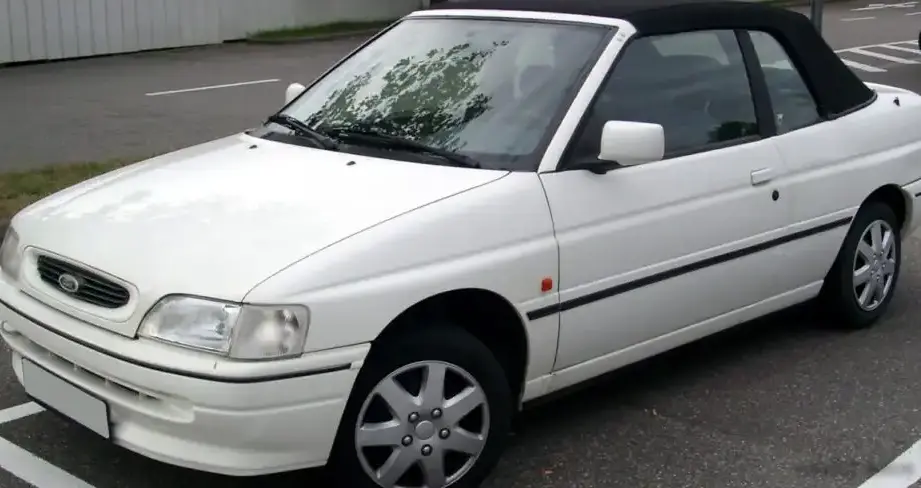
The Ford Escort VI Cabrio 1.8 i 16V XR3i, produced between 1993 and 1995, represented a sporty and desirable variant within the Escort VI Cabriolet range. Positioned as a step up from the base models, the XR3i offered increased performance and a more focused driving experience. It was part of the sixth generation of the Escort (Mk VI), which saw the introduction of a more rounded and modern design compared to its predecessors. The Escort VI, and specifically the Cabriolet, aimed to appeal to buyers seeking an affordable and stylish open-top car, primarily in the European market. This particular 1.8L 16V engine paired with a manual transmission was a popular choice for those wanting a balance between performance and practicality.
Technical Specifications
| Brand | Ford |
| Model | Escort |
| Generation | Escort VI Cabrio (ALL) |
| Type (Engine) | 1.8 i 16V XR3i (105 Hp) |
| Start of production | 1993 |
| End of production | 1995 |
| Powertrain Architecture | Internal Combustion engine |
| Body type | Cabriolet |
| Seats | 5 |
| Doors | 2 |
| Fuel consumption (combined) | 8.5 l/100 km (27.7 US mpg, 33.2 UK mpg, 11.8 km/l) |
| Fuel Type | Petrol (Gasoline) |
| Acceleration 0 – 100 km/h | 11.1 sec |
| Acceleration 0 – 62 mph | 11.1 sec |
| Acceleration 0 – 60 mph | 10.5 sec |
| Maximum speed | 183 km/h (113.71 mph) |
| Weight-to-power ratio | 11.4 kg/Hp, 87.5 Hp/tonne |
| Weight-to-torque ratio | 7.8 kg/Nm, 127.5 Nm/tonne |
| Power | 105 Hp @ 5500 rpm |
| Power per litre | 58.5 Hp/l |
| Torque | 153 Nm @ 4000 rpm (112.85 lb.-ft. @ 4000 rpm) |
| Engine layout | Front, Transverse |
| Engine Model/Code | RDA |
| Engine displacement | 1796 cm3 (109.6 cu. in.) |
| Number of cylinders | 4 |
| Engine configuration | Inline |
| Cylinder Bore | 80.6 mm (3.17 in.) |
| Piston Stroke | 88 mm (3.46 in.) |
| Compression ratio | 10:1 |
| Number of valves per cylinder | 4 |
| Fuel injection system | Multi-port manifold injection |
| Engine aspiration | Naturally aspirated engine |
| Valvetrain | DOHC |
| Engine oil capacity | 4.25 l (4.49 US qt | 3.74 UK qt) |
| Coolant | 7 l (7.4 US qt | 6.16 UK qt) |
| Kerb Weight | 1200 kg (2645.55 lbs.) |
| Max. weight | 1675 kg (3692.74 lbs.) |
| Max load | 475 kg (1047.2 lbs.) |
| Trunk (boot) space – minimum | 322 l (11.37 cu. ft.) |
| Fuel tank capacity | 55 l (14.53 US gal | 12.1 UK gal) |
| Length | 4040 mm (159.06 in.) |
| Width | 1692 mm (66.61 in.) |
| Height | 1379 mm (54.29 in.) |
| Wheelbase | 2525 mm (99.41 in.) |
| Front track | 1443 mm (56.81 in.) |
| Rear (Back) track | 1462 mm (57.56 in.) |
| Drivetrain Architecture | The Internal combustion engine (ICE) drives the front wheels of the vehicle. |
| Drive wheel | Front wheel drive |
| Number of gears and type of gearbox | 5 gears, manual transmission |
| Front suspension | Spring Strut |
| Rear suspension | Coil spring |
| Front brakes | Ventilated discs |
| Rear brakes | Drum |
| Steering type | Steering rack and pinion |
| Power steering | Hydraulic Steering |
| Tires size | 185/60 R14 H |
Powertrain & Engine Architecture
The XR3i Cabriolet was powered by Ford’s 1.8-liter, 16-valve inline-four engine, designated the RDA code. This engine was a significant upgrade over the smaller displacement options available in the Escort range. It featured multi-port fuel injection, a dual overhead camshaft (DOHC) valvetrain, and a compression ratio of 10:1. These features contributed to its relatively high output for a naturally aspirated engine of that era. The engine’s 105 horsepower at 5500 rpm and 153 Nm (113 lb-ft) of torque at 4000 rpm provided a noticeable performance boost compared to the lower-spec models. The five-speed manual transmission was the standard offering, providing drivers with full control over the engine’s power band. The engine’s design prioritized a balance between performance and fuel efficiency, making it suitable for both spirited driving and everyday use.
Driving Characteristics
The 1.8L XR3i Cabriolet offered a more engaging driving experience than the base Escort Cabriolets. While not a sports car by any means, the increased power and responsive engine made it feel lively and capable. Acceleration to 60 mph took around 10.5 seconds, and it could reach a top speed of 113.71 mph. The five-speed manual transmission allowed drivers to keep the engine in its optimal power range, providing good acceleration in most situations. The suspension, while tuned for comfort, offered reasonable handling, and the ventilated front disc brakes provided adequate stopping power. Compared to the automatic transmission options available on other Escort models, the manual gearbox in the XR3i provided a more direct connection to the engine and a more rewarding driving experience. The open-top nature of the Cabriolet added to the sense of freedom and enjoyment, although it did introduce some wind noise at higher speeds.
Equipment & Trim Levels
The XR3i trim level came with a number of standard features designed to enhance both comfort and style. Interior appointments typically included sport seats with upgraded upholstery, often featuring a patterned fabric. The dashboard featured a sporty instrument cluster with additional gauges, such as a voltmeter and oil pressure gauge. Power steering was standard, making the car easier to maneuver. Optional extras included alloy wheels, a sunroof, and a premium sound system. The XR3i also featured body-colored bumpers and side moldings, giving it a more refined appearance compared to the more basic Escort models. The overall interior design was functional and well-laid-out, with a focus on providing a comfortable and enjoyable driving environment.
Chassis & Braking
The Escort VI Cabriolet utilized a front-wheel-drive layout with a MacPherson strut front suspension and a coil spring rear suspension. The front brakes were ventilated discs, providing good stopping power, while the rear brakes were drums. This configuration was typical for cars in this class during the early 1990s. The chassis was reinforced to compensate for the lack of a fixed roof, providing adequate rigidity for open-top driving. Stabilizer bars were fitted to both the front and rear axles to reduce body roll during cornering. The steering was a rack-and-pinion system with hydraulic power assistance, offering precise and responsive steering feel. Tire size was typically 185/60 R14, providing a good balance between grip and ride comfort.
Market Reception & Comparison
The Ford Escort VI Cabrio 1.8 i 16V XR3i was generally well-received by automotive critics. It was praised for its sporty styling, engaging driving experience, and relatively affordable price. Compared to other convertibles in its class, such as the Peugeot 205 Cabriolet and the Renault 5 Cabriolet, the Escort offered a good balance of performance, practicality, and value. The 1.8L engine provided a noticeable performance advantage over the smaller engine options available in competing models. Fuel economy was reasonable for a car of its type, and reliability was generally good. However, some critics noted that the interior quality was not as refined as some of its rivals. The XR3i appealed to buyers who wanted a stylish and fun-to-drive convertible without breaking the bank.
Legacy
The Ford Escort VI Cabrio 1.8 i 16V XR3i has become a popular choice among classic car enthusiasts. The RDA engine, while not known for being exceptionally durable, is relatively straightforward to maintain and repair. Parts availability is generally good, although some components may be becoming increasingly difficult to find. The XR3i’s combination of sporty styling, engaging driving dynamics, and affordable price has made it a desirable classic. Well-maintained examples are now sought after by collectors and enthusiasts, and prices have been steadily increasing in recent years. The Escort VI Cabrio XR3i represents a significant chapter in Ford’s history, and it continues to be enjoyed by drivers around the world.