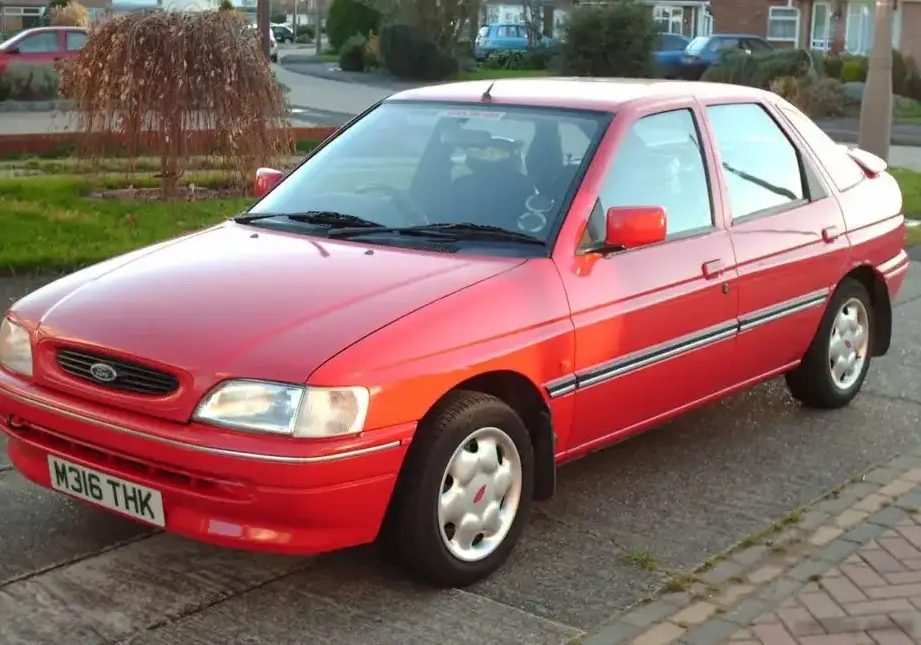
The Ford Escort VI Hatch, produced between 1993 and 1995, represented a significant evolution of Ford’s popular compact car. The 1.8 i 16V variant, generating 105 horsepower, occupied a middle ground within the Escort VI lineup, offering a balance between performance and affordability. Built on the GAL platform, this generation of Escort aimed to modernize the model with improved styling, safety features, and engine options, catering to the European market’s demand for practical and reliable transportation. This specific engine and trim level was positioned as a step up from the base models, appealing to buyers seeking a more spirited driving experience without the higher cost of the performance-oriented versions.
Technical Specifications
| Brand | Ford |
| Model | Escort |
| Generation | Escort VI Hatch (GAL) |
| Type (Engine) | 1.8 i 16V (105 Hp) |
| Start of production | 1993 |
| End of production | 1995 |
| Powertrain Architecture | Internal Combustion engine |
| Body type | Hatchback |
| Seats | 5 |
| Doors | 3/5 |
| Fuel consumption (urban) | 10.4 l/100 km (22.6 US mpg, 27.2 UK mpg, 9.6 km/l) |
| Fuel consumption (extra urban) | 6 l/100 km (39.2 US mpg, 47.1 UK mpg, 16.7 km/l) |
| Fuel consumption (combined) | 7.9 l/100 km (29.8 US mpg, 35.8 UK mpg, 12.7 km/l) |
| Fuel Type | Petrol (Gasoline) |
| Acceleration 0 – 100 km/h | 10.7 sec |
| Acceleration 0 – 62 mph | 10.7 sec |
| Acceleration 0 – 60 mph | 10.2 sec |
| Maximum speed | 187 km/h (116.2 mph) |
| Weight-to-power ratio | 10.3 kg/Hp, 96.8 Hp/tonne |
| Weight-to-torque ratio | 7.1 kg/Nm, 141 Nm/tonne |
| Power | 105 Hp @ 5500 rpm |
| Power per litre | 58.5 Hp/l |
| Torque | 153 Nm @ 4000 rpm (112.85 lb.-ft. @ 4000 rpm) |
| Engine layout | Front, Transverse |
| Engine Model/Code | RDA |
| Engine displacement | 1796 cm3 (109.6 cu. in.) |
| Number of cylinders | 4 |
| Engine configuration | Inline |
| Cylinder Bore | 80.6 mm (3.17 in.) |
| Piston Stroke | 88 mm (3.46 in.) |
| Compression ratio | 10:1 |
| Number of valves per cylinder | 4 |
| Fuel injection system | Multi-port manifold injection |
| Engine aspiration | Naturally aspirated engine |
| Valvetrain | DOHC |
| Engine oil capacity | 4.25 l (4.49 US qt | 3.74 UK qt) |
| Coolant | 7 l (7.4 US qt | 6.16 UK qt) |
| Kerb Weight | 1085 kg (2392.02 lbs.) |
| Max. weight | 1600 kg (3527.4 lbs.) |
| Max load | 515 kg (1135.38 lbs.) |
| Trunk (boot) space – minimum | 380 l (13.42 cu. ft.) |
| Trunk (boot) space – maximum | 735 l (25.96 cu. ft.) |
| Fuel tank capacity | 55 l (14.53 US gal | 12.1 UK gal) |
| Length | 4104 mm (161.57 in.) |
| Width | 1696 mm (66.77 in.) |
| Height | 1397 mm (55 in.) |
| Wheelbase | 2525 mm (99.41 in.) |
| Front track | 1440 mm (56.69 in.) |
| Rear (Back) track | 1455 mm (57.28 in.) |
| Drivetrain Architecture | The Internal combustion engine (ICE) drives the front wheels of the vehicle. |
| Drive wheel | Front wheel drive |
| Number of gears and type of gearbox | 5 gears, manual transmission |
| Front suspension | Wishbone |
| Rear suspension | Coil spring |
| Front brakes | Ventilated discs |
| Rear brakes | Drum |
| Assisting systems | ABS (Anti-lock braking system) |
| Steering type | Steering rack and pinion |
| Power steering | Hydraulic Steering |
| Tires size | 175/70 R13 |
Powertrain & Engine Architecture
The heart of the Escort VI 1.8 i 16V is the Ford RDA engine, a 1.8-liter inline-four cylinder powerplant. This engine utilized a multi-port fuel injection system, delivering fuel directly to each intake port for improved efficiency and responsiveness. The ‘16V’ designation indicates a dual overhead camshaft (DOHC) valvetrain, featuring four valves per cylinder. This configuration enhanced the engine’s breathing capabilities, contributing to its increased power output compared to earlier Escort models. The RDA engine was known for its relative simplicity and durability, making it a reliable choice for everyday driving. The five-speed manual transmission was the standard offering, providing drivers with precise control over the engine’s power band. The transmission’s gear ratios were tuned for a balance of acceleration and fuel economy, although some reviewers noted that the shift action could feel slightly notchy.
Driving Characteristics
The 1.8 i 16V Escort offered a noticeable step up in performance compared to the lower-displacement engines available in the range. With 105 horsepower, it provided adequate acceleration for most driving situations, achieving 0-60 mph in around 10.2 seconds. While not a sports car, the 1.8L engine delivered a reasonably engaging driving experience, particularly when revved towards its 5500 rpm power peak. Compared to the more powerful versions of the Escort VI, such as the XR3i, the 1.8 i 16V prioritized fuel efficiency and affordability. The manual transmission allowed for good driver involvement, but the gear ratios weren’t optimized for outright speed. The suspension provided a comfortable ride, but body roll was noticeable during cornering. Overall, the driving experience was practical and enjoyable, making it a suitable choice for daily commuting and longer journeys.
Equipment & Trim Levels
The 1.8 i 16V trim typically included features such as power steering, central locking, and an upgraded interior trim compared to the base models. Interior upholstery was usually cloth, with options for different color schemes. Depending on the market and optional packages, features like electric windows, a sunroof, and an upgraded audio system were available. The dashboard layout was functional and straightforward, with clearly labeled controls. Safety features included an anti-lock braking system (ABS) as standard equipment, a significant improvement over earlier Escort models. The overall interior ambiance was practical and durable, reflecting the Escort’s focus on providing reliable transportation.
Chassis & Braking
The Escort VI 1.8 i 16V utilized a front-wheel-drive chassis with independent wishbone suspension at the front and a coil spring rear suspension. This setup provided a good balance of ride comfort and handling. The front brakes were ventilated discs, offering good stopping power, while the rear brakes were drums. The ABS system helped to prevent wheel lockup during hard braking, enhancing safety. The steering was a rack and pinion system with hydraulic power assistance, providing precise and responsive steering feel. The tires were typically 175/70 R13, offering a good compromise between grip and fuel economy.
Market Reception & Comparison
The Ford Escort VI 1.8 i 16V was generally well-received by automotive critics as a practical and affordable family car. It offered a good balance of performance, fuel economy, and features. Compared to the lower-powered Escort models, the 1.8 i 16V provided a more enjoyable driving experience. However, it didn’t offer the same level of performance as the XR3i or other sporty variants. Fuel economy was respectable for its time, averaging around 29.8 US mpg in combined driving. Reliability was generally good, although some owners reported minor issues with the fuel injection system and electrical components. In terms of competition, the Escort VI 1.8 i 16V faced rivals such as the Volkswagen Golf, Opel Astra, and Peugeot 306.
Legacy
The Ford Escort VI 1.8 i 16V remains a popular choice among classic car enthusiasts and budget-conscious buyers. The RDA engine is known for its durability and relatively simple maintenance requirements. Parts availability is generally good, making it easier to keep these cars on the road. While not a particularly rare or valuable model, well-maintained examples of the 1.8 i 16V Escort are increasingly sought after by collectors and those looking for a nostalgic driving experience. The Escort VI, in general, is remembered as a solid and reliable family car that played a significant role in the European automotive landscape of the 1990s.