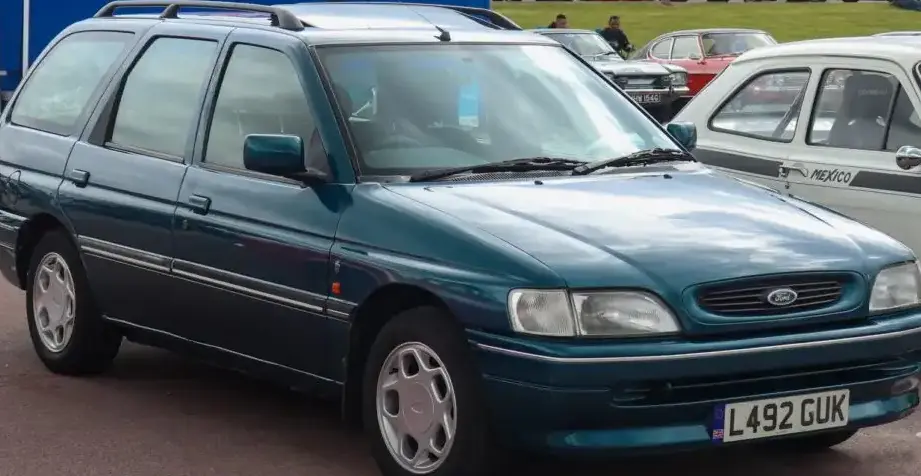
The Ford Escort VI Turnier 1.4, produced between 1992 and 1995, represents a practical and economical variant within the sixth generation (GAL) of the popular Ford Escort line. Positioned as an entry-level offering in the Turnier (estate/wagon) body style, this model aimed to provide affordable family transport with a focus on fuel efficiency and usability. It was a key component of Ford’s European lineup during a period of increasing competition in the compact family car segment. The 1.4-liter engine and five-speed manual transmission combination was designed to appeal to buyers prioritizing cost-effectiveness over outright performance.
Technical Specifications
| Brand | Ford |
| Model | Escort |
| Generation | Escort VI Turnier (GAL) |
| Type (Engine) | 1.4 (73 Hp) |
| Start of production | 1992 |
| End of production | 1995 |
| Powertrain Architecture | Internal Combustion engine |
| Body type | Station wagon (estate) |
| Seats | 5 |
| Doors | 5 |
| Fuel consumption (combined) | 7.9 l/100 km (29.8 US mpg, 35.8 UK mpg, 12.7 km/l) |
| Fuel Type | Petrol (Gasoline) |
| Acceleration 0 – 100 km/h | 16.1 sec |
| Acceleration 0 – 62 mph | 16.1 sec |
| Acceleration 0 – 60 mph | 15.3 sec |
| Maximum speed | 163 km/h (101.28 mph) |
| Weight-to-power ratio | 15 kg/Hp, 66.7 Hp/tonne |
| Weight-to-torque ratio | 10.3 kg/Nm, 96.8 Nm/tonne |
| Power | 73 Hp @ 5500 rpm |
| Power per litre | 52.4 Hp/l |
| Torque | 106 Nm @ 4000 rpm (78.18 lb.-ft. @ 4000 rpm) |
| Engine layout | Front, Transverse |
| Engine displacement | 1392 cm3 (84.95 cu. in.) |
| Number of cylinders | 4 |
| Engine configuration | Inline |
| Cylinder Bore | 77.2 mm (3.04 in.) |
| Piston Stroke | 74.3 mm (2.93 in.) |
| Compression ratio | 9.5:1 |
| Number of valves per cylinder | 2 |
| Fuel injection system | Single-point injection |
| Engine aspiration | Naturally aspirated engine |
| Valvetrain | OHC |
| Kerb Weight | 1095 kg (2414.06 lbs.) |
| Max. weight | 1575 kg (3472.28 lbs.) |
| Max load | 480 kg (1058.22 lbs.) |
| Trunk (boot) space – minimum | 460 l (16.24 cu. ft.) |
| Trunk (boot) space – maximum | 860 l (30.37 cu. ft.) |
| Fuel tank capacity | 55 l (14.53 US gal | 12.1 UK gal) |
| Length | 4268 mm (168.03 in.) |
| Width | 1690 mm (66.54 in.) |
| Height | 1410 mm (55.51 in.) |
| Wheelbase | 2525 mm (99.41 in.) |
| Front track | 1440 mm (56.69 in.) |
| Rear (Back) track | 1462 mm (57.56 in.) |
| Drivetrain Architecture | The Internal combustion engine (ICE) drives the front wheels of the vehicle. |
| Drive wheel | Front wheel drive |
| Number of gears and type of gearbox | 5 gears, manual transmission |
| Front suspension | Wishbone |
| Rear suspension | Coil spring |
| Front brakes | Ventilated discs |
| Rear brakes | Drum |
| Assisting systems | ABS (Anti-lock braking system) |
| Steering type | Steering rack and pinion |
| Power steering | Hydraulic Steering |
| Tires size | 175/70 R13 |
Powertrain & Engine Architecture
The heart of the Escort VI Turnier 1.4 is the Ford CVH (Compound Valve Hemispherical) engine, specifically the 1392cc variant. This engine, designated with various codes depending on the market, utilizes a single-point fuel injection system. This system, while simpler and less efficient than multi-point injection, contributed to the vehicle’s affordability. The CVH engine is an inline-four cylinder configuration with two valves per cylinder operated by an overhead camshaft (OHC). The 9.5:1 compression ratio was a typical value for naturally aspirated gasoline engines of the era. The five-speed manual transmission was the standard offering, providing a reasonable spread of gears for both urban driving and highway cruising. The transmission was chosen for its durability and cost-effectiveness, rather than sporting performance.
Driving Characteristics
The 1.4-liter engine in the Escort VI Turnier delivered modest performance. With 73 horsepower, acceleration was leisurely, taking approximately 16 seconds to reach 60 mph. The focus was on providing adequate power for everyday driving rather than spirited acceleration. The five-speed manual transmission allowed drivers to keep the engine in its optimal power band, but the lack of significant torque (106 Nm) meant frequent downshifts were necessary when encountering hills or overtaking. Compared to the higher-output 1.6-liter or even the diesel variants, the 1.4 felt noticeably slower. However, its lighter weight and simpler mechanicals contributed to a more nimble feel in city driving.
Equipment & Trim Levels
The 1.4-liter Escort VI Turnier typically came with a basic level of equipment. Standard features included power steering, a basic stereo system, and cloth upholstery. The interior was functional and durable, prioritizing practicality over luxury. Options available included upgraded stereo systems, electric front windows, and a sunroof. Trim levels were relatively limited, with the 1.4 representing the entry point into the Turnier range. The dashboard layout was straightforward, with clearly marked controls and a simple instrument cluster.
Chassis & Braking
The Escort VI Turnier featured a front-wheel-drive layout with independent wishbone suspension at the front and a coil spring rear suspension. This setup provided a reasonable balance between ride comfort and handling. The front brakes were ventilated discs, offering adequate stopping power, while the rear brakes were drums, a cost-saving measure common in this class of vehicle. ABS (Anti-lock Braking System) was often included as standard equipment, enhancing safety. The steering was rack and pinion, providing precise and responsive control.
Market Reception & Comparison
The Escort VI Turnier 1.4 was generally well-received as a practical and affordable family car. Critics praised its fuel efficiency and spacious interior, but noted its lack of outright performance. Compared to the more powerful 1.6-liter and diesel variants, the 1.4 offered a lower purchase price but at the expense of performance. The 1.6-liter provided a noticeable improvement in acceleration and overall driving experience, while the diesel models offered superior fuel economy. However, the 1.4 remained a popular choice for buyers prioritizing value and practicality.
Legacy
The Ford Escort VI Turnier 1.4, while not a performance icon, remains a reliable and affordable classic car. The CVH engine, while not known for its sophistication, is relatively durable and easy to maintain. Parts availability is generally good, making it a viable option for those seeking a classic estate car. In the used car market, these models are typically found at very affordable prices, making them attractive to first-time car owners or those seeking a practical and economical vehicle. The simplicity of the design and the availability of parts contribute to its continued appeal as a dependable and cost-effective mode of transport.