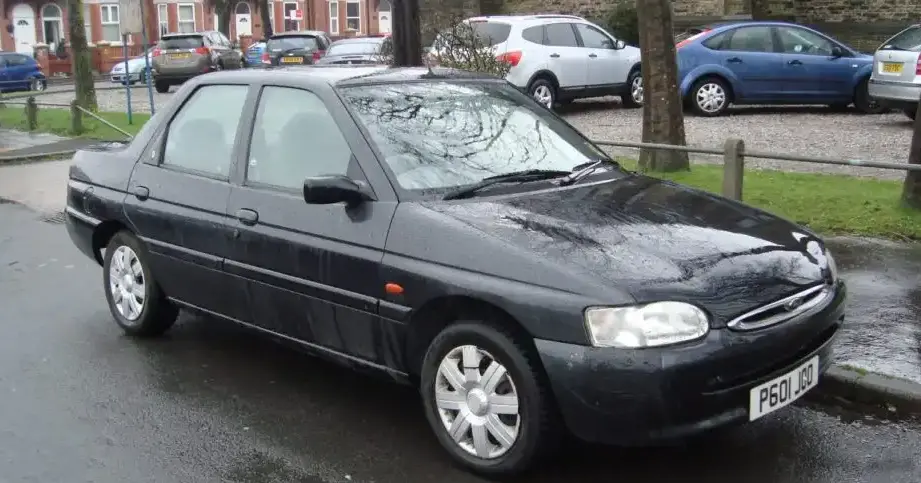
The Ford Escort VII, produced between 1995 and 1998, represented a significant evolution of Ford’s long-running Escort line. Built on the GAL, AAL, and ABL platform codes, this generation aimed to modernize the compact offering with improved styling, safety features, and engine options. The 1.8 i 16V variant, equipped with a 1796cc engine producing 115 horsepower, occupied a mid-range position within the Escort VII lineup, offering a balance between performance and affordability. It was positioned above the base 1.3 and 1.6 liter models, but below the more potent 2.0 liter versions.
Technical Specifications
| Brand | Ford |
| Model | Escort |
| Generation | Escort VII (GAL, AAL, ABL) |
| Type (Engine) | 1.8 i 16V (115 Hp) |
| Start of production | 1995 |
| End of production | 1998 |
| Powertrain Architecture | Internal Combustion engine |
| Body type | Sedan |
| Seats | 5 |
| Doors | 4 |
| Fuel consumption (combined) | 7.3 l/100 km |
| Fuel consumption (US mpg) | 32.2 |
| Fuel consumption (UK mpg) | 38.7 |
| Fuel consumption (km/l) | 13.7 |
| Fuel Type | Petrol (Gasoline) |
| Acceleration 0 – 100 km/h | 10 sec |
| Acceleration 0 – 62 mph | 10 sec |
| Acceleration 0 – 60 mph | 9.5 sec |
| Maximum speed | 196 km/h (121.79 mph) |
| Weight-to-power ratio | 9.7 kg/Hp |
| Weight-to-torque ratio | 7 kg/Nm |
| Power | 115 Hp @ 5750 rpm |
| Power per litre | 64 Hp/l |
| Torque | 160 Nm @ 4500 rpm (118.01 lb.-ft. @ 4500 rpm) |
| Engine layout | Front, Transverse |
| Engine Model/Code | RKC |
| Engine displacement | 1796 cm3 (109.6 cu. in.) |
| Number of cylinders | 4 |
| Engine configuration | Inline |
| Cylinder Bore | 80.6 mm (3.17 in.) |
| Piston Stroke | 88 mm (3.46 in.) |
| Compression ratio | 9.8:1 |
| Number of valves per cylinder | 4 |
| Fuel injection system | Multi-port manifold injection |
| Engine aspiration | Naturally aspirated |
| Valvetrain | DOHC |
| Engine oil capacity | 4.25 l (4.49 US qt | 3.74 UK qt) |
| Coolant capacity | 7 l (7.4 US qt | 6.16 UK qt) |
| Kerb Weight | 1115 kg (2458.15 lbs.) |
| Max. weight | 1650 kg (3637.63 lbs.) |
| Max load | 535 kg (1179.47 lbs.) |
| Trunk (boot) space – minimum | 490 l (17.3 cu. ft.) |
| Fuel tank capacity | 55 l (14.53 US gal | 12.1 UK gal) |
| Length | 4293 mm (169.02 in.) |
| Width | 1700 mm (66.93 in.) |
| Height | 1394 mm (54.88 in.) |
| Wheelbase | 2525 mm (99.41 in.) |
| Front track | 1440 mm (56.69 in.) |
| Rear track | 1455 mm (57.28 in.) |
| Drivetrain Architecture | Front wheel drive |
| Number of gears | 5 |
| Gearbox type | Manual transmission |
| Front suspension | Wishbone |
| Rear suspension | Coil spring |
| Front brakes | Ventilated discs |
| Rear brakes | Drum |
| Assisting systems | ABS (Anti-lock braking system) |
| Steering type | Steering rack and pinion |
| Power steering | Hydraulic |
| Tires size | 175/65 R14 |
Powertrain & Engine Architecture
The heart of the Escort VII 1.8 i 16V was the RKC engine, a 1.8-liter inline-four cylinder powerplant. This engine utilized a multi-port fuel injection system, delivering fuel directly to each intake port for improved efficiency and responsiveness. The 16-valve dual overhead camshaft (DOHC) configuration further enhanced breathing and contributed to the engine’s respectable power output. The engine’s design prioritized reliability and ease of maintenance, making it a popular choice for everyday driving. The five-speed manual transmission was the standard offering, providing drivers with precise control over the engine’s power band. The transmission’s gear ratios were tuned for a balance of acceleration and fuel economy, making it suitable for both city and highway driving.
Driving Characteristics
The 1.8L engine provided a noticeable step up in performance compared to the lower-displacement Escort models. While not a sports car, the 115 horsepower and 160 Nm of torque offered adequate acceleration for merging onto highways and overtaking slower traffic. The five-speed manual transmission allowed drivers to keep the engine in its optimal power range, resulting in a more engaging driving experience. Compared to the 2.0L versions, the 1.8L felt less strained at higher speeds, but lacked the ultimate punch for spirited driving. The suspension provided a comfortable ride, absorbing bumps and imperfections in the road effectively. However, it wasn’t particularly sporty, with a noticeable degree of body roll during cornering.
Equipment & Trim Levels
The 1.8 i 16V trim typically included features such as power steering, central locking, and electric front windows. Interior upholstery was generally cloth, with a functional and durable design. Optional extras included air conditioning, a sunroof, and upgraded audio systems. The dashboard layout was straightforward and easy to use, with clearly labeled controls. Higher trim levels, often denoted by specific packages, added features like alloy wheels, fog lights, and more premium interior materials.
Chassis & Braking
The Escort VII utilized a front-wheel-drive layout with independent wishbone suspension at the front and a coil spring rear suspension. This configuration provided a good balance of ride comfort and handling. The braking system consisted of ventilated discs at the front and drum brakes at the rear. Anti-lock Braking System (ABS) was standard, enhancing safety by preventing wheel lockup during hard braking. The chassis was relatively lightweight, contributing to the car’s agility and fuel efficiency. Stabilizer bars were included to reduce body roll during cornering, although they were typically smaller in diameter than those found on the higher-performance models.
Market Reception & Comparison
The Escort VII 1.8 i 16V was generally well-received by automotive critics as a practical and reliable family car. It offered a good compromise between performance, fuel economy, and price. Compared to the 1.6L models, the 1.8L provided a noticeable improvement in acceleration and overall driving experience. However, the 2.0L versions offered significantly more power, appealing to drivers who prioritized performance. Fuel economy was respectable for its class, averaging around 32.2 US mpg in combined driving conditions. Reliability was generally good, with the RKC engine proving to be durable and long-lasting.
Legacy
The Ford Escort VII 1.8 i 16V has maintained a reasonable reputation for reliability in the used car market. The RKC engine is known for its durability, and parts availability remains relatively good. While not a collector’s item, well-maintained examples are still sought after by enthusiasts and those looking for an affordable and practical classic car. The Escort VII represented a significant step forward for Ford in terms of design, safety, and technology, and the 1.8 i 16V variant offered a compelling combination of features and performance for its time.