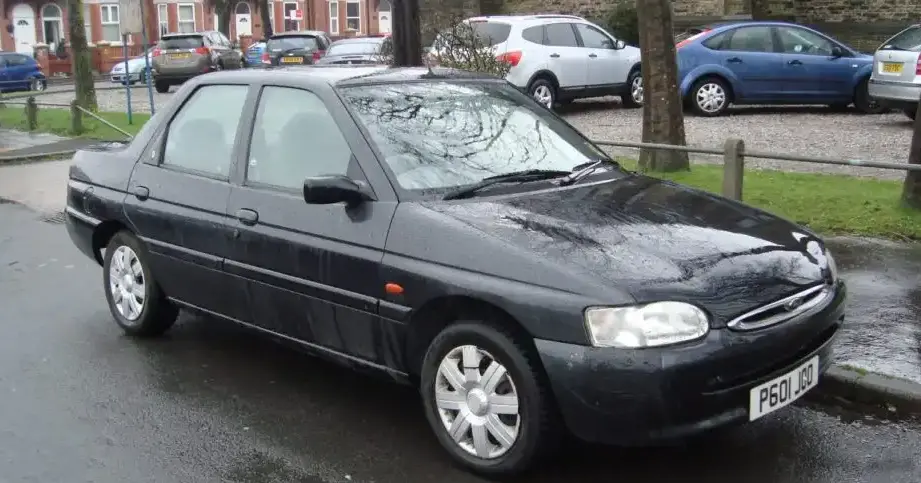
The Ford Escort VII, produced between 1995 and 1998, represented a significant evolution of Ford’s long-running Escort line. Within the seventh generation (chassis codes GAL, AAL, and ABL), the 1.8 TD variant, powered by a 90 horsepower turbocharged diesel engine, occupied a unique position. It was aimed at buyers seeking fuel efficiency and reasonable performance for long-distance driving, particularly in European markets where diesel engines were favored. This model served as a practical and economical option within the Escort VII range, slotting below the more powerful gasoline variants and above the base-level diesel offerings.
Technical Specifications
| Brand | Ford |
| Model | Escort |
| Generation | Escort VII (GAL, AAL, ABL) |
| Type (Engine) | 1.8 TD (90 Hp) |
| Start of production | 1995 |
| End of production | 1998 |
| Powertrain Architecture | Internal Combustion engine |
| Body type | Sedan |
| Seats | 5 |
| Doors | 4 |
| Fuel consumption (combined) | 6.3 l/100 km (37.3 US mpg, 44.8 UK mpg, 15.9 km/l) |
| Fuel Type | Diesel |
| Acceleration 0 – 100 km/h | 11.5 sec |
| Acceleration 0 – 62 mph | 11.5 sec |
| Acceleration 0 – 60 mph | 10.9 sec |
| Maximum speed | 172 km/h (106.88 mph) |
| Weight-to-power ratio | 12.8 kg/Hp, 77.9 Hp/tonne |
| Weight-to-torque ratio | 6.4 kg/Nm, 155.8 Nm/tonne |
| Power | 90 Hp @ 4500 rpm |
| Power per litre | 51.3 Hp/l |
| Torque | 180 Nm @ 2000 rpm (132.76 lb.-ft. @ 2000 rpm) |
| Engine layout | Front, Transverse |
| Engine Model/Code | RFD, RFK, RFS |
| Engine displacement | 1753 cm3 (106.97 cu. in.) |
| Number of cylinders | 4 |
| Engine configuration | Inline |
| Cylinder Bore | 82.5 mm (3.25 in.) |
| Piston Stroke | 82 mm (3.23 in.) |
| Compression ratio | 21.5:1 |
| Number of valves per cylinder | 2 |
| Fuel injection system | Precombustion chamber injection |
| Engine aspiration | Turbocharger |
| Valvetrain | OHC |
| Engine oil capacity | 5.1 l (5.39 US qt | 4.49 UK qt) |
| Coolant | 9.3 l (9.83 US qt | 8.18 UK qt) |
| Kerb Weight | 1155 kg (2546.34 lbs.) |
| Max. weight | 1700 kg (3747.86 lbs.) |
| Max load | 545 kg (1201.52 lbs.) |
| Trunk (boot) space – minimum | 490 l (17.3 cu. ft.) |
| Fuel tank capacity | 55 l (14.53 US gal | 12.1 UK gal) |
| Length | 4293 mm (169.02 in.) |
| Width | 1700 mm (66.93 in.) |
| Height | 1394 mm (54.88 in.) |
| Wheelbase | 2525 mm (99.41 in.) |
| Front track | 1440 mm (56.69 in.) |
| Rear (Back) track | 1462 mm (57.56 in.) |
| Drivetrain Architecture | The Internal combustion engine (ICE) drives the front wheels of the vehicle. |
| Drive wheel | Front wheel drive |
| Number of gears and type of gearbox | 5 gears, manual transmission |
| Front suspension | Wishbone |
| Rear suspension | Coil spring |
| Front brakes | Ventilated discs |
| Rear brakes | Drum |
| Assisting systems | ABS (Anti-lock braking system) |
| Steering type | Steering rack and pinion |
| Power steering | Hydraulic Steering |
| Tires size | 175/70 R13 T |
Powertrain & Engine Architecture
The heart of the Escort VII 1.8 TD was the RFD (and related RFK, RFS) engine, a 1.8-liter inline-four cylinder diesel. This engine utilized precombustion chamber injection, a system common in European diesels of the era. This system involved injecting fuel into a precombustion chamber connected to the main cylinder, promoting more complete combustion and reducing noise. The engine was turbocharged, boosting power output to 90 horsepower at 4500 rpm and 180 Nm (132.76 lb-ft) of torque at 2000 rpm. The turbocharger significantly improved responsiveness and overall performance compared to naturally aspirated diesel engines. The engine featured an overhead camshaft (OHC) valvetrain with two valves per cylinder. The manual transmission offered was a standard five-speed unit, chosen for its durability and efficiency. While an automatic transmission was available on some Escort VII models, it was not typically paired with the 1.8 TD engine.
Driving Characteristics
The 1.8 TD Escort offered a blend of fuel economy and usable performance. Acceleration to 60 mph took around 10.9 seconds, and it had a top speed of approximately 107 mph. While not a sports car, the turbocharger provided a noticeable boost in power, making overtaking and highway cruising relatively effortless. The five-speed manual transmission allowed drivers to keep the engine in its optimal power band. Compared to the gasoline-powered Escorts, the 1.8 TD offered significantly better fuel economy, making it a popular choice for high-mileage drivers. However, it lacked the outright acceleration and responsiveness of the higher-horsepower gasoline engines. The diesel engine also produced more engine noise and vibration than its gasoline counterparts.
Equipment & Trim Levels
The 1.8 TD typically came with a moderate level of equipment. Standard features generally included power steering, central locking, and an adjustable steering column. Interior upholstery was typically cloth, and the dashboard featured a functional, if somewhat basic, design. Optional extras included air conditioning, electric windows, and a sunroof. The trim level of the 1.8 TD often fell in the mid-range of the Escort VII lineup, offering a good balance of features and affordability. It was positioned above the base-level diesel models and below the more luxurious and powerful gasoline variants.
Chassis & Braking
The Escort VII 1.8 TD utilized a front-wheel-drive layout with independent wishbone suspension at the front and a coil spring rear suspension. This setup provided a reasonable level of ride comfort and handling. The front brakes were ventilated discs, offering good stopping power, while the rear brakes were drums. An anti-lock braking system (ABS) was often included as standard equipment, enhancing safety. The chassis was designed to accommodate the added weight of the diesel engine and its components. Stabilizer bars were used to reduce body roll during cornering.
Market Reception & Comparison
The Escort VII 1.8 TD was generally well-received by critics and buyers alike, particularly in Europe. It was praised for its fuel efficiency, reliability, and reasonable performance. Compared to other trims in the Escort VII lineup, the 1.8 TD offered a compelling value proposition for drivers prioritizing economy and practicality. While the gasoline-powered models offered more excitement, the diesel variant appealed to those covering long distances or seeking lower running costs. Fuel economy was a key selling point, and the 1.8 TD consistently outperformed its gasoline counterparts in this regard.
Legacy
The Ford Escort VII 1.8 TD powertrain has proven to be remarkably durable over the long term. Many examples are still on the road today, testament to the engine’s robust construction and relatively simple design. While maintenance costs can increase with age, the engine is generally considered reliable and relatively easy to repair. In the used car market, the 1.8 TD Escort remains a popular choice for budget-conscious buyers seeking a practical and economical vehicle. Its reputation for fuel efficiency and durability continues to attract a loyal following.