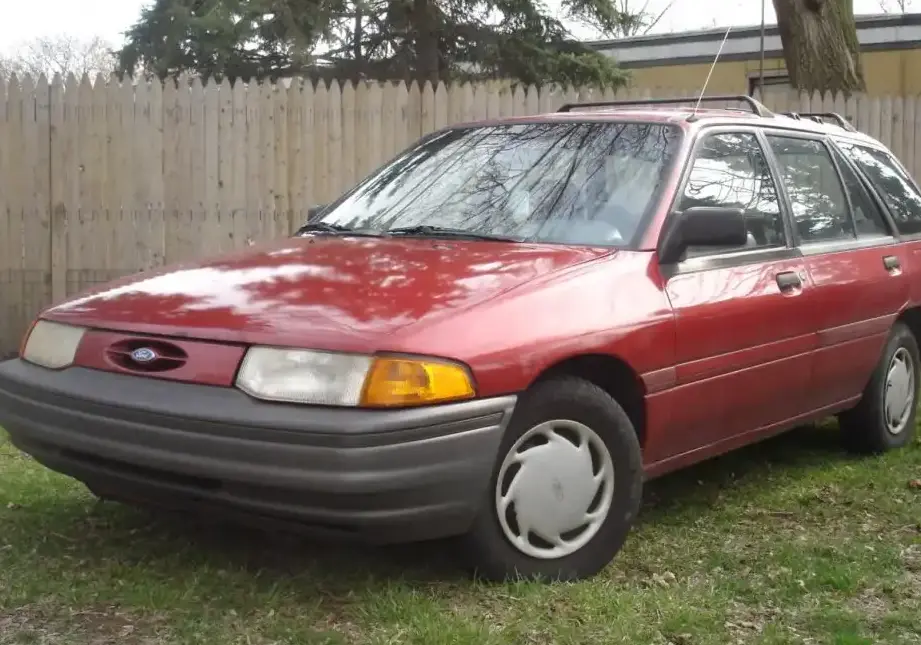
The Ford Escort Wagon II, produced for the US market between 1991 and 1996, represented a significant update to Ford’s compact offering. Positioned as a practical and affordable family vehicle, the Escort Wagon II aimed to provide a spacious and versatile alternative to burgeoning sport utility vehicles. Within the Escort Wagon II lineup, the 1.9i variant with an automatic transmission occupied a middle ground, offering a balance between fuel economy, ease of use, and acceptable performance. It served as a step up from the base model, appealing to buyers who prioritized convenience over outright speed or manual transmission engagement. This generation of Escort was based on the global Ford Escort platform, but with modifications tailored to American tastes and regulations.
Technical Specifications
| Brand | Ford |
| Model | Escort |
| Generation | Escort Wagon II (USA) |
| Type (Engine) | 1.9i (88 Hp) Automatic |
| Start of production | 1991 |
| End of production | 1996 |
| Powertrain Architecture | Internal Combustion engine |
| Body type | Station wagon (estate) |
| Seats | 5 |
| Doors | 5 |
| Fuel Type | Petrol (Gasoline) |
| Maximum speed | 165 km/h (102.53 mph) |
| Weight-to-power ratio | 12.5 kg/Hp, 80.2 Hp/tonne |
| Weight-to-torque ratio | 7.5 kg/Nm, 133.1 Nm/tonne |
| Power | 88 Hp @ 4400 rpm |
| Power per litre | 47.3 Hp/l |
| Torque | 146 Nm @ 3800 rpm (107.68 lb.-ft. @ 3800 rpm) |
| Engine layout | Front, Transverse |
| Engine displacement | 1859 cm3 (113.44 cu. in.) |
| Number of cylinders | 4 |
| Engine configuration | Inline |
| Cylinder Bore | 82 mm (3.23 in.) |
| Piston Stroke | 88 mm (3.46 in.) |
| Compression ratio | 9:1 |
| Number of valves per cylinder | 2 |
| Fuel injection system | Multi-port manifold injection |
| Engine aspiration | Naturally aspirated engine |
| Valvetrain | OHC |
| Engine oil capacity | 3.8 l (4.02 US qt | 3.34 UK qt) |
| Coolant | 6 l (6.34 US qt | 5.28 UK qt) |
| Kerb Weight | 1097 kg (2418.47 lbs.) |
| Fuel tank capacity | 50 l (13.21 US gal | 11 UK gal) |
| Length | 4351 mm (171.3 in.) |
| Width | 1694 mm (66.69 in.) |
| Height | 1361 mm (53.58 in.) |
| Wheelbase | 2500 mm (98.43 in.) |
| Front track | 1435 mm (56.5 in.) |
| Rear (Back) track | 1435 mm (56.5 in.) |
| Drivetrain Architecture | The Internal combustion engine (ICE) drives the front wheels of the vehicle. |
| Drive wheel | Front wheel drive |
| Number of gears and type of gearbox | 4 gears, automatic transmission |
| Front suspension | Spring Strut |
| Rear suspension | Spring Strut |
| Front brakes | Ventilated discs |
| Rear brakes | Drum |
| Assisting systems | ABS (Anti-lock braking system) |
| Steering type | Steering rack and pinion |
| Power steering | Hydraulic Steering |
| Tires size | 175/65 R14 |
| Wheel rims size | 14 |
Powertrain & Engine Architecture
The heart of the 1.9i Escort Wagon was the Ford 1.9-liter inline-four cylinder engine. While not a particularly powerful unit, it was known for its relative durability and ease of maintenance. The engine code varied, but commonly seen were variants related to the Ford Zetec engine family. This engine utilized a multi-port fuel injection system, which improved fuel efficiency and reduced emissions compared to earlier carburetor-based systems. The overhead camshaft (OHC) valvetrain, with two valves per cylinder, was a standard design for the era. The automatic transmission was typically a four-speed unit, designed to provide smooth and convenient shifting. It wasn’t known for its sporty responsiveness, but it suited the intended purpose of the vehicle – comfortable and practical transportation.
Driving Characteristics
The 1.9i automatic Escort Wagon offered a comfortable, if uninspiring, driving experience. With 88 horsepower, acceleration was adequate for everyday driving, but passing maneuvers required planning. The four-speed automatic transmission featured relatively conservative gear ratios, prioritizing fuel economy over performance. Compared to the five-speed manual transmission available on other Escort models, the automatic version felt noticeably slower. The automatic’s shift points were programmed for efficiency, often holding gears longer to maximize fuel mileage. Handling was typical for a front-wheel-drive wagon of the time – predictable and safe, but not particularly engaging. The suspension was tuned for comfort, absorbing bumps reasonably well, but body roll was noticeable in corners.
Equipment & Trim Levels
The 1.9i automatic trim level generally included features such as air conditioning, power steering, and an AM/FM radio. Interior upholstery was typically cloth, with a durable and practical design. Optional extras included a cassette player, upgraded sound systems, and power windows/locks. The dashboard layout was functional and straightforward, with easy-to-read gauges. Higher trim levels, such as the LX, offered additional features like alloy wheels, upgraded interior trim, and a sunroof.
Chassis & Braking
The Escort Wagon II utilized a relatively simple chassis design, with a MacPherson strut front suspension and a twist-beam rear suspension. Front brakes were ventilated discs, providing adequate stopping power, while rear brakes were drums. The inclusion of ABS (Anti-lock Braking System) was a notable safety feature for the time, helping to prevent wheel lockup during hard braking. Steering was rack-and-pinion, assisted by hydraulic power steering for ease of maneuverability. The suspension was tuned for a comfortable ride, with stabilizer bars helping to reduce body roll.
Market Reception & Comparison
The 1.9i automatic Escort Wagon was generally well-received by consumers looking for a practical and affordable family vehicle. Critics noted its spacious interior, good fuel economy, and comfortable ride. However, the engine’s lack of power and the automatic transmission’s sluggishness were common criticisms. Compared to the 1.9-liter manual transmission version, the automatic offered less performance but greater convenience. Against competitors like the Dodge Caravan or Chevrolet Cavalier Wagon, the Escort Wagon offered a more European-influenced driving experience and a reputation for reliability. Fuel economy was competitive for the segment, averaging around 25-30 mpg in mixed driving conditions.
Legacy
The Ford Escort Wagon II, particularly the 1.9i automatic variant, has developed a reputation as a reliable and affordable used car. The engine, while not high-performance, is known for its durability and relatively low maintenance costs. Parts availability remains good, making repairs relatively straightforward. Today, these wagons are often sought after by enthusiasts looking for a practical and nostalgic vehicle. While not a collector’s item, well-maintained examples command reasonable prices in the used car market. The 1.9i automatic Escort Wagon represents a solid and dependable choice for those seeking a classic American station wagon.