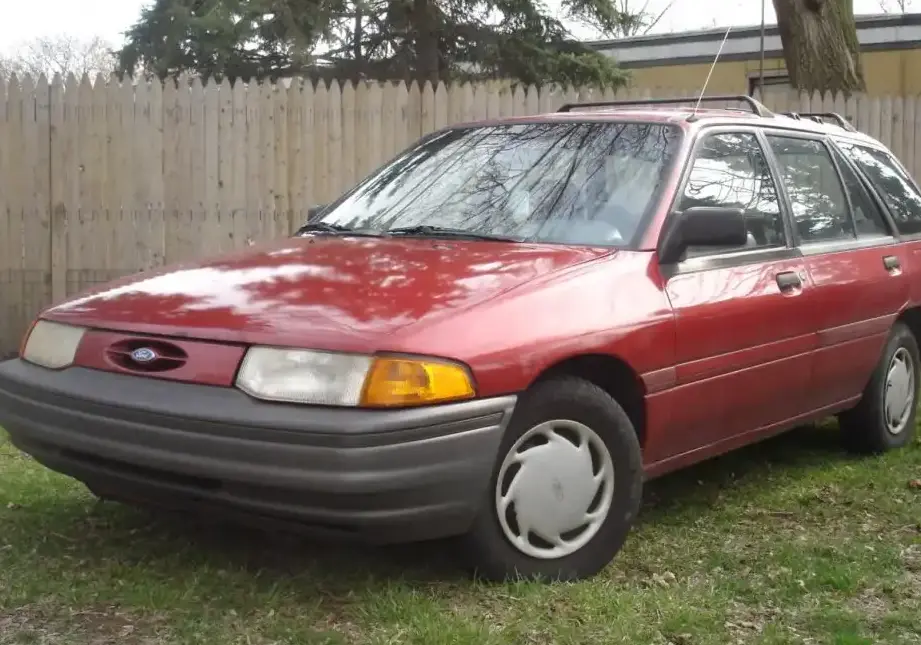
The Ford Escort Wagon II, produced for the US market between 1991 and 1996, represented a significant update to Ford’s compact offering. Positioned as a practical and affordable family vehicle, the Escort Wagon aimed to compete with similar offerings from Japanese manufacturers. Within the second generation (1991-1996) lineup, the 2.0i LX trim, powered by a 2.0-liter inline-four engine producing 110 horsepower, occupied a mid-range position, offering a balance between performance and value. It sat above the base models and below the more performance-oriented trims, appealing to buyers seeking a comfortable and capable wagon for everyday use.
Technical Specifications
| Brand | Ford |
| Model | Escort |
| Generation | Escort Wagon II (USA) |
| Type | 2.0i LX (110 Hp) |
| Start of production | 1991 |
| End of production | 1996 |
| Powertrain Architecture | Internal Combustion engine |
| Body type | Station wagon (estate) |
| Seats | 5 |
| Doors | 5 |
| Fuel Type | Petrol (Gasoline) |
| Weight-to-power ratio | 10.4 kg/Hp, 96 Hp/tonne |
| Weight-to-torque ratio | 6.7 kg/Nm, 148.3 Nm/tonne |
| Power | 110 Hp @ 5000 rpm |
| Power per litre | 55.4 Hp/l |
| Torque | 170 Nm @ 3750 rpm (125.39 lb.-ft. @ 3750 rpm) |
| Engine layout | Front, Transverse |
| Engine displacement | 1987 cm3 (121.25 cu. in.) |
| Number of cylinders | 4 |
| Engine configuration | Inline |
| Cylinder Bore | 84.8 mm (3.34 in.) |
| Piston Stroke | 87.9 mm (3.46 in.) |
| Compression ratio | 9.2:1 |
| Number of valves per cylinder | 2 |
| Fuel injection system | Multi-port manifold injection |
| Engine aspiration | Naturally aspirated engine |
| Valvetrain | OHC |
| Kerb Weight | 1146 kg (2526.5 lbs.) |
| Trunk (boot) space – minimum | 482 l (17.02 cu. ft.) |
| Trunk (boot) space – maximum | 1161 l (41 cu. ft.) |
| Fuel tank capacity | 48 l (12.68 US gal | 10.56 UK gal) |
| Length | 4387 mm (172.72 in.) |
| Width | 1702 mm (67.01 in.) |
| Height | 1369 mm (53.9 in.) |
| Wheelbase | 2500 mm (98.43 in.) |
| Front track | 1435 mm (56.5 in.) |
| Rear (Back) track | 1435 mm (56.5 in.) |
| Drivetrain Architecture | The Internal combustion engine (ICE) drives the front wheels of the vehicle. |
| Drive wheel | Front wheel drive |
| Number of gears and type of gearbox | 5 gears, manual transmission |
| Front suspension | Spring Strut |
| Rear suspension | Spring Strut |
| Front brakes | Ventilated discs |
| Rear brakes | Drum |
| Steering type | Steering rack and pinion |
| Power steering | Hydraulic Steering |
| Tires size | 185/65 R14 S |
Powertrain & Engine Architecture
The heart of the 2.0i LX Escort Wagon was the Ford Zetec engine, specifically the 1.998-liter (2.0L) inline-four cylinder unit. This engine, designated internally as the B4E, featured a single overhead camshaft (SOHC) design with two valves per cylinder. Multi-port fuel injection was employed, contributing to improved fuel efficiency and smoother power delivery compared to earlier carburetor-equipped models. The engine’s 9.2:1 compression ratio was a compromise between performance and the fuel quality typically available in the US market. While not a high-revving engine, the Zetec provided adequate power for everyday driving and hauling loads. The 110 horsepower peak was achieved at 5000 rpm, while the 170 Nm (125 lb-ft) of torque was readily available at 3750 rpm. The engine was transversely mounted, driving the front wheels.
Driving Characteristics
The 2.0i LX Escort Wagon offered a comfortable, if not particularly sporty, driving experience. The 5-speed manual transmission provided reasonable control over the engine’s power band. Acceleration was adequate for merging onto highways and passing slower traffic, but it wasn’t a particularly quick vehicle. The gear ratios were tuned for fuel economy and everyday usability rather than outright performance. Compared to the base model Escort Wagons with smaller engines, the 2.0i LX offered a noticeable improvement in responsiveness. However, it lacked the more spirited performance of potential higher-output variants that were available in other markets. The front-wheel-drive configuration provided predictable handling, although it wasn’t as engaging as a rear-wheel-drive vehicle.
Equipment & Trim Levels
The LX trim level included several standard features designed to enhance comfort and convenience. These typically included features like air conditioning, a basic AM/FM stereo, cloth upholstery, and power steering. Optional extras could include upgraded sound systems, power windows and locks, and a sunroof. The interior was functional and relatively spacious, with a focus on practicality. The dashboard layout was straightforward and easy to use. The wagon body style provided ample cargo space, making it well-suited for families and those needing to transport larger items. The LX trim aimed to provide a step up in refinement compared to the base models without the added cost of the more premium trims.
Chassis & Braking
The Escort Wagon II utilized a relatively simple chassis design. Front suspension consisted of MacPherson strut setup, while the rear employed a twist-beam axle with coil springs. This configuration provided a comfortable ride, but it wasn’t particularly sophisticated in terms of handling. The braking system featured ventilated discs on the front wheels and drum brakes on the rear. Power-assisted steering was standard, making it easy to maneuver in tight spaces. The tires were typically 185/65 R14 size, providing a good balance between ride comfort and handling. Stabilizer bars were included to reduce body roll during cornering, but the overall handling characteristics were geared towards comfort and stability rather than sporty performance.
Market Reception & Comparison
The Ford Escort Wagon II 2.0i LX was generally well-received by automotive critics as a practical and affordable family vehicle. It was praised for its spacious interior, comfortable ride, and reasonable fuel economy. However, some critics noted that the engine lacked the power and refinement of some of its competitors. Compared to other trims in the Escort lineup, the 2.0i LX offered a good balance between performance and value. It was more expensive than the base models, but it provided a noticeable improvement in performance and features. Fuel economy was competitive with other vehicles in its class, typically achieving around 25-30 mpg in combined driving. Reliability was generally good, although some owners reported minor issues with the fuel injection system and electrical components.
Legacy
The Ford Escort Wagon II 2.0i LX remains a relatively common sight on used car lots today. The Zetec engine, while not known for being exceptionally durable, is generally reliable if properly maintained. Parts availability is good, and repairs are relatively straightforward. The 2.0i LX trim is often considered a good value in the used car market, offering a practical and affordable option for those seeking a compact wagon. While it may not be a collector’s item, it represents a significant chapter in Ford’s history and remains a capable and dependable vehicle for everyday use. Its simple design and relatively low maintenance costs make it an attractive option for budget-conscious buyers.