
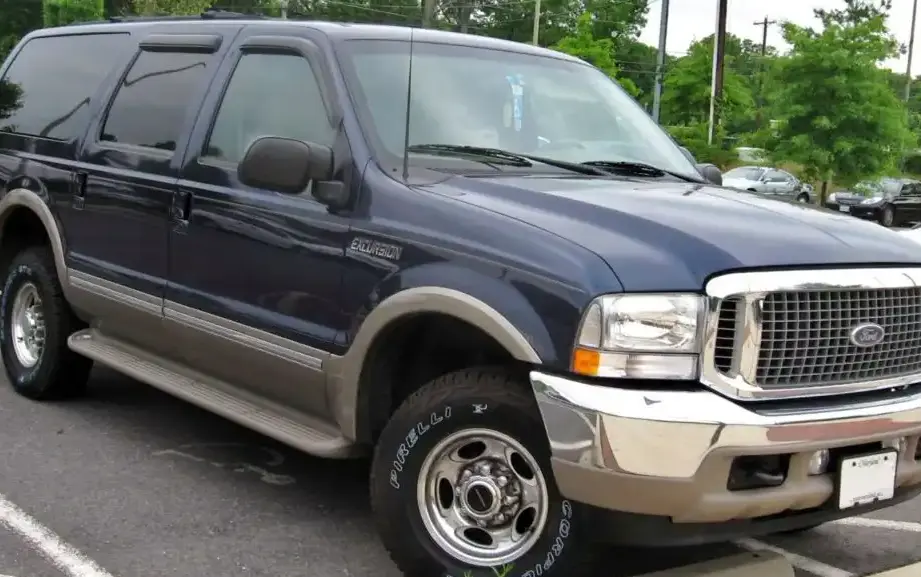
The Ford Excursion 7.3L Turbo Diesel 4WD, produced from 2000 to 2005, represented Ford’s entry into the full-size, heavy-duty SUV segment, aiming to provide a vehicle larger than the already substantial Ford Navigator. Built on a heavily modified Ford Super Duty truck chassis, the Excursion was designed to appeal to customers needing significant towing capacity, interior space, and a robust, truck-based platform. It quickly became known for its immense size and capability, though it also faced criticism for its fuel economy and maneuverability. The 7.3-liter Power Stroke diesel engine, paired with a four-speed automatic transmission and four-wheel drive, was a popular configuration, offering a balance of power and usability for demanding tasks.
Technical Specifications
| Brand | Ford |
| Model | Excursion |
| Generation | Excursion |
| Type (Engine) | 7.3 TD (253 Hp) 4WD |
| Start of production | 2000 year |
| End of production | 2005 year |
| Powertrain Architecture | Internal Combustion engine |
| Body type | SUV |
| Seats | 8-9 |
| Doors | 5 |
| Fuel Type | Diesel |
| Weight-to-power ratio | 14.2 kg/Hp, 70.4 Hp/tonne |
| Weight-to-torque ratio | 5.3 kg/Nm, 188.6 Nm/tonne |
| Power | 253 Hp @ 2700 rpm |
| Power per litre | 34.8 Hp/l |
| Torque | 678 Nm @ 1600 rpm, 500.07 lb.-ft. @ 1600 rpm |
| Engine layout | Front, Longitudinal |
| Engine displacement | 7270 cm3, 443.64 cu. in. |
| Number of cylinders | 8 |
| Engine configuration | V-engine |
| Cylinder Bore | 104.4 mm, 4.11 in. |
| Piston Stroke | 106.2 mm, 4.18 in. |
| Compression ratio | 17:1 |
| Number of valves per cylinder | 2 |
| Fuel injection system | Diesel Commonrail |
| Engine aspiration | Turbocharger |
| Valvetrain | OHC |
| Engine oil capacity | 14.2 l, 15 US qt | 12.49 UK qt |
| Coolant | 31 l, 32.76 US qt | 27.28 UK qt |
| Kerb Weight | 3595 kg, 7925.62 lbs |
| Max. weight | 4173 kg, 9199.89 lbs |
| Max load | 578 kg, 1274.27 lbs |
| Trunk (boot) space – minimum | 1359 l, 47.99 cu. ft. |
| Trunk (boot) space – maximum | 4145 l, 146.38 cu. ft. |
| Fuel tank capacity | 167 l, 44.12 US gal | 36.73 UK gal |
| Length | 5758 mm, 226.69 in. |
| Width | 2032 mm, 80 in. |
| Height | 2024 mm, 79.69 in. |
| Wheelbase | 3480 mm, 137.01 in. |
| Front track | 1737 mm, 68.39 in. |
| Rear (Back) track | 1730 mm, 68.11 in. |
| Drive wheel | All wheel drive (4×4) |
| Number of gears and type of gearbox | 4 gears, automatic transmission |
| Front suspension | Leaf spring |
| Rear suspension | Leaf spring |
| Front brakes | Ventilated discs |
| Rear brakes | Ventilated discs |
| Assisting systems | ABS (Anti-lock braking system) |
| Steering type | Worm-reduction unit |
| Power steering | Hydraulic Steering |
| Tires size | 265/75 R16 |
Powertrain & Engine Architecture
The heart of the Excursion 7.3L 4WD was the Ford Power Stroke 7.3-liter turbocharged diesel engine. This engine, designated with codes like E4OD, was a robust and relatively simple design for its time. It featured a cast iron block and head, a single overhead camshaft (OHC) design operating two valves per cylinder, and a HEUI (Hydraulic Electronic Unit Injector) fuel injection system. The HEUI system used high-pressure engine oil to actuate the fuel injectors, providing precise fuel delivery. The turbocharger, a variable geometry unit, helped to deliver strong low-end torque, crucial for towing and hauling. The four-speed automatic transmission (4R100) was chosen for its durability and ability to handle the engine’s substantial torque output. While not the most technologically advanced transmission, it proved reliable when properly maintained.
Driving Characteristics
The Excursion 7.3L Automatic offered a unique driving experience. The 253 horsepower and 678 lb-ft of torque provided ample power for most tasks, but the vehicle’s immense weight (over 7,900 pounds) meant acceleration was not brisk. The four-speed automatic transmission, while durable, had relatively wide gear ratios. This resulted in a noticeable shift between gears and didn’t allow the engine to stay in its peak power band for extended periods. Compared to the later 6.0L Power Stroke engine, the 7.3L felt less refined but arguably more reliable. Manual transmission versions of the Excursion offered quicker acceleration and better fuel economy, but the automatic was favored by many owners for its ease of use, especially when towing.
Equipment & Trim Levels
The Excursion 7.3L 4WD was available in several trim levels, including XL, XLT, and Limited. The base XL trim offered basic amenities like air conditioning, cloth upholstery, and a basic audio system. The XLT trim added features such as power windows and locks, keyless entry, and upgraded interior trim. The Limited trim was the most luxurious, featuring leather upholstery, woodgrain interior accents, a premium audio system, and automatic climate control. Common optional extras included a DVD entertainment system, heated seats, and a sunroof. All trims featured a spacious interior with seating for up to nine passengers, depending on the configuration.
Chassis & Braking
The Excursion’s chassis was based on the Ford Super Duty truck platform, utilizing a heavy-duty frame and suspension. Both front and rear suspension utilized leaf springs, designed to handle heavy loads. The 4WD system was a traditional part-time system with a manually selectable transfer case. Braking duties were handled by ventilated disc brakes on all four wheels, assisted by an Anti-lock Braking System (ABS). Due to the vehicle’s weight, braking performance was adequate but not exceptional. The large tires (typically 265/75R16) provided good traction in various conditions.
Market Reception & Comparison
The Ford Excursion received mixed reviews upon its release. Critics praised its spacious interior, impressive towing capacity, and robust construction. However, it was heavily criticized for its poor fuel economy, large size (making it difficult to maneuver in urban environments), and relatively high price. Compared to other large SUVs of the time, such as the Chevrolet Suburban and GMC Yukon XL, the Excursion offered more interior space and towing capacity but at the expense of fuel efficiency and maneuverability. The 7.3L diesel engine was generally well-regarded for its reliability, but the 6.0L Power Stroke introduced later in the Excursion’s production run faced more reliability concerns.
Legacy
The Ford Excursion 7.3L 4WD has developed a strong following among enthusiasts and those needing a heavy-duty SUV. The 7.3L Power Stroke engine is known for its durability and relative simplicity, making it a popular choice for modifications and upgrades. While fuel economy remains a concern, the Excursion’s robust construction and spacious interior continue to appeal to owners. In the used car market, well-maintained examples of the 7.3L Excursion command a premium price, reflecting their reputation for reliability and capability. The Excursion remains a unique and imposing vehicle, representing a bygone era of large, truck-based SUVs.
