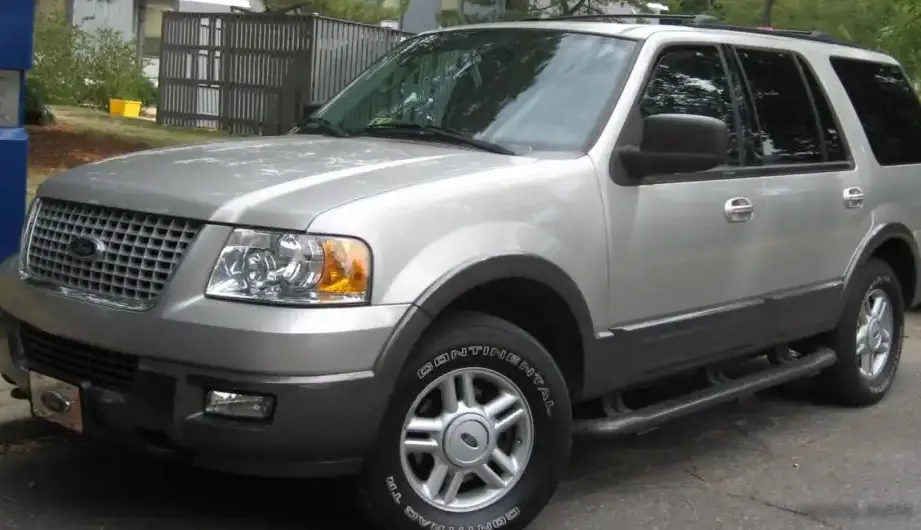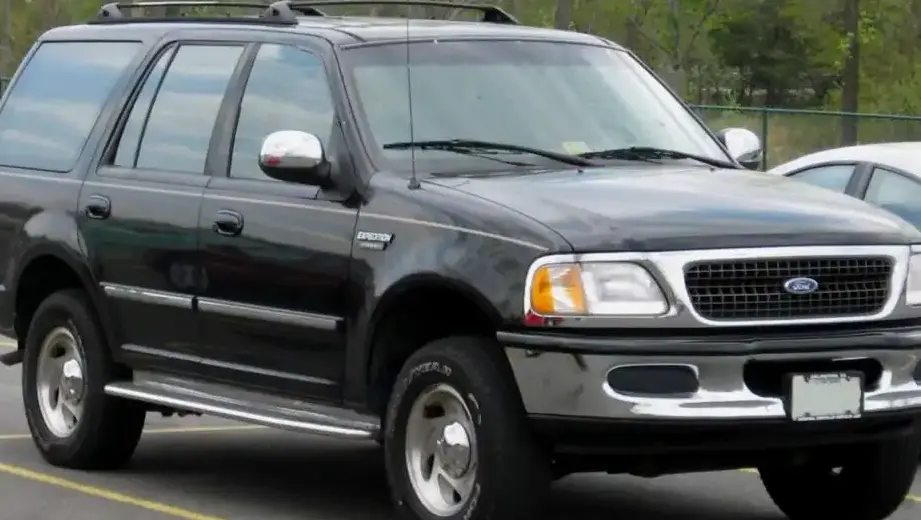
The Ford Expedition, launched in 1997 as a 1997 model year vehicle, marked Ford’s entry into the growing full-size SUV market. Replacing both the Ford Bronco and the truck-based Ford Explorer, the Expedition was designed to offer a more comfortable and spacious experience, alongside substantial towing capabilities. The first generation, internally designated the U173, was produced from 1997 through 2003. Within this generation, the 4.6L i V8 16V XLT, generating 218 horsepower, held a significant position as a mid-range offering, striking a balance between affordability and capability. It proved a popular choice for buyers desiring a large SUV without the higher price point of the premium trims.
Technical Specifications
| Brand | Ford |
| Model | Expedition |
| Generation | Expedition I (U173) |
| Type (Engine) | 4.6 i V8 16V XLT (218 Hp) |
| Start of production | 1997 year |
| End of production | 2003 year |
| Powertrain Architecture | Internal Combustion engine |
| Body type | SUV |
| Seats | 5 |
| Doors | 5 |
| Fuel consumption (urban) | 15.7 l/100 km (15 US mpg, 18 UK mpg) |
| Fuel consumption (extra urban) | 11.8 l/100 km (19.9 US mpg, 23.9 UK mpg) |
| Fuel Type | Petrol (Gasoline) |
| Acceleration 0 – 100 km/h | 11.3 sec |
| Acceleration 0 – 62 mph | 11.3 sec |
| Acceleration 0 – 60 mph | 10.7 sec |
| Maximum speed | 170 km/h (105.63 mph) |
| Weight-to-power ratio | 10.1 kg/Hp |
| Weight-to-torque ratio | 5.6 kg/Nm |
| Power | 218 Hp @ 4400 rpm |
| Torque | 393 Nm @ 3250 rpm (289.86 lb.-ft. @ 3250 rpm) |
| Engine layout | Front, Longitudinal |
| Engine Model/Code | Triton |
| Engine displacement | 4601 cm3 (280.77 cu. in.) |
| Number of cylinders | 8 |
| Engine configuration | V-engine |
| Cylinder Bore | 90.2 mm (3.55 in.) |
| Piston Stroke | 90 mm (3.54 in.) |
| Compression ratio | 9:1 |
| Number of valves per cylinder | 2 |
| Fuel injection system | Multi-port manifold injection |
| Engine aspiration | Naturally aspirated engine |
| Valvetrain | OHC |
| Engine oil capacity | 5.7 l (6.02 US qt | 5.02 UK qt) |
| Coolant | 17.9 l (18.91 US qt | 15.75 UK qt) |
| Kerb Weight | 2200 kg (4850.17 lbs.) |
| Trunk (boot) space – minimum | 3350 l (118.3 cu. ft.) |
| Fuel tank capacity | 98 l (25.89 US gal | 21.56 UK gal) |
| Length | 5200 mm (204.72 in.) |
| Width | 2000 mm (78.74 in.) |
| Height | 1900 mm (74.8 in.) |
| Wheelbase | 3020 mm (118.9 in.) |
| Front track | 1660 mm (65.35 in.) |
| Rear (Back) track | 1660 mm (65.35 in.) |
| Drivetrain Architecture | The Internal combustion engine (ICE) drives the rear wheels of the vehicle. |
| Drive wheel | Rear wheel drive |
| Number of gears and type of gearbox | 4 gears, automatic transmission |
| Front suspension | Torsion |
| Rear suspension | Rigid axle suspension |
| Front brakes | Ventilated discs |
| Rear brakes | Disc |
| Assisting systems | ABS (Anti-lock braking system) |
| Power steering | Hydraulic Steering |
| Tires size | 255/70 R16 |
Powertrain & Engine Architecture
The Ford Expedition XLT was powered by Ford’s 4.6-liter Triton V8 engine. This engine was part of Ford’s modular engine family, utilizing a single overhead camshaft (OHC) design with two valves per cylinder. The 4.6L engine featured multi-port fuel injection, delivering fuel directly into each intake port to enhance combustion efficiency. While minor revisions occurred throughout the production run, the engine code remained largely consistent. The standard transmission pairing for the 4.6L engine was the 4R70W four-speed automatic transmission. This transmission was known for its durability and relatively smooth shifting, though it lacked the efficiency of more modern transmissions. The 4R70W featured electronic control, enabling adaptive shift patterns based on driving conditions.
Driving Characteristics
The combination of the 4.6L V8’s 218 horsepower and 393 lb-ft of torque, coupled with the 4R70W automatic transmission, delivered adequate, but not particularly sporty, performance. Acceleration from 0-60 mph took approximately 10.7 seconds, placing it in line with other full-size SUVs of the period. The automatic transmission, while smooth, did result in some power loss compared to the rare manual transmission option. The gear ratios were optimized for towing and hauling, rather than rapid acceleration. In everyday driving, the Expedition XLT felt capable and comfortable, especially on the highway. However, passing maneuvers required careful planning, and the engine could feel strained when fully loaded or ascending steep inclines.
Equipment & Trim Levels
The XLT trim level positioned the Expedition as a step above the base model, offering a balance of features and affordability. Standard equipment generally included air conditioning, power windows and locks, a CD player, and cloth upholstery. Optional extras encompassed leather seats, a power sunroof, upgraded audio systems, and rear-seat entertainment systems. The interior design was functional and spacious, accommodating up to eight passengers depending on the seating configuration. The XLT trim also frequently included features such as a tilt steering wheel and cruise control.
Chassis & Braking
The Expedition I (U173) employed a body-on-frame construction, providing a robust and durable platform. The front suspension utilized torsion bars, while the rear suspension featured a solid axle with leaf springs. This configuration prioritized load-carrying capacity and towing ability over refined handling characteristics. Braking was provided by ventilated discs at the front and solid discs at the rear. An anti-lock braking system (ABS) was standard, enhancing safety during emergency braking situations. The steering system was hydraulic power steering, offering relatively easy maneuverability despite the vehicle’s substantial size.
Market Reception & Comparison
The Ford Expedition was generally well-received by both automotive critics and consumers. The 4.6L V8/automatic combination was lauded for its reliability and sufficient power. However, some reviewers pointed out that the engine could feel underpowered when fully loaded or while towing. Compared to the larger 5.4L V8 engine available in higher trim levels, the 4.6L offered improved fuel economy, albeit at the cost of performance. Fuel economy averaged around 15 mpg in the city and 19 mpg on the highway, which was typical for a full-size SUV of that era. The Expedition quickly gained popularity among families and individuals needing a versatile vehicle suitable for both daily commutes and weekend excursions.
Legacy
The 4.6L Triton V8 engine, in general, proved to be a durable and reliable powerplant. However, the early 4R70W transmissions were occasionally prone to issues, particularly if not maintained properly. Today, the first-generation Ford Expedition remains a relatively affordable option in the used car market. The 4.6L XLT variant is often sought after for its balance of features, reliability, and price. While not as highly sought after as some classic SUVs, the Expedition I holds a significant place in automotive history as a key vehicle that helped define the modern full-size SUV segment. Consistent maintenance, including regular fluid changes and timely repairs, is essential for ensuring the continued longevity of these vehicles.