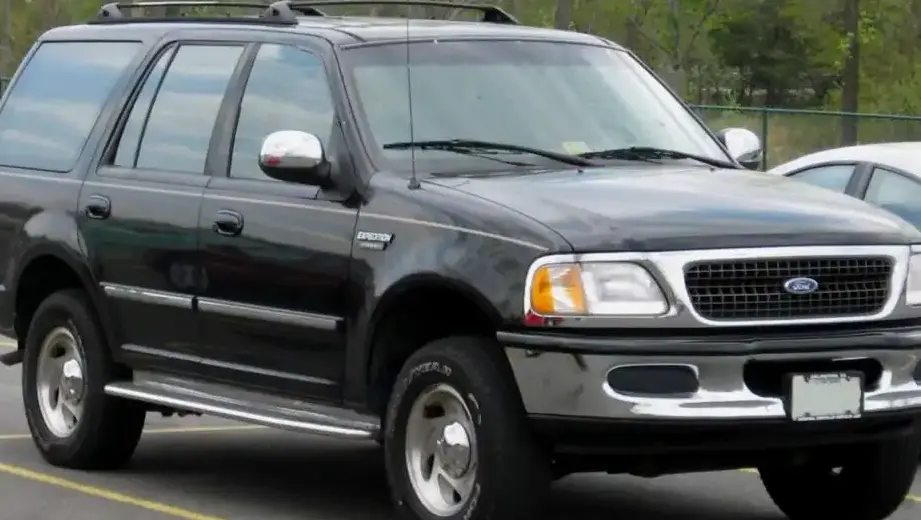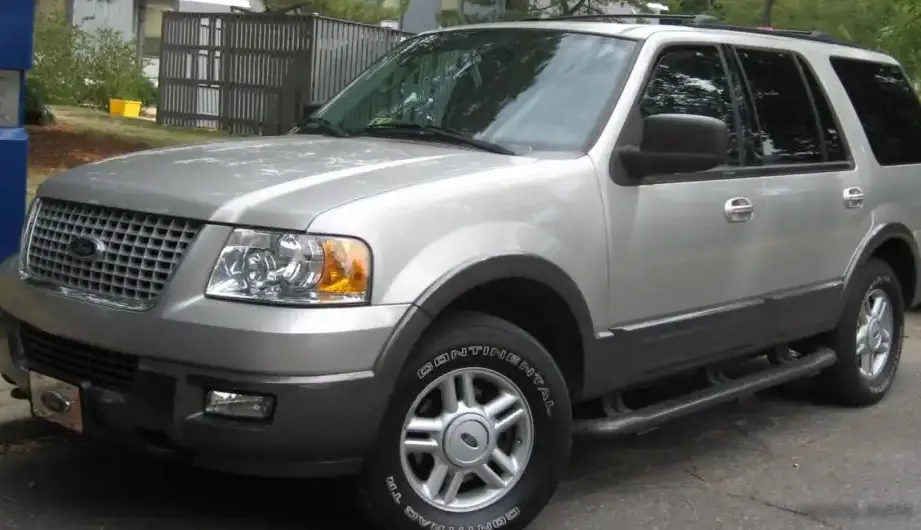
The Ford Expedition IV MAX, specifically the facelifted version produced from 2021 to 2024 (chassis code U553), represents the pinnacle of Ford’s full-size SUV offerings. This variant, equipped with the 3.5 EcoBoost V6 engine producing 380 horsepower and paired with Ford’s 10-speed SelectShift automatic transmission, was positioned as a premium trim within the Expedition MAX lineup, catering to buyers needing substantial towing capacity and interior space. The “MAX” designation indicates an extended wheelbase, providing significantly more cargo volume behind the third row compared to the standard Expedition. This generation saw a substantial overhaul in technology and refinement compared to its predecessor, aiming to compete directly with offerings from Chevrolet, GMC, and Jeep.
Technical Specifications
| Brand | Ford |
| Model | Expedition |
| Generation | Expedition IV MAX (U553, facelift 2021) |
| Type (Engine) | 3.5 EcoBoost V6 (380 Hp) SelectShift |
| Start of production | 2021 |
| End of production | 2024 |
| Powertrain Architecture | Internal Combustion engine |
| Body type | SUV |
| Seats | 8 |
| Doors | 5 |
| Fuel consumption (economy) – urban (EPA) | 14.7 l/100 km (16 US mpg, 19.2 UK mpg, 6.8 km/l) |
| Fuel consumption (economy) – extra urban (EPA) | 10.2 l/100 km (23.1 US mpg, 27.7 UK mpg, 9.8 km/l) |
| Fuel consumption (economy) – combined (EPA) | 12.4 l/100 km (19 US mpg, 22.8 UK mpg, 8.1 km/l) |
| Fuel Type | Petrol (Gasoline) |
| Weight-to-power ratio | 6.6 kg/Hp, 151.4 Hp/tonne |
| Weight-to-torque ratio | 3.9 kg/Nm, 253.8 Nm/tonne |
| Power | 380 Hp @ 5000 rpm |
| Power per litre | 108.7 Hp/l |
| Torque | 637 Nm @ 2250 rpm (469.83 lb.-ft. @ 2250 rpm) |
| Engine layout | Front, Longitudinal |
| Engine Model/Code | EcoBoost |
| Engine displacement | 3497 cm3 (213.4 cu. in.) |
| Number of cylinders | 6 |
| Engine configuration | V-engine |
| Cylinder Bore | 92.5 mm (3.64 in.) |
| Piston Stroke | 86.6 mm (3.41 in.) |
| Compression ratio | 10.5:1 |
| Number of valves per cylinder | 4 |
| Fuel injection system | Direct injection |
| Engine aspiration | Twin-Turbo, Intercooler |
| Valvetrain | DOHC, TI-VCT |
| Engine oil capacity | 5.7 l (6.02 US qt | 5.02 UK qt) |
| Coolant | 14.6 l (15.43 US qt | 12.85 UK qt) |
| Kerb Weight | 2510 kg (5533.6 lbs.) |
| Trunk (boot) space – minimum | 972 l (34.33 cu. ft.) |
| Trunk (boot) space – maximum | 3439 l (121.45 cu. ft.) |
| Fuel tank capacity | 105.2 l (27.79 US gal | 23.14 UK gal) |
| Permitted trailer load with brakes (12%) | 2858 kg (6300.81 lbs.) |
| Length | 5635 mm (221.85 in.) |
| Width | 2029 mm (79.88 in.) |
| Width with mirrors folded | 2124 mm (83.62 in.) |
| Width including mirrors | 2373 mm (93.43 in.) |
| Height | 1940 mm (76.38 in.) |
| Wheelbase | 3342 mm (131.57 in.) |
| Front track | 1717 mm (67.6 in.) |
| Rear (Back) track | 1707 mm (67.2 in.) |
| Front overhang | 971 mm (38.23 in.) |
| Rear overhang | 1322 mm (52.05 in.) |
| Ride height (ground clearance) | 249 mm (9.8 in.) |
| Approach angle | 24° |
| Departure angle | 21.5° |
| Ramp-over (brakeover) angle | 20.3° |
| Drivetrain Architecture | The Internal combustion engine (ICE) drives the rear wheels of the vehicle. |
| Drive wheel | Rear wheel drive |
| Number of gears and type of gearbox | 10 gears, automatic transmission SelectShift |
| Front suspension | Double wishbone, Transverse stabilizer |
| Rear suspension | Independent multi-link spring suspension with stabilizer |
| Front brakes | Ventilated discs |
| Rear brakes | Ventilated discs |
| Assisting systems | ABS (Anti-lock braking system) |
| Steering type | Steering rack and pinion |
| Power steering | Electric Steering |
| Tires size | 275/65 R18 |
| Wheel rims size | 18 |
Powertrain & Engine Architecture
The heart of this Expedition variant is Ford’s 3.5-liter EcoBoost V6 engine. This engine, part of Ford’s EcoBoost family, utilizes a twin-turbocharged configuration with direct fuel injection and variable valve timing (TI-VCT). The engine code is generally consistent across the range, but specific calibrations differ. The direct injection system allows for precise fuel delivery, enhancing both power and efficiency. The twin-turbochargers provide a broad torque curve, minimizing turbo lag and delivering strong acceleration. The 10-speed SelectShift automatic transmission is a crucial component, offering a wide range of gear ratios to optimize both fuel economy and performance. This transmission allows the engine to operate within its optimal power band more frequently. The transmission features a fully automatic mode, as well as a manual shift mode for driver control.
Driving Characteristics
The 380-horsepower EcoBoost V6, coupled with the 10-speed automatic, delivers a confident and capable driving experience. While not as overtly sporty as some competitors, the Expedition MAX offers ample power for highway cruising, towing, and accelerating with a full load of passengers. The 10-speed transmission is generally smooth and responsive, although some drivers have noted occasional hunting for the right gear in certain situations. Compared to lower-output engine options, this variant provides significantly more effortless acceleration and a greater sense of security when merging onto highways or passing other vehicles. The extended wheelbase of the MAX model contributes to a comfortable ride, but it also makes the vehicle feel larger and less nimble in tight spaces.
Equipment & Trim Levels
The 3.5 EcoBoost MAX trim typically included a generous array of standard features. These often included leather upholstery, heated and ventilated front seats, a power-adjustable driver’s seat with memory function, a premium sound system (often from Sony or Bang & Olufsen), a large touchscreen infotainment system with navigation, and a suite of advanced driver-assistance systems (ADAS) such as adaptive cruise control, lane-keeping assist, and automatic emergency braking. Optional extras could include a panoramic sunroof, rear-seat entertainment system, and upgraded towing packages. The interior design focused on providing a luxurious and spacious environment for passengers.
Chassis & Braking
The Expedition MAX utilizes a body-on-frame construction, providing a robust and durable platform for heavy-duty use. The suspension consists of an independent front suspension with double wishbones and a transverse stabilizer, and an independent multi-link rear suspension with a stabilizer. This setup aims to balance ride comfort with handling stability. Braking duties are handled by ventilated discs on all four wheels, providing ample stopping power. The anti-lock braking system (ABS) is standard, enhancing safety during emergency braking situations.
Market Reception & Comparison
The 2021-2024 Ford Expedition MAX 3.5 EcoBoost was generally well-received by automotive critics. It was praised for its spacious interior, powerful engine, and refined ride quality. Fuel economy, however, was a common criticism, as expected for a vehicle of this size and weight. Compared to the base engine options, the EcoBoost variant offered a significant performance upgrade, justifying the higher price tag for buyers prioritizing power and towing capacity. Reliability reports have been generally positive, although some owners have reported minor issues with the infotainment system.
Legacy
The 3.5 EcoBoost engine has proven to be a durable and reliable powerplant in the Expedition MAX. The 10-speed automatic transmission has also demonstrated good long-term reliability. On the used car market, these models hold their value relatively well, particularly those with low mileage and a well-maintained service history. The combination of power, space, and features makes the 2021-2024 Expedition MAX 3.5 EcoBoost a desirable option for families and individuals needing a large, capable SUV.