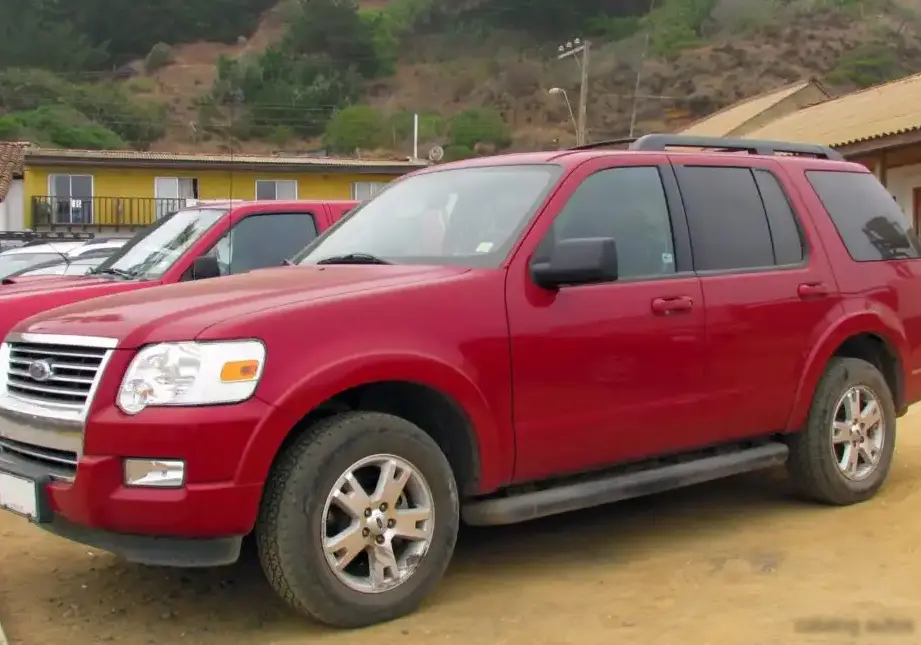
The Ford Explorer IV, produced from 2006 to 2010, represented a significant evolution for Ford’s popular SUV. This fourth generation marked a shift towards a more refined and capable vehicle, aiming to compete effectively in the increasingly crowded mid-size SUV segment. Among the various configurations offered, the 4.6-liter V8 engine paired with a four-wheel-drive system and automatic transmission stands out as a potent and popular choice, particularly for American buyers seeking a blend of power, space, and all-weather capability. This variant occupied a premium position within the Explorer IV lineup, offering a substantial step up in performance compared to the V6 options.
Technical Specifications
| Brand | Ford |
| Model | Explorer |
| Generation | Explorer IV |
| Type (Engine) | 4.6 V8 (292 Hp) 4×4 Automatic |
| Start of production | 2006 |
| End of production | 2010 |
| Powertrain Architecture | Internal Combustion engine |
| Body type | SUV |
| Seats | 7 |
| Doors | 5 |
| Fuel consumption (urban) | 16.8 l/100 km (14 US mpg, 16.8 UK mpg) |
| Fuel consumption (extra urban) | 11.8 l/100 km (19.9 US mpg, 23.9 UK mpg) |
| Fuel Type | Petrol (Gasoline) |
| Weight-to-power ratio | 7.4 kg/Hp |
| Weight-to-torque ratio | 5.3 kg/Nm |
| Power | 292 Hp @ 5750 rpm |
| Power per litre | 63.5 Hp/l |
| Torque | 407 Nm @ 3950 rpm (300.19 lb.-ft. @ 3950 rpm) |
| Engine layout | Front, Longitudinal |
| Engine displacement | 4601 cm3 (280.77 cu. in.) |
| Number of cylinders | 8 |
| Engine configuration | V-engine |
| Cylinder Bore | 90.2 mm (3.55 in.) |
| Piston Stroke | 90 mm (3.54 in.) |
| Compression ratio | 9.8:1 |
| Number of valves per cylinder | 3 |
| Fuel injection system | Multi-port manifold injection |
| Engine aspiration | Naturally aspirated engine |
| Valvetrain | SOHC |
| Engine oil capacity | 5.7 l (6.02 US qt | 5.02 UK qt) |
| Coolant capacity | 13.2 l (13.95 US qt | 11.61 UK qt) |
| Kerb Weight | 2170 kg (4784.03 lbs.) |
| Max. weight | 2825 kg (6228.06 lbs.) |
| Max load | 655 kg (1444.03 lbs.) |
| Trunk (boot) space – minimum | 385 l (13.6 cu. ft.) |
| Trunk (boot) space – maximum | 2370 l (83.7 cu. ft.) |
| Fuel tank capacity | 85 l (22.45 US gal | 18.7 UK gal) |
| Permitted trailer load with brakes (12%) | 1588 kg (3500.94 lbs.) |
| Length | 4912 mm (193.39 in.) |
| Width | 1872 mm (73.7 in.) |
| Width with mirrors folded | 1969 mm (77.52 in.) |
| Width including mirrors | 2154 mm (84.8 in.) |
| Height | 1849 mm (72.8 in.) |
| Wheelbase | 2888 mm (113.7 in.) |
| Front track | 1547 mm (60.91 in.) |
| Rear (Back) track | 1570 mm (61.81 in.) |
| Front overhang | 899 mm (35.39 in.) |
| Rear overhang | 1125 mm (44.29 in.) |
| Ride height (ground clearance) | 208 mm (8.19 in.) |
| Approach angle | 28.2° |
| Departure angle | 23.8° |
| Ramp-over (brakeover) angle | 18.4° |
| Drivetrain Architecture | ICE drives four wheels permanently |
| Drive wheel | All wheel drive (4×4) |
| Number of gears and type of gearbox | 6 gears, automatic transmission |
| Front suspension | Independent, McPherson with coil spring and anti-roll bar |
| Rear suspension | Independent multi-link spring suspension with stabilizer |
| Front brakes | Disc |
| Rear brakes | Disc |
| Assisting systems | ABS (Anti-lock braking system), Hydraulic Power Steering |
| Tires size | 245/65 R17; 235/65 R18 |
| Wheel rims size | 7.5J x 17; 7.5J x 18 |
INTRODUCTION
The 2006-2010 Ford Explorer IV, built on the D3 platform, represented a move away from the body-on-frame construction of previous generations to a more modern unibody design. This change aimed to improve ride quality, handling, and fuel efficiency. The 4.6-liter V8 4×4 Automatic variant was positioned as the top-tier offering, appealing to buyers who prioritized power and towing capacity. It was a popular choice for families and individuals needing a versatile vehicle capable of handling both daily commutes and weekend adventures. Production spanned from 2006 to 2010, with minor updates occurring throughout the production run.
Powertrain & Engine Architecture
At the heart of this Explorer variant lies Ford’s 4.6-liter Modular V8 engine. Specifically, this engine typically utilized the engine code 2V. This engine is a 90-degree V8 featuring a single overhead camshaft (SOHC) design per cylinder bank. The engine employs multi-port fuel injection, delivering fuel directly into the intake ports. The 4.6L V8 is known for its relatively simple design and robust construction. The automatic transmission paired with this engine is a 5-speed 5R55E automatic. This transmission is electronically controlled and features overdrive for improved highway fuel economy. The 5R55E is known for its smooth shifting characteristics, but can be prone to issues if not properly maintained. The combination of the V8 and the automatic transmission provides a balance of power and convenience.
Driving Characteristics
The 4.6-liter V8 delivers a noticeable performance boost compared to the V6 options. With 292 horsepower and 300 lb-ft of torque, the Explorer IV 4×4 Automatic offers brisk acceleration and ample power for merging onto highways and passing other vehicles. While not a sports car, the V8 provides a confident and capable driving experience. The automatic transmission shifts smoothly, although it may not be as responsive as a manual transmission. The four-wheel-drive system provides enhanced traction in inclement weather and on slippery surfaces. The gear ratios are tuned for a balance of acceleration and fuel economy, with the overdrive gear helping to reduce engine speed at highway speeds. Compared to the manual transmission equipped Explorers, the automatic sacrifices some driver engagement for ease of use.
Equipment & Trim Levels
The 4.6-liter V8 4×4 Automatic Explorer typically came well-equipped, often representing the higher trim levels like the Limited or Eddie Bauer. Standard features generally included leather upholstery, heated front seats, a premium audio system, power-adjustable pedals, and automatic climate control. Optional extras could include a navigation system, a sunroof, and rear-seat entertainment system. The interior design focused on comfort and practicality, with ample space for passengers and cargo. The exterior styling featured chrome accents and unique badging to distinguish it from lower trim levels.
Chassis & Braking
The Explorer IV’s unibody construction contributed to improved rigidity and handling. The front suspension utilizes an independent McPherson strut design, while the rear suspension employs an independent multi-link setup. Both suspensions feature coil springs and stabilizer bars to enhance stability and reduce body roll. The braking system consists of disc brakes on all four wheels, providing adequate stopping power. Anti-lock braking system (ABS) was standard, enhancing safety in emergency braking situations. The 4×4 system is typically an automatic engaging system, seamlessly distributing power to all four wheels when needed.
Market Reception & Comparison
The Explorer IV 4.6 V8 4×4 Automatic received generally positive reviews, with critics praising its powerful engine, comfortable ride, and spacious interior. However, fuel economy was a common criticism, as the V8 engine consumed significantly more fuel than the V6 options. Compared to competitors like the Chevrolet Traverse and Honda Pilot, the Explorer offered a more traditional SUV experience with a focus on power and towing capacity. The V6 models offered better fuel economy and a lower price point, appealing to a different segment of buyers. Reliability was generally good, although some owners reported issues with the automatic transmission and the power windows.
Legacy
The Ford Explorer IV 4.6 V8 4×4 Automatic remains a popular choice in the used car market, particularly among buyers seeking a capable and affordable SUV. The 4.6-liter V8 engine is known for its durability, although regular maintenance is essential to prevent issues. The automatic transmission can be a potential weak point, so it’s important to inspect its condition before purchasing. Overall, this Explorer variant offers a compelling combination of power, space, and capability, making it a solid choice for families and individuals needing a versatile vehicle.