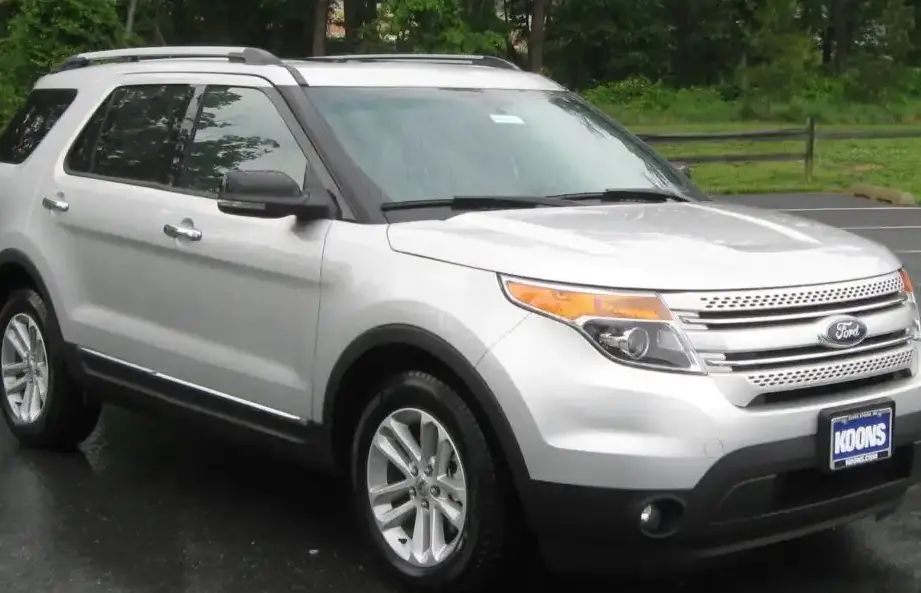
The Ford Explorer V 3.5 Ti-VCT V6 (290 Hp) 4WD Automatic represents a significant iteration of Ford’s popular SUV, produced from 2011 to 2016. This variant occupied a mid-to-upper position within the fifth-generation Explorer (2011-2019) lineup, offering a balance of power, capability, and family-oriented features. It was a key model for Ford as they transitioned the Explorer from a body-on-frame truck-based platform to a more modern, car-based unibody construction, aiming to improve ride quality, fuel efficiency, and handling. This shift was crucial in attracting a broader range of buyers, particularly those seeking a comfortable and versatile SUV for daily use and family adventures.
Technical Specifications
| Brand | Ford |
| Model | Explorer |
| Generation | Explorer V |
| Type (Engine) | 3.5 Ti-VCT V6 (290 Hp) 4WD Automatic |
| Start of production | 2011 |
| End of production | 2016 |
| Powertrain Architecture | Internal Combustion engine |
| Body type | SUV |
| Seats | 7 |
| Doors | 5 |
| Fuel consumption (urban) | 13.8 l/100 km (17 US mpg, 20.5 UK mpg, 7.2 km/l) |
| Fuel consumption (extra urban) | 10.2 l/100 km (23.1 US mpg, 27.7 UK mpg, 9.8 km/l) |
| Fuel consumption (combined) | 12.4 l/100 km (19 US mpg, 22.8 UK mpg, 8.1 km/l) |
| Fuel Type | Petrol (Gasoline) |
| Power | 290 Hp @ 6500 rpm |
| Power per litre | 83.1 Hp/l |
| Torque | 346 Nm @ 4000 rpm (255.2 lb.-ft. @ 4000 rpm) |
| Engine layout | Front, Transverse |
| Engine displacement | 3490 cm3 (212.97 cu. in.) |
| Number of cylinders | 6 |
| Engine configuration | V-engine |
| Cylinder Bore | 92.5 mm (3.64 in.) |
| Piston Stroke | 86.7 mm (3.41 in.) |
| Compression ratio | 10.8:1 |
| Number of valves per cylinder | 4 |
| Fuel injection system | Multi-port manifold injection |
| Engine aspiration | Naturally aspirated engine |
| Valvetrain | DOHC |
| Engine oil capacity | 5.7 l (6.02 US qt | 5.02 UK qt) |
| Coolant capacity | 11.5 l (12.15 US qt | 10.12 UK qt) |
| Trunk (boot) space – minimum | 595 l (21.01 cu. ft.) |
| Trunk (boot) space – maximum | 2285 l (80.69 cu. ft.) |
| Fuel tank capacity | 70 l (18.49 US gal | 15.4 UK gal) |
| Permitted trailer load with brakes (12%) | 2268 kg (5000.08 lbs.) |
| Length | 5006 mm (197.09 in.) |
| Width | 2004 mm (78.9 in.) |
| Width with mirrors folded | 2096 mm (82.52 in.) |
| Width including mirrors | 2291 mm (90.2 in.) |
| Height | 1788 mm (70.39 in.) |
| Wheelbase | 2860 mm (112.6 in.) |
| Front track | 1702 mm (67.01 in.) |
| Rear (Back) track | 1702 mm (67.01 in.) |
| Front overhang | 965 mm (37.99 in.) |
| Rear overhang | 1181 mm (46.5 in.) |
| Ride height (ground clearance) | 193 mm (7.6 in.) |
| Approach angle | 21.7° |
| Departure angle | 21.4° |
| Ramp-over (brakeover) angle | 16.5° |
| Drivetrain Architecture | The Internal combustion engine (ICE) drives permanently the four wheels of the vehicle. |
| Drive wheel | All wheel drive (4×4) |
| Number of gears and type of gearbox | 6 gears, automatic transmission |
| Front suspension | Independent type McPherson, Transverse stabilizer |
| Rear suspension | Independent multi-link suspension, Transverse stabilizer |
| Front brakes | Ventilated discs |
| Rear brakes | Disc |
| Assisting systems | ABS (Anti-lock braking system) |
| Steering type | Steering rack and pinion |
| Power steering | Electric Steering |
| Tires size | 245/65 R17; 245/60 R18; 255/50 R20 |
| Wheel rims size | 7.5J x 17; 8J x 18; 8.5J x 20 |
Powertrain & Engine Architecture
At the heart of the Explorer V 3.5 Ti-VCT lies Ford’s 3.5-liter Ti-VCT V6 engine. “Ti-VCT” stands for Twin Independent Variable Camshaft Timing, a technology that allows for precise control of valve timing on both the intake and exhaust sides of the engine. This optimizes performance and fuel efficiency across a wider range of engine speeds. The engine utilizes multi-port fuel injection, delivering fuel directly into the intake ports. The 6F55 automatic transmission, a six-speed unit, was standard. This transmission was known for its smooth shifting and responsiveness, contributing to a more refined driving experience compared to earlier Explorer models. The 6F55 was designed to handle the engine’s torque output effectively and provide adequate gear ratios for both highway cruising and towing.
Driving Characteristics
The 290 horsepower and 255 lb-ft of torque provided by the 3.5L V6 and 6-speed automatic offered a noticeable step up in performance compared to earlier Explorer configurations. While not a sports car, the Explorer V 3.5 Ti-VCT delivered adequate acceleration for merging onto highways and passing other vehicles. The automatic transmission was well-tuned, providing smooth and predictable shifts. Compared to the base 3.5L engine without Ti-VCT, the 290 hp version offered a more engaging driving experience. The 4WD system provided enhanced traction in inclement weather and on slippery surfaces, making it a capable all-weather vehicle. However, the added weight of the 4WD system and the automatic transmission did impact fuel economy compared to the rear-wheel-drive models.
Equipment & Trim Levels
The Explorer V 3.5 Ti-VCT 4WD Automatic was typically offered in higher trim levels, such as XLT and Limited. Standard features generally included tri-zone automatic climate control, a six-speaker audio system, power windows and locks, and keyless entry. Higher trims added features like leather upholstery, heated front seats, a premium audio system (often Sony branded), and a navigation system. Optional extras included a power liftgate, a panoramic sunroof, and a rear-seat entertainment system. The interior design focused on practicality and comfort, with ample space for passengers and cargo. The third-row seating was a key selling point for families.
Chassis & Braking
The fifth-generation Explorer featured a unibody construction, a significant departure from the previous body-on-frame design. This resulted in a more rigid and refined chassis, improving ride quality and handling. The front suspension utilized an independent McPherson strut setup, while the rear suspension employed an independent multi-link design. Both ends featured a transverse stabilizer bar to reduce body roll. Braking duties were handled by ventilated discs at the front and solid discs at the rear, with ABS standard. The braking system was generally considered adequate for the vehicle’s weight and performance.
Market Reception & Comparison
The Explorer V 3.5 Ti-VCT 4WD Automatic was generally well-received by critics and consumers. It was praised for its comfortable ride, spacious interior, and improved fuel economy compared to previous generations. However, some reviewers noted that the interior materials weren’t as premium as those found in some competing SUVs. Compared to the base 3.5L Explorer, the Ti-VCT version offered a noticeable performance boost, justifying the higher price tag for many buyers. Against competitors like the Honda Pilot, Toyota Highlander, and Chevrolet Traverse, the Explorer offered a compelling combination of features, performance, and value.
Legacy
The 3.5L Ti-VCT V6 and 6F55 automatic transmission combination proved to be relatively reliable, although some owners have reported issues with the fuel pump and timing chain guides over the long term. The Explorer V 3.5 Ti-VCT 4WD Automatic remains a popular choice in the used car market, offering a good balance of practicality, capability, and affordability. Its unibody construction and modern features make it a more appealing option than older, body-on-frame Explorers. The transition to a unibody platform with this generation Explorer set the stage for future iterations and solidified its position as a leading SUV in the American market.