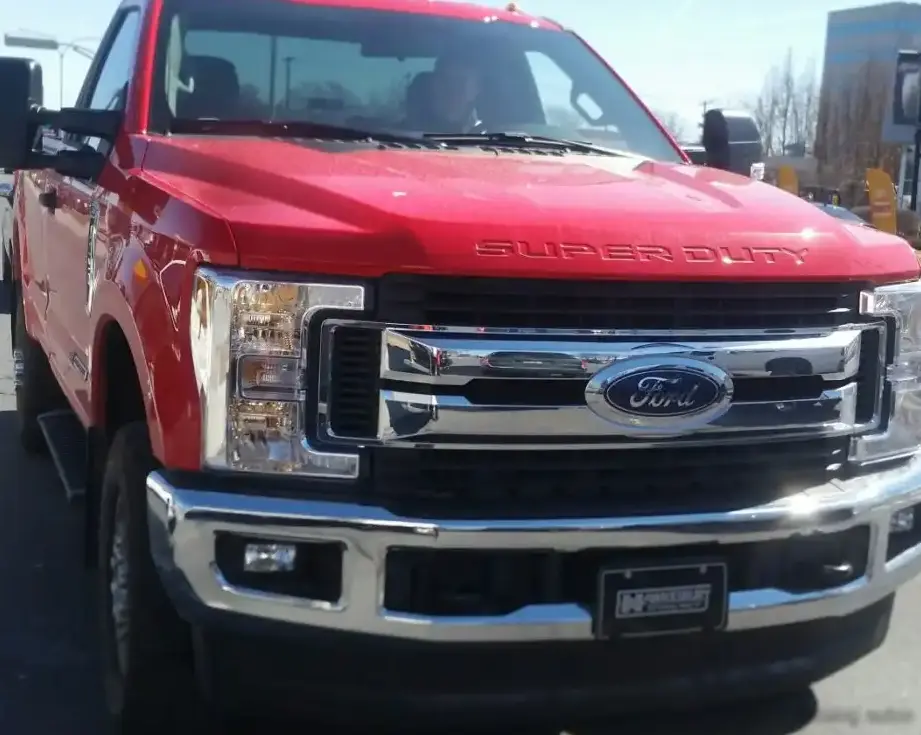
The Ford F-350 Super Duty IV, produced from 2017 to 2019, represents the fourth generation of Ford’s heavy-duty pickup truck line. This particular variant, the Regular Cab Long Box configuration powered by a 6.7-liter turbocharged diesel V8 engine producing 450 horsepower and paired with a six-speed automatic transmission, and featuring a Dual Rear Wheel (DRW) setup, was positioned as a work-focused, high-capacity offering within the Super Duty range. It catered to buyers needing substantial towing and payload capabilities, primarily in commercial and agricultural applications. This generation marked a significant step forward in Super Duty capability, with a fully-boxed frame and increased use of high-strength steel.
Technical Specifications
| Brand | Ford |
| Model | F-350 Super Duty |
| Generation | F-350 Super Duty IV Regular Cab Long box |
| Type (Engine) | 6.7d V8 (450 Hp) 4×4 Automatic DRW |
| Start of production | 2017 |
| End of production | 2019 |
| Powertrain Architecture | Internal Combustion engine |
| Body type | Pick-up |
| Seats | 3 |
| Doors | 2 |
| Fuel Type | Diesel |
| Weight-to-power ratio | 7.1 kg/Hp, 140.3 Hp/tonne |
| Weight-to-torque ratio | 2.5 kg/Nm, 395.1 Nm/tonne |
| Power | 450 Hp @ 2800 rpm |
| Power per litre | 67.6 Hp/l |
| Torque | 1267 Nm @ 1800 rpm (934.49 lb.-ft. @ 1800 rpm) |
| Engine layout | Front, Longitudinal |
| Engine displacement | 6653 cm3 (405.99 cu. in.) |
| Number of cylinders | 8 |
| Engine configuration | V-engine |
| Cylinder Bore | 99.06 mm (3.9 in.) |
| Piston Stroke | 107.95 mm (4.25 in.) |
| Compression ratio | 16.2:1 |
| Number of valves per cylinder | 4 |
| Fuel injection system | Diesel Commonrail |
| Engine aspiration | Turbocharger, Intercooler |
| Valvetrain | OHV |
| Engine oil capacity | 12.3 l (13 US qt | 10.82 UK qt) |
| Coolant | 33.2 l (35.08 US qt | 29.21 UK qt) |
| Kerb Weight | 3207-3396 kg (7070.22 – 7486.9 lbs.) |
| Trunk (boot) space – minimum | 2222 l (78.47 cu. ft.) |
| Fuel tank capacity | 110 l (29.06 US gal | 24.2 UK gal) |
| Permitted trailer load with brakes (12%) | 14470 kg (31900.89 lbs.) |
| Length | 5888 mm (231.81 in.) |
| Width | 2032 mm (80 in.) |
| Width including mirrors | 2690 mm (105.91 in.) |
| Height | 2047 mm (80.59 in.) |
| Wheelbase | 3597 mm (141.61 in.) |
| Front track | 1755 mm (69.09 in.) |
| Rear (Back) track | 1897 mm (74.69 in.) |
| Front overhang | 970 mm (38.19 in.) |
| Rear overhang | 1321 mm (52.01 in.) |
| Ride height (ground clearance) | 196 mm (7.72 in.) |
| Approach angle | 18.1° |
| Departure angle | 20.9° |
| Ramp-over (brakeover) angle | 24.6° |
| Drivetrain Architecture | The Internal combustion engine (ICE) drives the rear wheels permanently, and the front wheels are driven through an electrically or mechanically operated clutch if necessary. |
| Drive wheel | All wheel drive (4×4) |
| Number of gears and type of gearbox | 6 gears, automatic transmission TorqShift |
| Front suspension | Dependent spring suspension with anti-roll bar, Trailing arm |
| Rear suspension | Rigid axle suspension, Leaf spring |
| Front brakes | Ventilated discs, 363 mm |
| Rear brakes | Ventilated discs, 363 mm |
| Assisting systems | ABS (Anti-lock braking system) |
| Steering type | Cone worm with recirculation balls |
| Power steering | Hydraulic Steering |
| Tires size | 245/75 R17 |
| Wheel rims size | 17 |
Powertrain & Engine Architecture
The heart of this F-350 variant is the 6.7-liter Power Stroke Turbo Diesel V8. This engine, designated with various internal codes depending on the specific year and calibration, is a robust and heavily-built powerplant. It features a cast iron block, aluminum cylinder heads, and a variable geometry turbocharger with an intercooler to maximize power and efficiency. The fuel system utilizes a high-pressure common rail direct injection system, delivering fuel directly into the cylinders at extremely high pressures for optimal combustion. The engine employs an overhead valve (OHV) valvetrain, a design choice prioritizing durability and low-end torque. The six-speed TorqShift automatic transmission is specifically designed to handle the immense torque output of the diesel engine. It features a heavy-duty torque converter and robust internal components to ensure reliability under demanding conditions.
Driving Characteristics
The 450 horsepower and 1267 lb-ft of torque delivered by this powertrain configuration translate to exceptional towing and hauling capabilities. While not designed for outright speed, the F-350 provides ample power for accelerating with heavy loads. The automatic transmission is tuned for smooth shifts and maximizing engine braking, which is crucial when descending steep grades with a trailer. Compared to the gasoline-powered F-350 variants, the diesel offers significantly more low-end torque, making it easier to start and maintain momentum when towing. Compared to higher-output diesel variants (like those exceeding 475 hp), this version prioritizes a balance between power and fuel economy. The DRW configuration provides enhanced stability when towing heavy loads, distributing the weight more evenly across the rear axle.
Equipment & Trim Levels
The F-350 Super Duty IV in this configuration typically came standard with a basic but functional interior. Features included vinyl or cloth upholstery, air conditioning, a basic audio system, and power windows and locks. The Regular Cab configuration meant a focus on practicality over luxury, with limited interior space. Optional extras included upgraded audio systems, navigation, leather upholstery, power-adjustable seats, and various driver-assistance features. Trim levels like XL, XLT, and Lariat offered progressively more features and refinement. The DRW setup was often paired with the XLT or Lariat trims for customers needing maximum capability and a degree of comfort.
Chassis & Braking
The F-350 Super Duty IV features a fully-boxed frame constructed from high-strength steel, providing a solid foundation for heavy-duty use. The front suspension utilizes a two-stage leaf spring design with anti-roll bar, while the rear suspension employs a leaf spring setup optimized for load-carrying capacity. Braking duties are handled by ventilated disc brakes on all four wheels, providing ample stopping power even with heavy loads. The anti-lock braking system (ABS) helps maintain steering control during emergency braking situations. The DRW configuration significantly increases the vehicle’s gross vehicle weight rating (GVWR) and allows for a higher payload capacity.
Market Reception & Comparison
The 6.7-liter diesel F-350 Super Duty was widely praised for its exceptional towing and hauling capabilities. Critics noted the engine’s strong torque output and the transmission’s ability to handle heavy loads. Fuel economy, while not exceptional, was considered reasonable for a vehicle of this size and capability. Compared to the gasoline-powered F-350 variants, the diesel offered superior performance when towing and hauling, but at a higher initial cost. Compared to competing heavy-duty trucks from Ram and General Motors, the Ford F-350 was often lauded for its robust powertrain and overall durability.
Legacy
The 6.7-liter Power Stroke diesel engine has proven to be a remarkably durable and reliable powerplant. While early versions had some issues with exhaust gas recirculation (EGR) coolers and turbocharger failures, these were largely addressed in later model years. Today, well-maintained F-350 Super Duty trucks from the 2017-2019 model years remain highly sought after in the used truck market. Their combination of power, capability, and durability makes them a popular choice for buyers needing a reliable work truck. The DRW configuration, in particular, holds its value well due to its specialized capabilities.