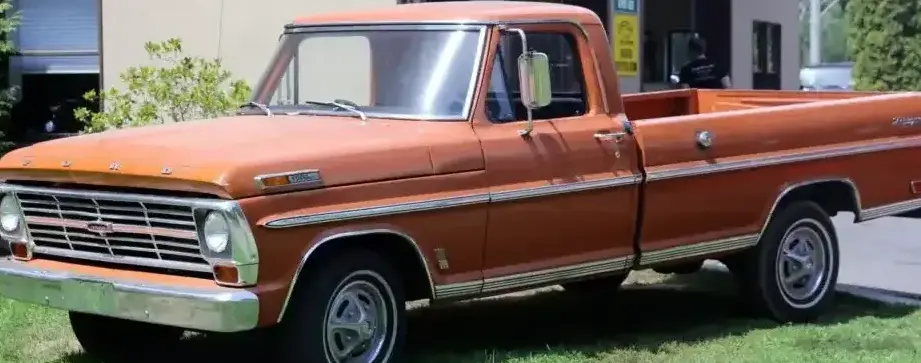
The Ford F-100, part of the broader F-Series lineup, represented Ford’s entry into the light-duty pickup truck market. Produced from 1970 through 1972, the F-100 with the 5.0-liter (302 cubic inch) V8 engine and automatic transmission offered a balance between capability and affordability. This configuration occupied a middle ground within the F-Series range, positioned above the six-cylinder models and below the larger displacement V8 options like the 390 cubic inch engine. It was a popular choice for buyers needing a robust work truck without the expense of the top-tier trims.
Technical Specifications
| Brand | Ford |
| Model | F-Series F-100/F-150 |
| Generation | F-Series F-100 V |
| Type (Engine) | 5.0 302 V8 (205 Hp) Automatic |
| Start of production | 1970 |
| End of production | 1972 |
| Powertrain Architecture | Internal Combustion engine |
| Body type | Pick-up |
| Seats | 3 |
| Doors | 2 |
| Fuel Type | Petrol (Gasoline) |
| Power | 205 Hp |
| Power per litre | 41.4 Hp/l |
| Torque | 407 Nm / 300.19 lb.-ft. |
| Engine layout | Front, Longitudinal |
| Engine displacement | 4949 cm3 / 302.01 cu. in. |
| Number of cylinders | 8 |
| Engine configuration | V-engine |
| Cylinder Bore | 101.6 mm / 4 in. |
| Piston Stroke | 76.2 mm / 3 in. |
| Compression ratio | 8.6:1 |
| Fuel injection system | Carburettor |
| Engine aspiration | Naturally aspirated engine |
| Coolant | 20.8 l / 21.98 US qt | 18.3 UK qt |
| Max. weight | 2268 kg / 5000.08 lbs. |
| Trunk (boot) space – minimum | 1274-2163 l / 44.99 – 76.39 cu. ft. |
| Fuel tank capacity | 74 l / 19.55 US gal | 16.28 UK gal |
| Length | 4636-5138 mm / 182.52 – 202.28 in. |
| Wheelbase | 2921-3327 mm / 115 – 130.98 in. |
| Wading depth | 658-660 mm / 25.91 – 25.98 in. |
| Drivetrain Architecture | The Internal combustion engine (ICE) drives the rear wheels of the vehicle. |
| Drive wheel | Rear wheel drive |
| Number of gears and type of gearbox | 3 gears, automatic transmission Cruise-O-Matic |
| Front suspension | Independent coil spring |
| Front brakes | Drum |
| Rear brakes | Drum |
| Steering type | Cone worm with recirculation balls |
| Power steering | Electric Steering |
| Tires size | 215/75 R15; 225/75 R15 |
| Wheel rims size | 7J x 15 |
Powertrain & Engine Architecture
The heart of this F-100 variant was the Ford 302 cubic inch (4.9 liters) small-block V8, internally designated as the 5.0. This engine, part of the Windsor family, was a staple of Ford’s lineup for decades. The 1970-1972 version typically featured a two-barrel carburetor, contributing to its 205 horsepower output. The engine’s architecture was a traditional pushrod V8, with two valves per cylinder. The automatic transmission was the Ford Cruise-O-Matic, a three-speed unit known for its smoothness and durability. This transmission was a popular choice for buyers who preferred the convenience of an automatic over a manual gearbox, especially for everyday driving and hauling lighter loads.
Driving Characteristics
The 5.0-liter V8 with the Cruise-O-Matic provided adequate, though not exhilarating, performance. Acceleration was reasonable for the time, but the truck wasn’t designed for rapid speed. The automatic transmission’s gear ratios were optimized for towing and hauling, prioritizing low-end torque over high-revving power. Compared to the manual transmission versions, the automatic offered a more relaxed driving experience, but at the expense of some responsiveness. The 302 V8 was noticeably less powerful than the available 390 cubic inch V8, making it a better choice for those who didn’t regularly tow heavy trailers or carry substantial payloads. The truck felt planted and stable, typical of Ford’s F-Series trucks, but the drum brakes on all four wheels required a firm pedal and weren’t as effective as disc brakes.
Equipment & Trim Levels
The F-100 with the 5.0 V8 and automatic transmission typically came standard with a basic interior featuring a vinyl bench seat. Options included upgraded upholstery, a radio, and a heater. The trim level was generally considered mid-range for the F-100 lineup. While not as luxurious as the higher-end trims, it offered a step up from the base models. Exterior options included different paint colors and chrome trim packages. Power steering was often an optional extra, as was air conditioning, which was becoming increasingly popular during this era.
Chassis & Braking
The F-100 utilized a body-on-frame construction, providing a robust and durable platform. The front suspension consisted of independent coil springs, offering a relatively comfortable ride for a truck. The rear suspension was a traditional leaf spring setup, designed to handle heavier loads. Braking was handled by drum brakes on all four wheels. While adequate for the time, they lacked the stopping power and fade resistance of disc brakes. The steering system was a cone worm and recirculating ball setup, providing a solid, if somewhat indirect, steering feel.
Market Reception & Comparison
The F-100 with the 5.0 V8 and automatic transmission was well-received by buyers looking for a versatile and reliable pickup truck. Critics praised its durability and ease of use, but noted that it wasn’t the most powerful or fuel-efficient option available. Compared to the six-cylinder models, the V8 offered significantly more power and towing capacity. However, it came at a higher price and with slightly lower fuel economy. Compared to the larger V8s, the 302 offered a good balance of power and efficiency, making it a popular choice for those who didn’t need the extra grunt of the bigger engines.
Legacy
The 1970-1972 Ford F-100 with the 5.0 V8 and automatic transmission remains a popular classic truck today. The 302 Windsor V8 is known for its reliability and relatively simple maintenance. Parts availability is generally good, making it easier to keep these trucks on the road. While not a high-performance machine, this configuration offers a comfortable and capable driving experience. The Cruise-O-Matic transmission, when properly maintained, is also known for its longevity. In the used car market, these trucks are often sought after by collectors and enthusiasts who appreciate their classic styling and robust construction. They represent a significant era in American truck design and continue to be enjoyed by owners across the country.