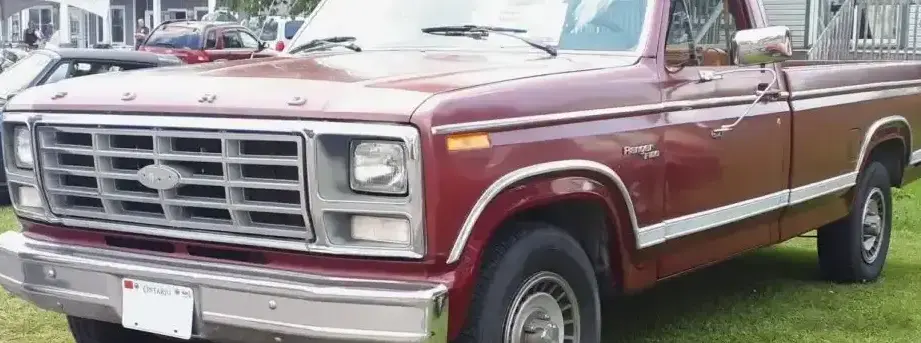
The Ford F-Series F-100 VII Regular Cab, equipped with the 3.8-liter V6 engine producing 110 horsepower, represented a key offering in Ford’s light-duty truck lineup during its 1982-1983 production run. This generation, part of the broader F-Series (which also included the F-150), aimed to balance affordability and capability for a wide range of buyers. The F-100 was positioned as the entry-level offering, catering to those needing a work truck for light to medium-duty tasks, while the F-150 offered increased payload and towing capacity. This particular 3.8L V6 configuration was designed to provide a more economical option compared to the larger V8 engines available, appealing to buyers prioritizing fuel efficiency and lower initial cost.
Technical Specifications
| Brand | Ford |
| Model | F-Series F-100/F-150 |
| Generation | F-Series F-100 VII Regular Cab |
| Type (Engine) | 3.8 V6 (110 Hp) |
| Start of production | 1982 |
| End of production | 1983 |
| Powertrain Architecture | Internal Combustion engine |
| Body type | Pick-up |
| Seats | 2-3 |
| Doors | 2 |
| Fuel Type | Petrol (Gasoline) |
| Power | 110 Hp |
| Power per litre | 28.9 Hp/l |
| Torque | 248 Nm / 182.92 lb.-ft. |
| Engine layout | Front, Longitudinal |
| Engine displacement | 3802 cm3 / 232.01 cu. in. |
| Number of cylinders | 6 |
| Engine configuration | V-engine |
| Fuel injection system | Carburettor |
| Engine aspiration | Naturally aspirated engine |
| Max. weight | 2132 kg / 4700.26 lbs. |
| Fuel tank capacity | 62-72 l / 16.38 – 19.02 US gal | 13.64 – 15.84 UK gal |
| Length | 4808-5291 mm / 189.29 – 208.31 in. |
| Width | 1372-1778 mm / 54.02 – 70 in. |
| Height | 1760-1765 mm / 69.29 – 69.49 in. |
| Wheelbase | 2967-3378 mm / 116.81 – 132.99 in. |
| Wading depth | 721-739 mm / 28.39 – 29.09 in. |
| Drivetrain Architecture | The Internal combustion engine (ICE) drives the rear wheels of the vehicle. |
| Drive wheel | Rear wheel drive |
| Number of gears and type of gearbox | 3 gears, manual transmission |
| Front suspension | Independent coil spring |
| Front brakes | Disc |
| Rear brakes | Drum |
| Power steering | Electric Steering |
| Tires size | 195/75 R15 |
| Wheel rims size | 5.5J x 15 |
Powertrain & Engine Architecture
The heart of this F-100 variant was the 3.8-liter (232 cubic inch) Ford V6 engine. While not a high-performance powerplant, it was a durable and relatively simple design. The engine utilized a carbureted fuel delivery system, common for the era, which provided adequate fuel atomization for the engine’s modest power output. The V6 configuration offered a good balance between smoothness and compactness. The engine featured a two-valve per cylinder valvetrain, operated by a single camshaft. The 3-speed manual transmission was the standard offering, providing a straightforward gear selection for work-oriented driving. The transmission’s gear ratios were optimized for low-end torque, prioritizing hauling and towing capability over outright acceleration.
Driving Characteristics
The 110 horsepower and 183 lb-ft of torque delivered by the 3.8L V6 and 3-speed manual transmission resulted in a driving experience focused on utility rather than speed. Acceleration was modest, and the truck felt most comfortable at lower speeds, particularly when carrying a load. The manual transmission allowed for precise control, but required more driver involvement than an automatic. The gear ratios were spaced to maximize torque in the lower gears, making it suitable for starting with a heavy trailer or navigating challenging terrain. Compared to the available V8 options, this V6 configuration offered significantly less power, but also better fuel economy. The V6 was noticeably slower in acceleration and hill climbing, but provided a more economical option for those who didn’t require the extra power.
Equipment & Trim Levels
The F-100 with the 3.8L V6 typically represented the base trim level. Standard features were minimal, reflecting its work-truck orientation. The interior generally consisted of a vinyl bench seat, basic instrumentation (speedometer, fuel gauge, and temperature gauge), and a simple dashboard layout. Options were available, including upgraded interior trim, a radio, and a heater. The exterior typically featured minimal brightwork, with a focus on durability and functionality. The bed was typically equipped with a basic bed liner. The overall goal was to provide a functional and affordable truck, with buyers able to add options as needed.
Chassis & Braking
The F-100’s chassis was a traditional body-on-frame construction, providing a robust and durable platform. The front suspension utilized independent coil springs, offering a reasonable ride quality for a truck. The rear suspension employed leaf springs, designed to handle heavier loads. The braking system featured disc brakes on the front wheels and drum brakes on the rear. Power steering was available, but not standard, and provided easier maneuverability, especially at low speeds. The tires, typically 195/75 R15, were chosen for a balance of durability and traction. The rear axle ratio was selected to optimize fuel economy and towing capability.
Market Reception & Comparison
The 3.8L V6-equipped F-100 was generally well-received by buyers seeking an affordable and fuel-efficient light-duty truck. Critics acknowledged its limitations in terms of power, but praised its durability and low operating costs. Compared to the V8-powered F-100 and F-150 models, the V6 offered significantly better fuel economy, making it an attractive option for those who primarily used the truck for local hauling and commuting. However, it lacked the towing and payload capacity of its V8 counterparts. The V6 was often seen as a good choice for farmers, ranchers, and small business owners who needed a reliable truck for everyday tasks.
Legacy
The 3.8L V6 engine, while not known for its high performance, proved to be a reliable and durable powerplant. Many examples of these F-100s are still on the road today, a testament to their robust construction. The carburetor, while requiring periodic maintenance, was relatively simple to repair. The 3-speed manual transmission is also known for its durability. In the used car market, these F-100s are often sought after by enthusiasts looking for a classic American truck that is relatively affordable to maintain. While not a collector’s item in the same vein as some of the higher-performance F-Series models, the 3.8L V6-equipped F-100 represents a significant part of Ford’s truck history and continues to be a popular choice for those seeking a dependable and practical work truck.