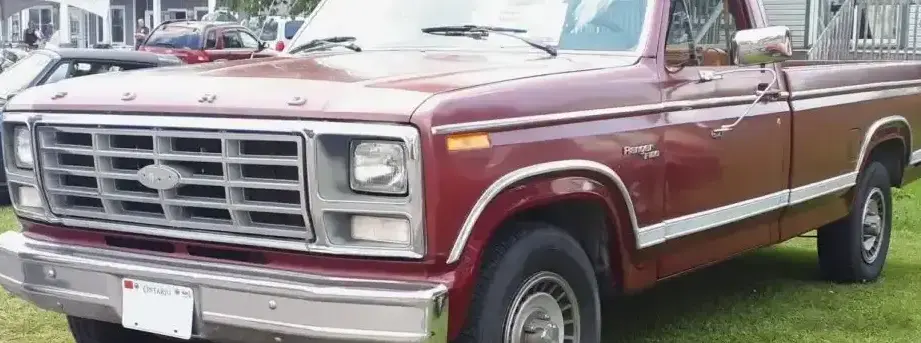
The Ford F-Series F-100 VII Regular Cab, equipped with the 4.2-liter V8 engine producing 115 horsepower, represents a transitional period for the iconic Ford pickup truck. Produced for a relatively short period, from 1981 to 1982, this variant occupied a middle ground in the F-Series lineup, offering a step up in power from the smaller six-cylinder engines while remaining more affordable than the larger and more potent 351 Windsor V8. It was part of the seventh generation of the F-Series (1980-1986), a generation that saw significant changes in styling and engineering compared to its predecessor, moving towards a more aerodynamic and fuel-efficient design. This particular configuration was primarily aimed at buyers needing a capable work truck without the expense of the higher-trim models.
Technical Specifications
| Brand | Ford |
| Model | F-Series F-100/F-150 |
| Generation | F-Series F-100 VII Regular Cab |
| Type (Engine) | 4.2 V8 (115 Hp) |
| Start of production | 1981 |
| End of production | 1982 |
| Powertrain Architecture | Internal Combustion engine |
| Body type | Pick-up |
| Seats | 2-3 |
| Doors | 2 |
| Fuel Type | Petrol (Gasoline) |
| Power | 115 Hp |
| Power per litre | 27.5 Hp/l |
| Torque | 279 Nm / 205.78 lb.-ft. |
| Engine layout | Front, Longitudinal |
| Engine displacement | 4179 cm3 / 255.02 cu. in. |
| Number of cylinders | 8 |
| Engine configuration | V-engine |
| Fuel injection system | Carburettor |
| Engine aspiration | Naturally aspirated engine |
| Max. weight | 2336 kg / 5150 lbs. |
| Fuel tank capacity | 62-72 l / 16.38 – 19.02 US gal | 13.64 – 15.84 UK gal |
| Length | 4808-5291 mm / 189.29 – 208.31 in. |
| Width | 1372-1778 mm / 54.02 – 70 in. |
| Height | 1755-1760 mm / 69.09 – 69.29 in. |
| Wheelbase | 2967-3378 mm / 116.81 – 132.99 in. |
| Wading depth | 696-721 mm / 27.4 – 28.39 in. |
| Drivetrain Architecture | The Internal combustion engine (ICE) drives the rear wheels of the vehicle. |
| Drive wheel | Rear wheel drive |
| Number of gears and type of gearbox | 3 gears, manual transmission |
| Front suspension | Independent coil spring |
| Front brakes | Disc |
| Rear brakes | Drum |
| Power steering | Electric Steering |
| Tires size | 195/75 R15; 205/75 R15 |
| Wheel rims size | 5.5J x 15 |
Powertrain & Engine Architecture
The heart of this F-100 variant is the 4.2-liter (255 cubic inch) V8 engine. This engine, often referred to as the 300 cubic inch inline-six’s “big brother”, was a relatively simple and robust design. It utilized a cast iron block and cylinder heads, and was equipped with a two-barrel carburetor for fuel delivery. The engine featured a traditional pushrod valvetrain with two valves per cylinder. While not a high-performance engine, it was known for its durability and low-end torque. The 115 horsepower output was adequate for typical light-duty truck tasks, but it wasn’t particularly exciting in terms of acceleration. The engine was mounted longitudinally in the chassis, driving the rear wheels through a three-speed manual transmission. This transmission was a standard offering, providing basic gear selection for work and hauling. An automatic transmission was available as an option, but the three-speed manual was the more common choice for this trim level.
Driving Characteristics
The driving experience in the 1981-1982 F-100 with the 4.2L V8 and manual transmission was characterized by its utilitarian nature. The three-speed manual gearbox offered a relatively wide gear spread, with a low first gear for starting with a load and a higher third gear for highway cruising. However, the lack of overdrive meant that engine speeds were relatively high at highway speeds, contributing to increased fuel consumption and noise. The engine delivered its peak torque at lower RPMs, making it well-suited for hauling and towing, but acceleration was modest. Compared to the available 351 Windsor V8, the 4.2L felt significantly less powerful, especially when fully loaded. The suspension, while adequate for most road conditions, was tuned for work rather than comfort, resulting in a somewhat firm ride. Steering was manual in many cases, requiring more effort at lower speeds.
Equipment & Trim Levels
The F-100 in this configuration typically represented the base or near-base trim level. Standard features were minimal, focusing on functionality rather than luxury. The interior usually consisted of a vinyl bench seat, a basic dashboard with essential gauges, and rubber floor mats. Options were available, including upgraded upholstery, a radio, and air conditioning, but these were often added at extra cost. The exterior typically featured minimal chrome trim and basic steel wheels. The emphasis was on providing a durable and affordable work truck, rather than a comfortable or stylish vehicle. The F-100 was available in a variety of cab and bed configurations, including regular cab, SuperCab (extended cab), and various bed lengths.
Chassis & Braking
The F-100’s chassis was a traditional body-on-frame construction, providing a robust and durable platform. The front suspension utilized independent coil springs, offering a reasonable level of ride comfort and handling. The rear suspension employed leaf springs, which were well-suited for carrying heavy loads. Braking was accomplished with disc brakes on the front wheels and drum brakes on the rear. Power steering was often an optional extra, with many models equipped with manual steering. Tire sizes typically ranged from 195/75R15 to 205/75R15, providing adequate traction for most applications. The frame itself was designed to withstand the stresses of heavy hauling and off-road use.
Market Reception & Comparison
The 1981-1982 F-100 with the 4.2L V8 was generally well-received as a capable and affordable work truck. Critics noted its durability and low-end torque, but also pointed out its lack of refinement and modest performance. Compared to the six-cylinder models, the 4.2L V8 offered a significant increase in power, making it a more suitable choice for those who frequently hauled or towed. However, it was less fuel-efficient than the six-cylinder engines. Compared to the 351 Windsor V8, the 4.2L was significantly less powerful, but also more affordable to purchase and maintain. The 4.2L engine was often seen as a good compromise between power, fuel economy, and cost.
Legacy
The 4.2L V8-powered F-100 has become a popular choice among classic truck enthusiasts. Its simplicity and durability make it relatively easy to maintain and repair. While not a high-performance vehicle, it offers a unique driving experience and a connection to a bygone era of American truck manufacturing. Today, these trucks are often found in restored condition or used as daily drivers. The 4.2L engine, while not as sought-after as some of the larger Ford V8s, is still considered a reliable and capable powerplant. Parts availability is generally good, and the truck’s relatively simple design makes it a good candidate for restoration projects. The F-100 remains a symbol of American work ethic and a testament to Ford’s long-standing tradition of building tough and dependable trucks.