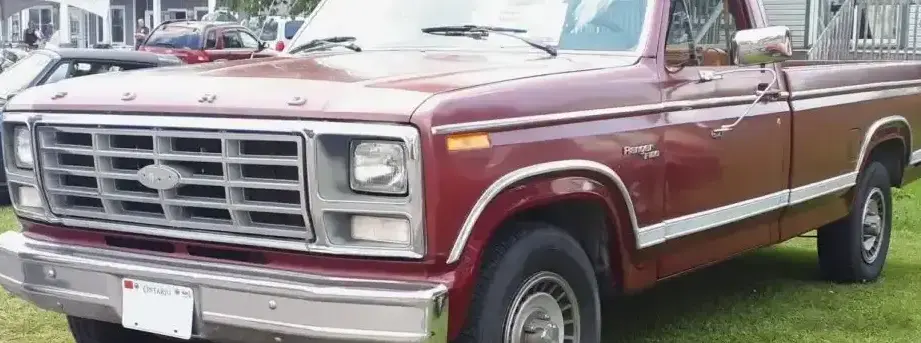
The Ford F-Series F-100 VII Regular Cab, equipped with the 4.9-liter inline-six engine producing 120 horsepower, represents a significant iteration in Ford’s long-running and immensely popular F-Series pickup truck lineage. Produced from 1979 through 1981, this variant occupied a crucial position in the lineup, offering a balance between affordability, capability, and fuel economy for buyers needing a workhorse vehicle. It falls within the seventh generation of the F-Series (1973-1979, with minor updates extending into 1980), a generation known for its increased size, comfort, and refinement compared to its predecessors. This particular configuration was aimed at buyers who didn’t require the higher performance of the V8 options, but still needed a dependable truck for everyday tasks and light-duty hauling.
Technical Specifications
| Brand | Ford |
| Model | F-Series F-100/F-150 |
| Generation | F-Series F-100 VII Regular Cab |
| Type (Engine) | 4.9 Six (120 Hp) |
| Start of production | September, 1979 |
| End of production | 1981 |
| Powertrain Architecture | Internal Combustion engine |
| Body type | Pick-up |
| Seats | 2-3 |
| Doors | 2 |
| Fuel Type | Petrol (Gasoline) |
| Power | 120 Hp |
| Power per litre | 24.4 Hp/l |
| Torque | 310 Nm / 228.64 lb.-ft. |
| Engine layout | Front, Longitudinal |
| Engine displacement | 4916 cm3 / 299.99 cu. in. |
| Number of cylinders | 6 |
| Engine configuration | Inline |
| Fuel injection system | Carburettor |
| Engine aspiration | Naturally aspirated engine |
| Max. weight | 2336 kg / 5150 lbs. |
| Fuel tank capacity | 62-72 l / 16.38 – 19.02 US gal | 13.64 – 15.84 UK gal |
| Length | 4808-5291 mm / 189.29 – 208.31 in. |
| Width | 1372-1778 mm / 54.02 – 70 in. |
| Height | 1755-1760 mm / 69.09 – 69.29 in. |
| Wheelbase | 2967-3378 mm / 116.81 – 132.99 in. |
| Wading depth | 696-721 mm / 27.4 – 28.39 in. |
| Drivetrain Architecture | The Internal combustion engine (ICE) drives the rear wheels of the vehicle. |
| Drive wheel | Rear wheel drive |
| Number of gears and type of gearbox | 3 gears, manual transmission |
| Front suspension | Independent coil spring |
| Front brakes | Disc |
| Rear brakes | Drum |
| Power steering | Electric Steering |
| Tires size | 195/75 R15; 205/75 R15 |
| Wheel rims size | 5.5J x 15 |
Powertrain & Engine Architecture
The heart of this F-100 variant is Ford’s 4.9-liter (299 cubic inch) inline-six engine. This engine, often referred to as the “300 six” due to its later, more common 4.9-liter displacement, was a mainstay of Ford’s truck and van lineup for decades. The 1979-1981 version produced 120 horsepower and 310 Nm (228.64 lb-ft) of torque. It utilized a single-barrel carburetor for fuel delivery, a relatively simple system known for its reliability, though less efficient than fuel injection. The engine featured a cast iron block and head, contributing to its durability. The valvetrain employed a traditional pushrod configuration. The three-speed manual transmission was the standard offering, providing straightforward gear changes. While not particularly sophisticated, this transmission was robust and well-suited to the engine’s torque characteristics.
Driving Characteristics
The 4.9-liter engine and three-speed manual transmission combination delivered a practical, if not exhilarating, driving experience. Acceleration was modest, but the engine provided ample low-end torque for hauling and towing. The gear ratios were optimized for work, prioritizing pulling power over rapid acceleration. Compared to the V8-powered F-100s, this variant felt noticeably slower, especially when fully loaded. However, the inline-six was smoother and quieter than the V8s, and it offered better fuel economy. The manual transmission allowed for precise control, particularly useful when navigating challenging terrain or towing heavy loads. The truck’s suspension, while designed for durability, provided a somewhat firm ride, especially when unladen.
Equipment & Trim Levels
The F-100 in this configuration typically represented the base trim level. Standard features included a basic vinyl bench seat, a simple dashboard with essential gauges, and a manually operated transmission. Options were available to enhance comfort and convenience, such as an upgraded radio, a heater and defroster, and different exterior paint colors. Power steering was often included, but air conditioning was typically an extra-cost option. The interior was functional and utilitarian, designed to withstand the rigors of daily use. The exterior styling was typical of the late 1970s Ford trucks, with a squared-off design and a prominent grille.
Chassis & Braking
The F-100 VII utilized a body-on-frame construction, providing a robust and durable chassis. The front suspension featured independent coil springs, offering a degree of ride comfort and handling. The rear suspension employed leaf springs, designed to handle heavy loads. The braking system consisted of disc brakes at the front and drum brakes at the rear. Power steering was often included, making maneuvering the large truck easier. Tire sizes typically ranged from 195/75 R15 to 205/75 R15, providing a balance between traction and ride quality. The truck’s relatively simple suspension and braking systems were reliable and easy to maintain.
Market Reception & Comparison
The 4.9-liter F-100 was well-received by buyers seeking a dependable and affordable work truck. Critics praised its durability and fuel economy, particularly compared to the V8 options. However, its lack of power was a common criticism. Compared to the F-150, which offered heavier-duty components and more powerful engine options, the F-100 was positioned as a lighter-duty truck suitable for everyday tasks and light hauling. The 300 six engine was known for its longevity, and many examples remain on the road today. The manual transmission was favored by those who preferred greater control and simplicity.
Legacy
The Ford F-100 with the 4.9-liter inline-six engine has earned a reputation for reliability and longevity. The 300 six engine is considered by many to be one of Ford’s most durable engines ever produced. In the used car market, these trucks are often sought after by enthusiasts and those looking for a simple, dependable work vehicle. Parts availability is generally good, and the truck’s relatively simple mechanical design makes it relatively easy to maintain. While not a high-performance machine, the 4.9-liter F-100 represents a significant chapter in the history of Ford trucks, embodying the values of durability, practicality, and affordability that have made the F-Series America’s best-selling truck for decades.