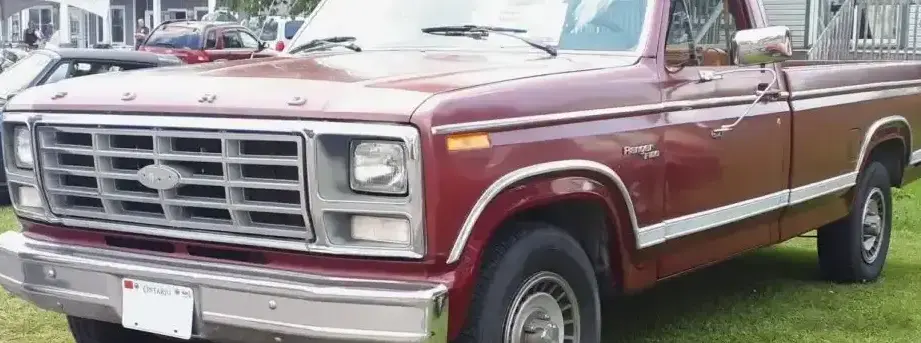
The Ford F-Series F-100 VII Regular Cab, equipped with the 5.0-liter V8 engine producing 133 horsepower, represents a significant iteration in Ford’s long-running and immensely popular F-Series pickup truck line. Produced from 1979 through 1983, this generation (often referred to as the “seventh generation”) marked a period of refinement and adaptation to changing market demands, including increased fuel efficiency concerns and evolving emissions regulations. This particular variant, the F-100 with the 302 cubic inch V8, occupied a middle ground in the F-Series lineup, offering a balance between capability and affordability. It served as a workhorse for farmers, ranchers, and tradespeople, while also appealing to those seeking a robust and reliable personal transportation vehicle.
Technical Specifications
| Brand | Ford |
| Model | F-Series F-100/F-150 |
| Generation | F-Series F-100 VII Regular Cab |
| Type (Engine) | 5.0 V8 (133 Hp) |
| Start of production | September, 1979 |
| End of production | 1983 |
| Powertrain Architecture | Internal Combustion engine |
| Body type | Pick-up |
| Seats | 2-3 |
| Doors | 2 |
| Fuel Type | Petrol (Gasoline) |
| Power | 133 Hp |
| Power per litre | 26.9 Hp/l |
| Torque | 316 Nm / 233.07 lb.-ft. |
| Engine layout | Front, Longitudinal |
| Engine displacement | 4949 cm3 / 302.01 cu. in. |
| Number of cylinders | 8 |
| Engine configuration | V-engine |
| Fuel injection system | Carburettor |
| Engine aspiration | Naturally aspirated engine |
| Max. weight | 2336 kg / 5150 lbs. |
| Fuel tank capacity | 62-72 l / 16.38 – 19.02 US gal | 13.64 – 15.84 UK gal |
| Length | 4808-5291 mm / 189.29 – 208.31 in. |
| Width | 1372-1778 mm / 54.02 – 70 in. |
| Height | 1755-1760 mm / 69.09 – 69.29 in. |
| Wheelbase | 2967-3378 mm / 116.81 – 132.99 in. |
| Wading depth | 696-721 mm / 27.4 – 28.39 in. |
| Drivetrain Architecture | The Internal combustion engine (ICE) drives the rear wheels of the vehicle. |
| Drive wheel | Rear wheel drive |
| Number of gears and type of gearbox | 3 gears, manual transmission |
| Front suspension | Independent coil spring |
| Front brakes | Disc |
| Rear brakes | Drum |
| Power steering | Electric Steering |
| Tires size | 195/75 R15; 205/75 R15 |
| Wheel rims size | 5.5J x 15 |
Powertrain & Engine Architecture
The heart of this F-100 variant is the 4.9-liter (302 cubic inch) Ford Windsor V8 engine. This engine, designated internally as the 302, is a small-block V8 known for its durability and relatively simple design. The 1979-1983 versions were typically equipped with a two-barrel carburetor, a configuration chosen to balance power delivery with fuel economy – a growing concern during this period. The engine features a cast iron block and cylinder heads, and utilizes a traditional pushrod valvetrain. The 133 horsepower output was a result of compromises made to meet tightening emissions standards. While the engine was capable of more power, the carburetor and exhaust system were tuned for lower emissions rather than peak performance. The engine’s longitudinal front-engine layout, coupled with a rear-wheel-drive drivetrain, was a standard configuration for American pickup trucks of the era. The standard transmission for this model year was a three-speed manual, providing a direct and robust connection between the engine and the rear wheels.
Driving Characteristics
The F-100 with the 302 V8 and three-speed manual transmission offered a practical and capable driving experience. While not a performance-oriented truck, the engine provided sufficient torque for hauling and towing, especially considering the relatively light weight of the F-100 compared to the heavier F-150 and F-250 models. The three-speed manual transmission, while simple, offered a good balance of usability and efficiency. Gear ratios were optimized for everyday driving and work-related tasks. Compared to the available six-cylinder engine, the V8 provided a noticeable increase in power and responsiveness. However, it lacked the higher horsepower figures of the larger V8 options available in the F-Series lineup. The truck’s suspension, featuring independent coil springs in the front and leaf springs in the rear, provided a reasonably comfortable ride, even when carrying a load. Steering was accomplished through a power steering system, making maneuvering the truck relatively easy.
Equipment & Trim Levels
The F-100 was offered in a variety of trim levels, ranging from basic work trucks to more comfortable and well-equipped models. The base model typically featured a vinyl bench seat, a simple dashboard with basic gauges, and minimal exterior trim. Optional equipment included a more comfortable cloth bench seat, upgraded interior trim, a radio, and air conditioning. Exterior options included chrome bumpers, bright wheel covers, and a sliding rear window. The F-100’s interior was designed for practicality and durability, with a focus on ease of cleaning and maintenance. The dashboard layout was straightforward, with clearly labeled controls and gauges. The overall aesthetic was functional rather than luxurious.
Chassis & Braking
The F-100’s chassis was a traditional body-on-frame construction, providing a robust and durable platform for hauling and towing. The front suspension utilized independent coil springs, offering a more comfortable ride compared to the solid axle setups found in some earlier trucks. The rear suspension featured leaf springs, which were well-suited for carrying heavy loads. Braking duties were handled by disc brakes in the front and drum brakes in the rear. While adequate for the truck’s weight and intended use, the braking system was not particularly sophisticated by modern standards. Power steering was standard, making it easier to maneuver the truck, especially at low speeds.
Market Reception & Comparison
The F-100 with the 5.0 V8 and manual transmission was generally well-received by buyers seeking a capable and affordable pickup truck. Critics praised the truck’s durability, reliability, and overall value. However, some noted that the engine’s horsepower output was relatively modest compared to some of its competitors. Compared to the six-cylinder F-100, the V8 offered a significant performance advantage, but at a slightly higher price. Compared to the larger V8-powered F-150 and F-250 models, the F-100 offered a more manageable size and weight, making it easier to drive and maneuver in urban environments. Fuel economy was a concern for some buyers, but the F-100’s fuel consumption was generally comparable to other pickup trucks of the era.
Legacy
The Ford F-Series F-100 VII Regular Cab, particularly the 5.0 V8 variant, has become a popular choice among classic truck enthusiasts. The 302 Windsor V8 engine is known for its reliability and ease of maintenance, making it a relatively affordable engine to rebuild or repair. Parts availability is generally good, thanks to the engine’s widespread use in other Ford vehicles. Today, these trucks are often sought after for restoration projects, and well-maintained examples can command a premium price. The F-100’s enduring popularity is a testament to its robust construction, simple design, and timeless appeal. It remains a symbol of American automotive history and a reminder of a time when pickup trucks were built to work hard and last a long time.