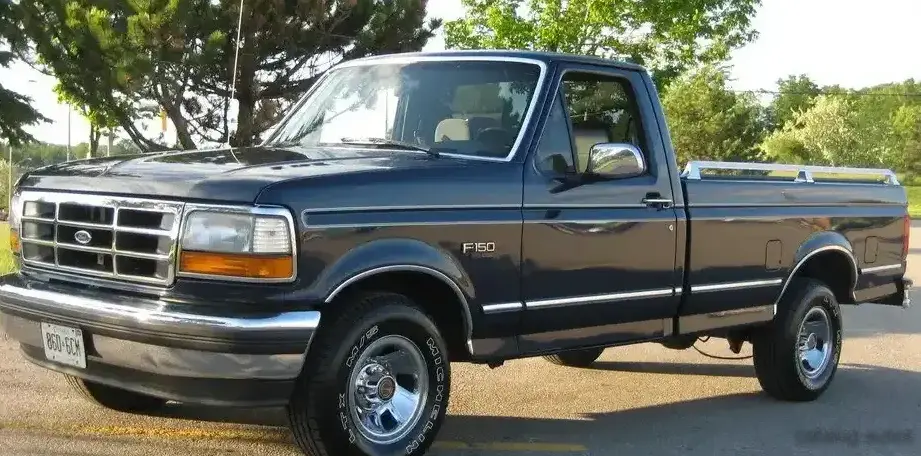
The Ford F-Series F-150 IX Regular Cab, equipped with the 4.9-liter inline-six engine and a four-speed automatic transmission, represents a workhorse configuration within the ninth generation of Ford’s immensely popular F-Series pickup trucks. Produced from 1991 to 1993, this variant occupied the entry-level position in the F-150 lineup, offering a balance of affordability, capability, and the convenience of an automatic transmission. It was a mainstay for buyers needing a reliable 4×4 truck for work or personal use, prioritizing practicality over outright performance.
Technical Specifications
| Brand | Ford |
| Model | F-Series F-150 IX Regular Cab |
| Type (Engine) | 4.9 (145 Hp) 4×4 Automatic |
| Start of production | August, 1991 |
| End of production | 1993 |
| Powertrain Architecture | Internal Combustion engine |
| Body type | Pick-up |
| Seats | 3 |
| Doors | 2 |
| Fuel Type | Petrol (Gasoline) |
| Power | 145 Hp @ 3400 rpm |
| Power per litre | 29.6 Hp/l |
| Torque | 360 Nm @ 2000 rpm / 265.52 lb.-ft. @ 2000 rpm |
| Engine layout | Front, Longitudinal |
| Engine displacement | 4900 cm3 / 299.02 cu. in. |
| Number of cylinders | 6 |
| Engine configuration | Inline |
| Cylinder Bore | 101.6 mm / 4 in. |
| Piston Stroke | 101 mm / 3.98 in. |
| Number of valves per cylinder | 2 |
| Fuel injection system | Multi-port manifold injection |
| Engine aspiration | Naturally aspirated engine |
| Engine oil capacity | 4.7 l / 4.97 US qt | 4.14 UK qt |
| Max. weight | 2835 kg / 6250.11 lbs |
| Fuel tank capacity | 69-141 l / 18.23 – 37.25 US gal | 15.18 – 31.02 UK gal |
| Length | 5006-5418 mm / 197.09 – 213.31 in. |
| Width | 2007 mm / 79.02 in. |
| Height | 1872 mm / 73.7 in. |
| Wheelbase | 2972-3378 mm / 117.01 – 132.99 in. |
| Wading depth | 851 mm / 33.5 in. |
| Drivetrain Architecture | The Internal combustion engine (ICE) drives the rear wheels permanently, and the front wheels are driven through an electrically or mechanically operated clutch if necessary. |
| Drive wheel | All wheel drive (4×4) |
| Number of gears and type of gearbox | 4 gears, automatic transmission |
| Front suspension | Independent coil spring |
| Rear suspension | Leaf spring |
| Front brakes | Disc |
| Rear brakes | Drum |
| Power steering | Electric Steering |
| Tires size | 235/75 R15 |
| Wheel rims size | 15 |
Introduction
The F-150 IX, part of the broader ninth-generation F-Series (1987-1991, with carryover into 1992-1993), represented a significant evolution in Ford’s pickup truck design. This generation saw increased emphasis on aerodynamics and interior comfort, while retaining the rugged durability expected of a Ford truck. The 1991-1993 models, like the F-150 IX, were largely carryovers from the previous year, with minor refinements. The 4.9-liter engine and automatic transmission combination was aimed at buyers who preferred the ease of use of an automatic over a manual transmission, and didn’t require the higher performance offered by the optional 5.0-liter V8 or the 5.8-liter V8.
Powertrain & Engine Architecture
The heart of this F-150 variant is the 4.9-liter (299 cubic inch) inline-six engine, often referred to as the “300 six” due to its historical predecessor. While officially rated at 145 horsepower at 3400 rpm and 360 Nm (265.52 lb-ft) of torque at 2000 rpm, this engine was known for its robust low-end torque and durability. The engine utilized a multi-port fuel injection system, a significant upgrade from the carbureted engines of earlier F-Series trucks, improving fuel efficiency and driveability. The engine’s valvetrain featured two valves per cylinder, operated by a single overhead camshaft. The four-speed automatic transmission (typically the AOD) was chosen for its simplicity and ease of operation. While not known for its quick shifts, it provided smooth and reliable performance for everyday driving and towing.
Driving Characteristics
The 4.9-liter engine and automatic transmission pairing delivered a driving experience focused on usability rather than speed. Acceleration was modest, but the engine’s strong low-end torque made it capable of handling moderate loads and tackling varied terrain. The automatic transmission’s gear ratios were optimized for towing and hauling, prioritizing pulling power over quick acceleration. Compared to the V8-powered F-150s, this variant felt noticeably slower, especially when fully loaded. However, the automatic transmission made it more accessible to a wider range of drivers, particularly those unfamiliar with manual transmissions. The 4×4 system provided enhanced traction in slippery conditions, making it a capable off-road vehicle for light to moderate trails.
Equipment & Trim Levels
The F-150 IX Regular Cab with the 4.9-liter engine and automatic transmission typically came with a fairly basic level of equipment. Standard features generally included a vinyl bench seat, basic instrumentation, and a simple AM/FM radio. Air conditioning was often an optional extra, as were power windows and locks. The interior trim was utilitarian, designed for durability and ease of cleaning. Buyers could opt for upgrades such as a cloth bench seat, a tilt steering wheel, and a more advanced sound system. The “IX” designation generally indicated a mid-range trim level, offering a step up from the base model but falling short of the more luxurious XLT trim.
Chassis & Braking
The F-150 IX featured a traditional body-on-frame construction, providing a robust and durable platform. The front suspension utilized independent coil springs, offering a relatively comfortable ride. The rear suspension employed leaf springs, designed to handle heavy loads. The braking system consisted of disc brakes on the front wheels and drum brakes on the rear. Power steering was standard, making it easier to maneuver the large pickup truck. The 235/75 R15 tires provided a good balance of on-road comfort and off-road traction. The chassis was designed to accommodate the truck’s weight and provide a stable platform for hauling and towing.
Market Reception & Comparison
The 4.9-liter F-150 with an automatic transmission was a popular choice for buyers who prioritized affordability and reliability. Critics generally praised the engine’s durability and low-end torque, but noted its lack of outright power. Compared to the V8-powered F-150s, this variant offered lower fuel consumption, but at the expense of performance. The automatic transmission was seen as a convenient feature, but some reviewers preferred the responsiveness of a manual transmission. In terms of reliability, the 4.9-liter engine was considered one of Ford’s most dependable powerplants, and the AOD automatic transmission, while not without its issues, was generally reliable when properly maintained.
Legacy
The 4.9-liter inline-six engine has earned a reputation as a remarkably durable and long-lasting powerplant. Many examples of this engine are still in service today, often with hundreds of thousands of miles on the odometer. The combination of the 4.9-liter engine and the AOD automatic transmission, while not the most exciting powertrain, proved to be a reliable and practical choice for many F-150 owners. In the used car market, these trucks are often sought after by those looking for a simple, affordable, and dependable work truck. While not a collector’s item, a well-maintained F-150 IX with the 4.9-liter engine represents a piece of American automotive history and a testament to Ford’s commitment to building durable and reliable trucks.