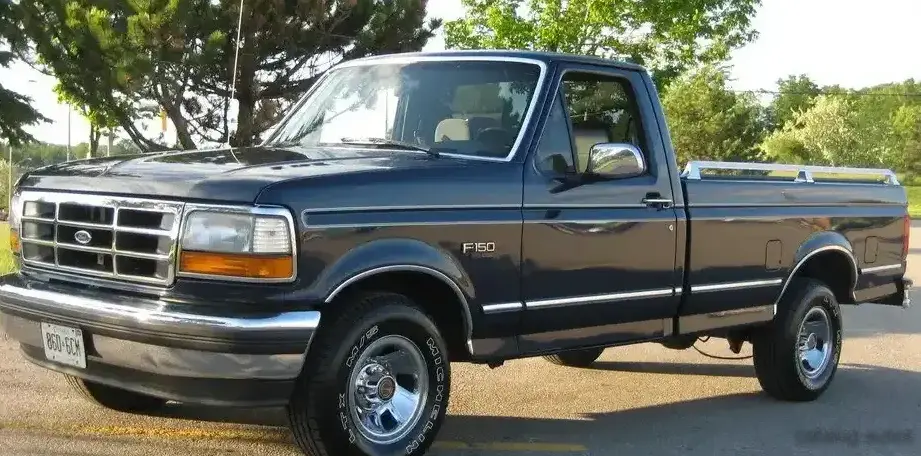
The Ford F-Series F-150 IX Regular Cab, equipped with the 4.9-liter inline-six engine producing 150 horsepower and paired with a four-speed automatic transmission and four-wheel drive, was a mainstay of Ford’s truck lineup from 1994 to 1997. This configuration represented a work-oriented, value-focused option within the ninth generation (F-Series IX) of Ford’s best-selling pickup truck. It served as a popular choice for buyers prioritizing capability and affordability over outright performance, particularly in regions where all-wheel drive was essential for work or recreational purposes. This model sat firmly as the entry-level engine and drivetrain option for those needing 4×4 capability.
Technical Specifications
| Brand | Ford |
| Model | F-Series F-150 IX Regular Cab |
| Type (Engine) | 4.9 (150 Hp) 4×4 Automatic |
| Start of production | 1994 |
| End of production | 1997 |
| Powertrain Architecture | Internal Combustion engine |
| Body type | Pick-up |
| Seats | 3 |
| Doors | 2 |
| Fuel Type | Petrol (Gasoline) |
| Power | 150 Hp |
| Power per litre | 30.6 Hp/l |
| Torque | 353 Nm / 260.36 lb.-ft. |
| Engine layout | Front, Longitudinal |
| Engine displacement | 4900 cm3 / 299.02 cu. in. |
| Number of cylinders | 6 |
| Engine configuration | Inline |
| Cylinder Bore | 101.6 mm / 4 in. |
| Piston Stroke | 101 mm / 3.98 in. |
| Number of valves per cylinder | 2 |
| Fuel injection system | Multi-port manifold injection |
| Engine aspiration | Naturally aspirated engine |
| Engine oil capacity | 4.7 l / 4.97 US qt | 4.14 UK qt |
| Coolant | 13 l / 13.74 US qt | 11.44 UK qt |
| Max. weight | 2835 kg / 6250.11 lbs. |
| Fuel tank capacity | 69-141 l / 18.23 – 37.25 US gal | 15.18 – 31.02 UK gal |
| Length | 5006-5418 mm / 197.09 – 213.31 in. |
| Width | 2007 mm / 79.02 in. |
| Height | 1872 mm / 73.7 in. |
| Wheelbase | 2972-3378 mm / 117.01 – 132.99 in. |
| Wading depth | 851 mm / 33.5 in. |
| Drivetrain Architecture | The Internal combustion engine (ICE) drives the rear wheels permanently, and the front wheels are driven through an electrically or mechanically operated clutch if necessary. |
| Drive wheel | All wheel drive (4×4) |
| Number of gears and type of gearbox | 4 gears, automatic transmission |
| Front suspension | Independent coil spring |
| Rear suspension | Leaf spring |
| Front brakes | Disc |
| Rear brakes | Drum |
| Power steering | Electric Steering |
| Tires size | 235/75 R15 |
| Wheel rims size | 15 |
Powertrain & Engine Architecture
The heart of this F-150 variant was the 4.9-liter (299 cubic inch) inline-six engine, often referred to as the “300 six” due to its earlier 4.9-liter predecessor. This engine, designated internally as the 4.9L Windsor, was a long-stroke design known for its durability and low-end torque. It featured a cast-iron block and cylinder head, and a two-valve-per-cylinder configuration. Fuel delivery was handled by a multi-port fuel injection system, a significant upgrade from the carburetor systems used in earlier F-Series trucks. The engine produced 150 horsepower and 353 Nm (260 lb-ft) of torque. The four-speed automatic transmission (typically the AOD or 4R70W, depending on the specific year and application) was chosen for its ease of use and suitability for work applications. While not offering the quickest acceleration, the automatic transmission provided smooth shifts and allowed the driver to focus on the task at hand. The 4×4 system employed a transfer case allowing the driver to switch between two-wheel drive and four-wheel drive modes, enhancing traction in challenging conditions.
Driving Characteristics
The 150 horsepower and automatic transmission combination resulted in a driving experience geared towards utility rather than sportiness. Acceleration was modest, and the truck felt most comfortable at lower speeds and when hauling or towing. The automatic transmission’s gear ratios were optimized for torque multiplication, providing adequate power for everyday tasks and moderate loads. Compared to the optional 5.0-liter V8 or the later 5.8-liter V8, this 4.9-liter engine offered significantly less horsepower and quicker acceleration. However, it also provided better fuel economy and a simpler, more robust mechanical design. The 4×4 system, when engaged, provided enhanced traction on slippery surfaces, making it suitable for off-road use and inclement weather. The leaf spring rear suspension, while providing a stable platform for hauling, resulted in a firmer ride compared to coil-sprung setups.
Equipment & Trim Levels
The 4.9-liter, 4×4 automatic F-150 typically came with a relatively basic level of equipment, reflecting its position as a value-oriented trim. Standard features generally included a basic AM/FM radio, vinyl upholstery, and manual windows and locks. Air conditioning was often an optional extra, as were power windows and locks. The interior was functional and durable, designed to withstand the rigors of work-truck use. Higher trim levels, such as the XLT, offered more luxurious features like cloth upholstery, upgraded sound systems, and additional convenience items. However, the base model prioritized affordability and practicality.
Chassis & Braking
The F-150 IX Regular Cab utilized a body-on-frame construction, providing a robust and durable chassis. The front suspension consisted of independent coil springs, while the rear suspension employed leaf springs. This configuration was typical for trucks of this era and provided a good balance of load-carrying capacity and ride comfort. The braking system featured disc brakes on the front wheels and drum brakes on the rear. Power steering was standard, making maneuvering the large truck easier. The 235/75R15 tires provided adequate grip for most driving conditions, and the 15-inch steel wheels were durable and affordable.
Market Reception & Comparison
The 4.9-liter, 4×4 automatic F-150 was well-received by buyers who needed a capable and affordable work truck. Critics generally praised its durability and low-end torque, but noted its lack of outright performance. Compared to the V8-powered F-150s, this variant offered better fuel economy, but at the expense of acceleration and towing capacity. The 4.9-liter engine was known for its reliability, and maintenance costs were generally lower than those associated with the V8 engines. This made it a popular choice for fleet buyers and individuals who prioritized long-term ownership costs.
Legacy
The 4.9-liter inline-six engine has earned a reputation as one of Ford’s most durable and reliable engines. Many examples are still on the road today, testament to its robust design and simple mechanicals. The combination of the 4.9-liter engine and the four-speed automatic transmission, while not particularly exciting, proved to be a dependable and long-lasting powertrain. In the used car market, these F-150s are often sought after by those looking for a simple, affordable, and capable truck. Parts availability remains good, and the engine is relatively easy to work on, making it a popular choice for restoration projects and DIY mechanics. While not a collector’s item, the 1994-1997 F-150 with the 4.9-liter engine and automatic transmission represents a solid and dependable piece of American automotive history.