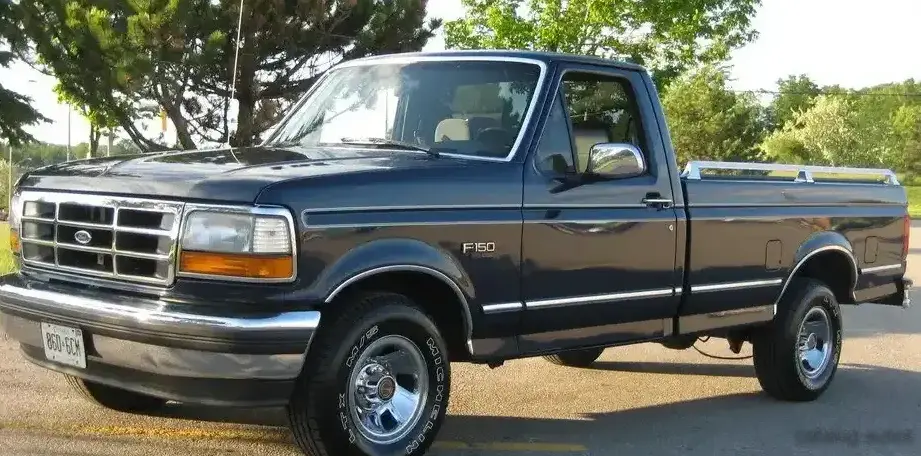
The Ford F-Series F-150 IX Regular Cab, equipped with the 5.8-liter V8 engine and automatic transmission, represents a significant iteration of America’s best-selling vehicle. Produced from 1991 through 1997, this configuration occupied a middle ground within the ninth generation (F-Series IX) of Ford’s full-size pickup truck line. It catered to buyers seeking a balance between capability, affordability, and the convenience of an automatic gearbox. This variant was positioned below the higher-output 5.8L and diesel options, and above the smaller 4.9L inline-six, making it a popular choice for both personal and light-duty commercial use.
Technical Specifications
| Brand | Ford |
| Model | F-Series F-100/F-150 |
| Generation | F-Series F-150 IX Regular Cab |
| Type (Engine) | 5.8 V8 (210 Hp) Automatic |
| Start of production | August, 1991 |
| End of production | 1997 |
| Powertrain Architecture | Internal Combustion engine |
| Body type | Pick-up |
| Seats | 3 |
| Doors | 2 |
| Fuel Type | Petrol (Gasoline) |
| Power | 210 Hp |
| Power per litre | 36.2 Hp/l |
| Torque | 427 Nm / 314.94 lb.-ft. |
| Engine layout | Front, Longitudinal |
| Engine displacement | 5800 cm3 / 353.94 cu. in. |
| Number of cylinders | 8 |
| Engine configuration | V-engine |
| Number of valves per cylinder | 2 |
| Fuel injection system | Multi-port manifold injection |
| Engine aspiration | Naturally aspirated engine |
| Engine oil capacity | 4.7 l / 4.97 US qt | 4.14 UK qt |
| Coolant | 15.5 l / 16.38 US qt | 13.64 UK qt |
| Max. weight | 2835 kg / 6250.11 lbs. |
| Fuel tank capacity | 131-141 l / 34.61 – 37.25 US gal | 28.82 – 31.02 UK gal |
| Length | 5006-5418 mm / 197.09 – 213.31 in. |
| Width | 2007 mm / 79.02 in. |
| Height | 1798 mm / 70.79 in. |
| Wheelbase | 2972-3378 mm / 117.01 – 132.99 in. |
| Wading depth | 767 mm / 30.2 in. |
| Drivetrain Architecture | The Internal combustion engine (ICE) drives the rear wheels of the vehicle. |
| Drive wheel | Rear wheel drive |
| Number of gears and type of gearbox | 4 gears, automatic transmission |
| Front suspension | Independent coil spring |
| Rear suspension | Leaf spring |
| Front brakes | Disc |
| Rear brakes | Drum |
| Power steering | Electric Steering |
| Tires size | 215/75 R15; 235/75 R15 |
| Wheel rims size | 15 |
Powertrain & Engine Architecture
The heart of this F-150 variant is Ford’s 5.8-liter (351 cubic inch) Windsor V8 engine. This engine, designated as the 351W, is a robust and relatively simple design, known for its durability and readily available parts. The 1991-1997 iteration utilized a multi-port fuel injection system, a significant upgrade from the carbureted versions of earlier years, improving fuel efficiency and throttle response. The engine features a two-valve per cylinder configuration and a cast iron block with aluminum cylinder heads. The automatic transmission paired with this engine was typically a four-speed AOD (Automatic Overdrive) transmission. This transmission provided a balance of performance and fuel economy, with the overdrive gear allowing for lower engine speeds during highway cruising. The AOD was known for its reliability, though it could be prone to overheating under heavy loads if not properly maintained. Regular fluid changes and a properly functioning auxiliary transmission cooler were crucial for longevity.
Driving Characteristics
The 210 horsepower and 315 lb-ft of torque delivered by the 5.8L V8 and AOD transmission combination provided adequate, though not exhilarating, performance. Acceleration was respectable for a full-size pickup, but it wasn’t designed for rapid starts. The AOD transmission’s gear ratios were optimized for towing and hauling, resulting in a slightly slower initial acceleration compared to the available manual transmission options. The automatic transmission smoothed out power delivery, making it easier to drive in everyday conditions. However, drivers seeking more control or wanting to maximize fuel economy often preferred the five-speed manual transmission. The truck’s leaf spring rear suspension provided a firm ride, suitable for carrying heavy loads, but could be somewhat bumpy when unloaded. The steering felt relatively heavy, typical of trucks of this era, but provided good feedback.
Equipment & Trim Levels
The F-150 IX Regular Cab with the 5.8L V8 and automatic transmission typically came standard with features like a basic AM/FM radio, manual windows and locks, and a vinyl bench seat. Higher trim levels, such as the XL and XLT, added features like air conditioning, upgraded interior trim, a tilt steering wheel, and power windows and locks. Optional extras included a cassette player, cruise control, and a sliding rear window. The interior was generally utilitarian, focused on durability and functionality rather than luxury. The Regular Cab configuration offered a basic, no-frills interior with limited storage space. The XLT trim, in particular, offered a step up in comfort with features like cloth upholstery and a more refined dashboard.
Chassis & Braking
The F-150 IX utilized a body-on-frame construction, providing a robust and durable platform. The front suspension consisted of independent coil springs, while the rear suspension employed leaf springs. This setup was designed to handle heavy loads and provide a stable ride. Braking duties were handled by disc brakes in the front and drum brakes in the rear. Power steering was standard, making the truck easier to maneuver, especially at low speeds. The tires were typically 215/75R15 or 235/75R15, providing a good balance of on-road comfort and off-road traction. The frame itself was fully boxed, contributing to the truck’s overall strength and rigidity.
Market Reception & Comparison
The 5.8L V8 automatic F-150 was well-received by buyers who prioritized convenience and reliability. Critics noted that it wasn’t the most powerful or fuel-efficient option in the lineup, but it offered a good balance of capabilities for a reasonable price. Compared to the smaller 4.9L inline-six, the 5.8L provided significantly more power and torque, making it better suited for towing and hauling. However, the 5.8L was less fuel-efficient than the 4.9L. Compared to the higher-output 5.8L variants, this 210 hp version offered a more affordable entry point into the V8 experience. The diesel options, while offering superior fuel economy and torque, came at a higher initial cost. Many buyers found this configuration to be the sweet spot for everyday use and occasional work tasks.
Legacy
The 5.8L Windsor V8 engine, in general, has a reputation for being a durable and reliable powerplant. The AOD transmission, while not without its weaknesses, is also considered relatively robust when properly maintained. Today, these F-150s are popular among collectors and enthusiasts who appreciate their classic American truck styling and simple mechanical design. Parts availability remains good, making them relatively easy to maintain and repair. While not as sought-after as some of the more powerful or rare F-150 variants, the 5.8L automatic models represent a solid and dependable choice for those seeking a classic American pickup truck. They are often seen as a good starting point for restoration projects or as reliable daily drivers for those who appreciate a simpler automotive experience. The engine’s simplicity makes it relatively easy for home mechanics to work on, further contributing to its enduring appeal.