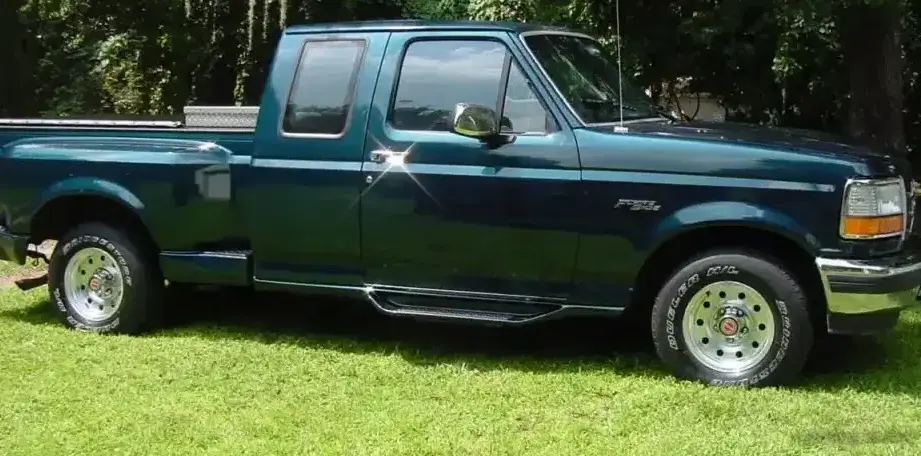
The Ford F-Series F-150 IX SuperCab, equipped with the 4.9-liter inline-six engine producing 150 horsepower and a four-wheel-drive system, was a mainstay of the American pickup truck market from 1994 to 1997. This variant occupied a crucial position in the F-150 lineup, serving as a more affordable and practical option compared to the higher-trim models with larger V8 engines. It represented a balance between capability, fuel economy, and price, appealing to a broad range of buyers – from farmers and ranchers to contractors and everyday drivers needing a versatile workhorse. The “IX” designation denoted the specific trim level, typically including features geared towards work and utility.
Technical Specifications
| Brand | Ford |
| Model | F-Series F-150 |
| Generation | F-Series F-150 IX SuperCab |
| Type (Engine) | 4.9 (150 Hp) 4×4 |
| Start of production | 1994 |
| End of production | 1997 |
| Powertrain Architecture | Internal Combustion engine |
| Body type | Pick-up |
| Seats | 5-6 |
| Doors | 2 |
| Fuel Type | Petrol (Gasoline) |
| Power | 150 Hp |
| Power per litre | 30.6 Hp/l |
| Torque | 353 Nm / 260.36 lb.-ft. |
| Engine layout | Front, Longitudinal |
| Engine displacement | 4900 cm3 / 299.02 cu. in. |
| Number of cylinders | 6 |
| Engine configuration | Inline |
| Cylinder Bore | 101.6 mm / 4 in. |
| Piston Stroke | 101 mm / 3.98 in. |
| Number of valves per cylinder | 2 |
| Fuel injection system | Multi-port manifold injection |
| Engine aspiration | Naturally aspirated engine |
| Engine oil capacity | 4.7 l / 4.97 US qt | 4.14 UK qt |
| Coolant | 12 l / 12.68 US qt | 10.56 UK qt |
| Max. weight | 2835 kg / 6250.11 lbs. |
| Fuel tank capacity | 131-141 l / 34.61 – 37.25 US gal | 28.82 – 31.02 UK gal |
| Length | 5565-5977 mm / 219.09 – 235.31 in. |
| Width | 2007 mm / 79.02 in. |
| Height | 1877 mm / 73.9 in. |
| Wheelbase | 3531-3937 mm / 139.02 – 155 in. |
| Wading depth | 848 mm / 33.39 in. |
| Drivetrain Architecture | The Internal combustion engine (ICE) drives the rear wheels permanently, and the front wheels are driven through an electrically or mechanically operated clutch if necessary. |
| Drive wheel | All wheel drive (4×4) |
| Number of gears and type of gearbox | 5 gears, manual transmission |
| Front suspension | Independent coil spring |
| Rear suspension | Leaf spring |
| Front brakes | Disc |
| Rear brakes | Drum |
| Power steering | Electric Steering |
| Tires size | 235/75 R15 |
| Wheel rims size | 15 |
Powertrain & Engine Architecture
The heart of this F-150 variant was the 4.9-liter (299 cubic inch) inline-six engine, often referred to as the “300 six” due to its earlier 4.9-liter predecessor. This engine, designated with various codes depending on the specific year and calibration, was known for its durability and relatively simple design. It featured a cast-iron block and cylinder head, a two-valve-per-cylinder configuration, and a multi-port fuel injection system. The fuel injection system, while not as sophisticated as those found in the V8 models, provided adequate fuel delivery for the engine’s output. The engine’s robust bottom end and relatively low compression ratio contributed to its longevity. The 150 horsepower was achieved at approximately 4,200 rpm, while peak torque of 260 lb-ft arrived at around 3,000 rpm. The five-speed manual transmission was the standard offering, providing a reasonable balance between fuel economy and usability. The transmission’s gear ratios were tailored to maximize the engine’s torque for hauling and towing.
Driving Characteristics
The 4.9-liter F-150 IX SuperCab 4×4 offered a distinctly different driving experience compared to its V8-powered siblings. While lacking the outright acceleration of the larger engines, it provided ample torque for everyday tasks and moderate towing duties. The manual transmission allowed for precise control, but required more driver involvement than the automatic options available on other trims. The 4×4 system, typically engaged via a floor-mounted lever or electronic switch, provided enhanced traction in off-road conditions or inclement weather. The suspension, tuned for work-truck applications, prioritized load-carrying capacity over ride comfort. The leaf spring rear suspension could feel stiff when unloaded, but settled nicely when hauling cargo. Overall, the driving experience was characterized by its practicality and dependability rather than sporty performance.
Equipment & Trim Levels
The IX trim level represented a mid-range offering within the F-150 lineup. Standard features typically included a basic AM/FM radio, vinyl upholstery, and manual windows and locks. The SuperCab configuration added extra interior space behind the front seats, offering limited seating for passengers or additional storage. Optional extras included air conditioning, a cassette player, upgraded interior trim, and various towing packages. The exterior typically featured black bumpers and side moldings, with a relatively understated appearance. The focus of the IX trim was on providing a functional and affordable truck without unnecessary frills.
Chassis & Braking
The F-150 IX SuperCab 4×4 utilized a body-on-frame construction, providing a robust and durable chassis. The front suspension featured independent coil springs, offering a degree of ride comfort and handling. The rear suspension employed leaf springs, designed to handle heavy loads. The braking system consisted of disc brakes on the front wheels and drum brakes on the rear. Power steering was standard, making maneuvering the large truck easier. The tires, typically 235/75R15, were chosen for their balance of on-road comfort and off-road capability.
Market Reception & Comparison
The 4.9-liter F-150 IX SuperCab 4×4 was generally well-received by buyers seeking a practical and affordable pickup truck. Critics praised its durability and fuel economy, particularly compared to the V8 models. However, it was often criticized for its lack of power and refinement. Compared to the 5.0-liter V8, the 4.9-liter engine offered significantly less horsepower and acceleration. However, the 4.9-liter engine typically achieved better fuel economy and required less frequent maintenance. The 4.9L engine was also seen as more reliable than the early iterations of the 5.0L V8. The 4.9L engine was a popular choice for those who prioritized practicality and longevity over outright performance.
Legacy
The 4.9-liter inline-six engine has earned a reputation for exceptional durability and longevity. Many examples of this engine are still in service today, often with well over 200,000 miles. The F-150 IX SuperCab 4×4, powered by this engine, remains a popular choice in the used truck market, particularly among those seeking a reliable and affordable work truck. While not as collectible as some of the higher-performance F-150 variants, it represents a significant chapter in the history of the Ford F-Series, embodying the values of practicality, dependability, and American ingenuity. Its simple design and robust construction have ensured its continued relevance in a world increasingly dominated by complex and technologically advanced vehicles.