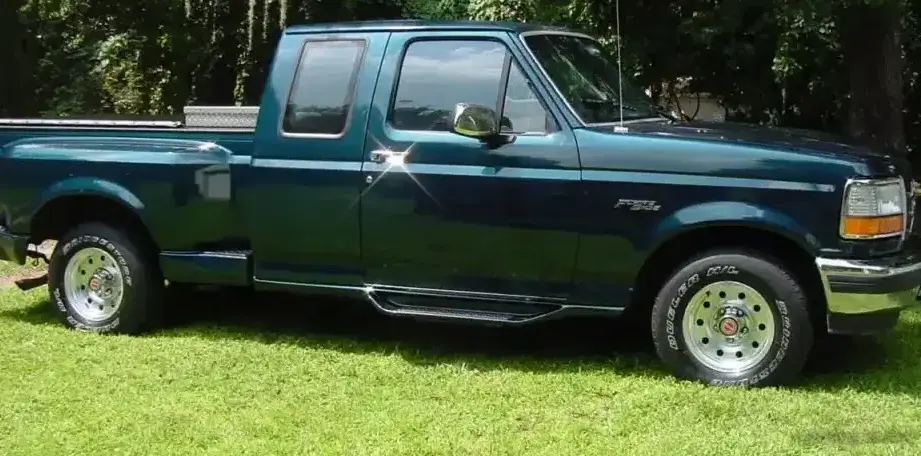
The Ford F-Series F-150 IX SuperCab, equipped with the 4.9-liter inline-six engine and a four-speed automatic transmission, was a mainstay of Ford’s full-size pickup truck lineup from 1994 through 1997. This configuration represented an entry-level offering within the ninth generation (F-Series IX) of the F-150, appealing to buyers prioritizing affordability and practicality over outright performance. The SuperCab body style offered extended passenger space compared to the standard cab, making it a popular choice for families and work crews. This variant played a significant role in maintaining the F-Series’ dominance in the highly competitive North American pickup truck market.
Technical Specifications
| Brand | Ford |
| Model | F-Series F-100/F-150 |
| Generation | F-Series F-150 IX SuperCab |
| Type (Engine) | 4.9 (150 Hp) Automatic |
| Start of production | 1994 |
| End of production | 1997 |
| Powertrain Architecture | Internal Combustion engine |
| Body type | Pick-up |
| Seats | 5-6 |
| Doors | 2 |
| Fuel Type | Petrol (Gasoline) |
| Power | 150 Hp |
| Power per litre | 30.6 Hp/l |
| Torque | 353 Nm / 260.36 lb.-ft. |
| Engine layout | Front, Longitudinal |
| Engine displacement | 4900 cm3 / 299.02 cu. in. |
| Number of cylinders | 6 |
| Engine configuration | Inline |
| Cylinder Bore | 101.6 mm / 4 in. |
| Piston Stroke | 101 mm / 3.98 in. |
| Number of valves per cylinder | 2 |
| Fuel injection system | Multi-port manifold injection |
| Engine aspiration | Naturally aspirated engine |
| Engine oil capacity | 4.7 l / 4.97 US qt | 4.14 UK qt |
| Coolant | 13 l / 13.74 US qt | 11.44 UK qt |
| Max. weight | 2835 kg / 6250.11 lbs. |
| Fuel tank capacity | 131-141 l / 34.61 – 37.25 US gal | 28.82 – 31.02 UK gal |
| Length | 5565-5977 mm / 219.09 – 235.31 in. |
| Width | 2007 mm / 79.02 in. |
| Height | 1821 mm / 71.69 in. |
| Wheelbase | 3531-3937 mm / 139.02 – 155 in. |
| Wading depth | 780 mm / 30.71 in. |
| Drivetrain Architecture | The Internal combustion engine (ICE) drives the rear wheels of the vehicle. |
| Drive wheel | Rear wheel drive |
| Number of gears and type of gearbox | 4 gears, automatic transmission |
| Front suspension | Independent coil spring |
| Rear suspension | Leaf spring |
| Front brakes | Disc |
| Rear brakes | Drum |
| Power steering | Electric Steering |
| Tires size | 235/75 R15 |
| Wheel rims size | 15 |
Powertrain & Engine Architecture
The heart of this F-150 variant was the 4.9-liter (299 cubic inch) inline-six engine, often referred to as the “300 six” due to its earlier 4.9-liter predecessor. While technically a 4.9L, it was commonly marketed as a 5.0L. This engine, designated internally as the 4.9L Windsor, was a long-stroke design known for its durability and low-end torque. It featured a cast-iron block and cylinder head, and a two-valve-per-cylinder configuration. Fuel delivery was handled by a multi-port fuel injection system, a significant upgrade from the carburetor-equipped engines of earlier F-Series models. The automatic transmission was a Ford AOD (Automatic Overdrive) four-speed unit. The AOD provided both automatic shifting and an overdrive gear for improved fuel economy at highway speeds. This transmission was known for its reliability, but could be prone to overheating under heavy loads if not properly maintained.
Driving Characteristics
The 150 horsepower and 260 lb-ft of torque produced by the 4.9-liter engine, when paired with the AOD automatic transmission, resulted in a truck that prioritized usability over outright speed. Acceleration was adequate for everyday driving, but not particularly brisk. The AOD transmission’s gear ratios were optimized for towing and hauling, providing strong low-end grunt. However, this came at the expense of quick acceleration. Compared to the optional 5.8-liter V8 or the later 4.6-liter modular V8 engines, the 4.9-liter felt noticeably less powerful. The automatic transmission also diminished the driver engagement found in the available manual transmission options. The truck’s ride quality was typical for a body-on-frame pickup of the era – firm but generally comfortable for daily use.
Equipment & Trim Levels
The 4.9-liter automatic F-150 SuperCab typically occupied the base or near-base trim level within the F-150 lineup. Standard features generally included a basic AM/FM radio, vinyl upholstery, and manual windows and locks. The SuperCab configuration added extra rear seating, increasing the truck’s passenger capacity. Optional extras included air conditioning, a cassette player, upgraded interior trim, and power windows and locks. The XL trim package was a common upgrade, adding features like color-matched exterior trim and a more comfortable interior. The SuperCab’s extended cab offered increased storage space behind the rear seats, making it a practical choice for both work and family use.
Chassis & Braking
The F-150 IX SuperCab utilized a traditional body-on-frame construction. The front suspension consisted of independent coil springs, providing a relatively comfortable ride. The rear suspension employed leaf springs, which were well-suited for carrying heavy loads. The braking system featured disc brakes on the front wheels and drum brakes on the rear. Power steering was standard, making maneuvering the large truck easier. The 235/75R15 tires provided adequate grip for most driving conditions. The chassis was designed to prioritize durability and load-carrying capacity, rather than sporty handling.
Market Reception & Comparison
The 4.9-liter automatic F-150 SuperCab was generally well-received by buyers seeking an affordable and reliable work truck. Critics noted its adequate power for most tasks, but acknowledged that it lacked the performance of the available V8 engines. Fuel economy was reasonable for a full-size pickup, but not exceptional. Compared to the V8-powered F-150s, the 4.9-liter offered lower purchase price and potentially lower maintenance costs due to its simpler design. However, the V8s provided significantly more power and towing capacity. The 4.9L/Automatic combination was often favored by those who prioritized fuel efficiency and didn’t require heavy-duty towing capabilities.
Legacy
The 4.9-liter inline-six engine and AOD automatic transmission combination proved to be remarkably durable. Many examples of these trucks remain on the road today, a testament to their robust construction. While not as sought-after as the V8-powered models, the 4.9-liter F-150 SuperCab holds a respectable position in the used car market, particularly among buyers looking for a reliable and affordable pickup truck. Parts availability remains good, and the engine’s simplicity makes it relatively easy to maintain. The 4.9L engine is still considered a very reliable engine, and is often sought after for its longevity and ease of repair. This variant represents a practical and dependable choice for those seeking a classic Ford pickup truck.