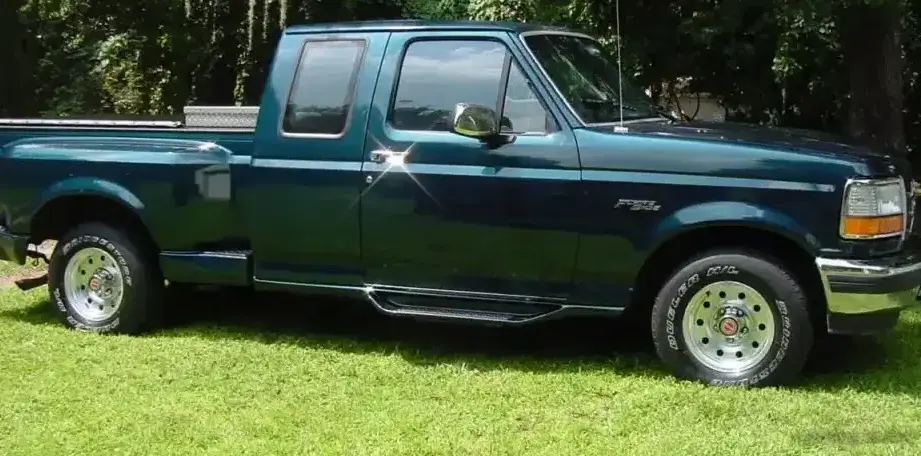
The Ford F-Series F-150 IX SuperCab, powered by the 5.0-liter V8 engine producing 185 horsepower, was a prominent fixture in Ford’s full-size pickup truck lineup from 1991 to 1993. This variant occupied a middle ground within the ninth generation (1987-1991) F-Series, striking a balance between capability and affordability. The “IX” designation identified a specific trim level, while the SuperCab configuration offered expanded passenger space compared to standard cab models. This particular engine and body style combination catered to buyers requiring a versatile truck for both work and family needs, representing a substantial portion of F-150 sales during its production years.
Technical Specifications
| Brand | Ford |
| Model | F-Series F-100/F-150 |
| Generation | F-Series F-150 IX SuperCab |
| Type (Engine) | 5.0 V8 (185 Hp) |
| Start of production | August, 1991 |
| End of production | 1993 |
| Powertrain Architecture | Internal Combustion engine |
| Body type | Pick-up |
| Seats | 5-6 |
| Doors | 2 |
| Fuel Type | Petrol (Gasoline) |
| Power | 185 Hp |
| Power per litre | 37.4 Hp/l |
| Torque | 366 Nm / 269.95 lb.-ft. |
| Engine layout | Front, Longitudinal |
| Engine displacement | 4942 cm3 / 301.58 cu. in. |
| Number of cylinders | 8 |
| Engine configuration | V-engine |
| Number of valves per cylinder | 2 |
| Fuel injection system | Multi-port manifold injection |
| Engine aspiration | Naturally aspirated engine |
| Engine oil capacity | 4.7 l / 4.97 US qt | 4.14 UK qt |
| Max. weight | 2835 kg / 6250.11 lbs. |
| Fuel tank capacity | 131-141 l / 34.61 – 37.25 US gal | 28.82 – 31.02 UK gal |
| Length | 5565-5977 mm / 219.09 – 235.31 in. |
| Width | 2007 mm / 79.02 in. |
| Height | 1821 mm / 71.69 in. |
| Wheelbase | 3531-3937 mm / 139.02 – 155 in. |
| Wading depth | 780 mm / 30.71 in. |
| Drivetrain Architecture | The Internal combustion engine (ICE) drives the rear wheels of the vehicle. |
| Drive wheel | Rear wheel drive |
| Number of gears and type of gearbox | 5 gears, manual transmission |
| Front suspension | Independent coil spring |
| Rear suspension | Leaf spring |
| Front brakes | Disc |
| Rear brakes | Drum |
| Power steering | Electric Steering |
| Tires size | 235/75 R15 |
| Wheel rims size | 15 |
Powertrain & Engine Architecture
The F-150 IX SuperCab’s powertrain centered around Ford’s 302 cubic inch (4.9 liter) 5.0-liter V8 engine. This engine, belonging to the Windsor family, had a long and respected history within Ford’s lineup. The 185 horsepower output was achieved through a relatively conservative engine tune, employing a two-barrel carburetor and multi-port fuel injection. The engine featured a cast iron block and cylinder heads, with a two-bolt main bearing cap design for enhanced durability. The valvetrain utilized a hydraulic lifter camshaft, simplifying routine maintenance. A five-speed manual transmission was the most common pairing for this engine, offering a robust design capable of handling the engine’s torque and the demands of truck operation. While an automatic transmission was offered, the manual provided a more connected driving experience and marginally improved fuel efficiency.
Driving Characteristics
The 185 hp 5.0-liter V8 in the F-150 IX SuperCab delivered adequate, though not exhilarating, performance. Acceleration was reasonable for a full-size pickup, but it wasn’t geared towards rapid acceleration. The five-speed manual transmission allowed for precise control over the engine’s powerband, and the gear ratios were well-matched for both towing and everyday driving scenarios. In comparison to the optional 351 Windsor V8, the 302 offered less peak horsepower, but it exhibited greater responsiveness at lower engine speeds. The leaf spring rear suspension provided a firm ride, characteristic of trucks from this era, and was well-suited for carrying substantial loads. The rear-wheel-drive configuration offered good traction under normal conditions, but could present challenges in slippery environments without appropriate weight distribution or tire selection.
Equipment & Trim Levels
The F-150 IX SuperCab trim level represented a step up in features compared to the base models. Standard equipment generally included a basic AM/FM radio, cloth upholstery, and a tilt steering wheel. The SuperCab configuration added extra rear seating, enhancing its practicality for families. Optional extras included air conditioning, power windows and locks, cruise control, and upgraded sound systems. The interior was generally functional and durable, designed to withstand the demands of truck ownership. The exterior featured bright trim and a relatively straightforward design, reflecting the truck’s utilitarian purpose.
Chassis & Braking
The F-150 IX SuperCab utilized a body-on-frame construction, providing a robust and durable chassis. The front suspension consisted of independent coil springs, offering a more comfortable ride compared to the solid axle setups found on some earlier models. The rear suspension employed leaf springs, which were well-suited for supporting heavy loads. The braking system featured disc brakes on the front wheels and drum brakes on the rear. Power steering was standard, simplifying maneuverability for this large truck. The 15-inch wheels were typically fitted with 235/75 R15 tires, providing a balance between ride comfort and durability.
Market Reception & Comparison
The F-150 IX SuperCab with the 5.0-liter V8 was generally well-received by both automotive critics and buyers. It offered a compelling value proposition, delivering a capable and versatile truck at a reasonable price point. Compared to the more powerful 351 Windsor V8, the 302 offered improved fuel economy and was considered more reliable. However, it lacked the raw power of the larger engine. The 185 hp version was often favored by buyers who didn’t require maximum towing capacity or performance, but still desired a capable truck for everyday use. Fuel economy was typical for a full-size pickup of the era, averaging around 14-16 mpg in mixed driving conditions.
Legacy
The 5.0-liter V8 engine in the F-150 IX SuperCab has proven to be a remarkably durable and reliable powerplant. Numerous examples remain on the road today, a testament to its robust construction and relatively simple design. While not as highly sought-after as some of the higher-performance F-150 variants, the 185 hp version continues to be a popular choice among truck enthusiasts and those seeking a dependable and affordable work truck. Parts availability remains generally good, and the engine is relatively straightforward to maintain. In the used car market, these trucks are often valued for their simplicity, durability, and classic American truck styling. They represent a significant period in Ford’s history and continue to be appreciated by a dedicated following.