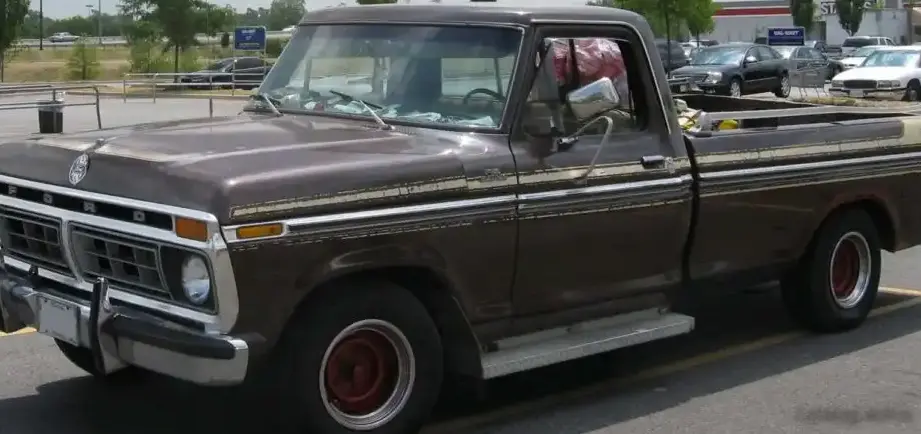
The Ford F-Series F-150 VI Regular Cab, equipped with the 6.4-liter (390 cubic inch) V8 engine producing 160 horsepower, represents a significant iteration in the long and storied history of Ford’s full-size pickup trucks. Produced for the 1975 and 1976 model years, this variant occupied a middle ground in the F-150 lineup, offering a balance between affordability and capability for buyers needing a robust work vehicle. It was part of the sixth generation of the F-Series (1973-1979), a generation known for its increased size, improved comfort, and a wider range of available options compared to its predecessors. This particular configuration, with its relatively low horsepower for the era, was aimed at buyers prioritizing durability and fuel economy (by 1970s standards) over outright performance.
Technical Specifications
| Brand | Ford |
| Model | F-Series F-100/F-150 |
| Generation | F-Series F-150 VI Regular Cab |
| Type (Engine) | 6.4 390 V8 (160 Hp) |
| Start of production | 1975 |
| End of production | 1976 |
| Powertrain Architecture | Internal Combustion engine |
| Body type | Pick-up |
| Seats | 3 |
| Doors | 2 |
| Fuel Type | Petrol (Gasoline) |
| Power | 160 Hp |
| Power per litre | 25 Hp/l |
| Engine displacement | 6391 cm3 |
| Engine displacement (cu. in.) | 390 cu. in. |
| Number of cylinders | 8 |
| Engine configuration | V-engine |
| Cylinder Bore | 102.87 mm |
| Cylinder Bore (in.) | 4.05 in. |
| Piston Stroke | 96.01 mm |
| Piston Stroke (in.) | 3.78 in. |
| Number of valves per cylinder | 4 |
| Fuel injection system | Carburettor |
| Engine aspiration | Naturally aspirated engine |
| Max. weight | 2744 kg |
| Max. weight (lbs.) | 6049.48 lbs. |
| Trunk (boot) space – minimum | 1852-2084 l |
| Trunk (boot) space – minimum (cu. ft.) | 65.4 – 73.6 cu. ft. |
| Length | 5215 mm |
| Length (in.) | 205.31 in. |
| Wheelbase | 3378 mm |
| Wheelbase (in.) | 132.99 in. |
| Wading depth | 665 mm |
| Wading depth (in.) | 26.18 in. |
| Drivetrain Architecture | The Internal combustion engine (ICE) drives the rear wheels of the vehicle. |
| Drive wheel | Rear wheel drive |
| Number of gears and type of gearbox | 3 gears, manual transmission |
| Front suspension | Independent coil spring, Transverse stabilizer |
| Rear suspension | Leaf spring |
| Front brakes | Disc |
| Rear brakes | Drum |
| Power steering | Electric Steering |
| Tires size | 215/75 R15; 225/75 R15 |
| Wheel rims size | 7J x 15 |
Powertrain & Engine Architecture
The heart of this F-150 variant was the 390 cubic inch (6.4-liter) Ford Windsor V8 engine. This engine, designated as the 390 FE series, was a robust and relatively simple design, known for its durability and low-end torque. The 160 horsepower output was achieved through the use of a two-barrel carburetor, a relatively conservative camshaft profile, and 8.5:1 compression ratio. The engine featured a cast iron block and cylinder heads, and a traditional pushrod valvetrain with two valves per cylinder. The 390 was a longitudinal front-engine layout. The standard transmission for this model year was a three-speed manual transmission. While an automatic transmission was available as an option, the base model typically came equipped with the manual, contributing to its lower price point.
Driving Characteristics
The 160 hp 390 V8, coupled with the three-speed manual transmission, provided adequate, but not exhilarating, performance. Acceleration was modest, and the truck was best suited for hauling and towing rather than spirited driving. The gear ratios in the three-speed manual were optimized for work, with a relatively low first gear for starting heavy loads and a higher final drive ratio for fuel efficiency on the highway. Compared to the available 302 cubic inch (5.0L) V8 or the larger 390 with higher horsepower ratings, this variant felt noticeably slower. However, the lower horsepower engine did offer a smoother, more manageable power delivery, making it easier to control when towing or navigating challenging terrain.
Equipment & Trim Levels
The F-150 Regular Cab with the 390 V8 was typically offered in a base trim level, focusing on functionality and affordability. Standard features included a basic vinyl bench seat, a simple dashboard with minimal instrumentation, and a steel bed. Options were available, such as upgraded interior trim, a radio, and a heater. Power steering and power brakes were also available as optional extras. The exterior typically featured minimal chrome trim, reflecting its work-oriented nature. The interior was designed for practicality, with durable materials and easy-to-clean surfaces.
Chassis & Braking
The F-150 VI utilized a body-on-frame construction, providing a robust and durable platform. The front suspension consisted of independent coil springs with a transverse stabilizer bar, offering a reasonable ride quality for a truck of its size. The rear suspension employed leaf springs, which were well-suited for carrying heavy loads. Braking duties were handled by disc brakes in the front and drum brakes in the rear. The braking system was adequate for the truck’s weight and performance, but lacked the stopping power of more modern systems. Steering was manual on the base model, with power steering available as an option.
Market Reception & Comparison
The 160 hp 390 V8-equipped F-150 was generally well-received by buyers who prioritized affordability and durability over performance. Critics noted its adequate power for most everyday tasks, but acknowledged that it was not the most exciting truck on the market. Compared to the 302 V8, the 390 offered more low-end torque, making it better suited for towing and hauling. However, the 302 was more fuel-efficient. The larger, higher-horsepower 390 variants provided significantly more power, but came at a higher price. This 160 hp version found its niche among farmers, ranchers, and tradesmen who needed a reliable and capable work truck without breaking the bank.
Legacy
The 390 Windsor V8 engine, in all its iterations, has earned a reputation for reliability and longevity. Many examples of this engine are still running today, a testament to its robust design and durable construction. While not as sought-after as some of the higher-performance variants, the 160 hp 390 F-150 remains a popular choice among classic truck enthusiasts who appreciate its simplicity and affordability. In the used car market, these trucks are often found in well-preserved condition, having been maintained by owners who valued their practicality and dependability. Parts availability is generally good, making them relatively easy to maintain and repair. The F-150 VI with the 390 V8 represents a pivotal moment in Ford truck history, embodying the spirit of American work ethic and durability.