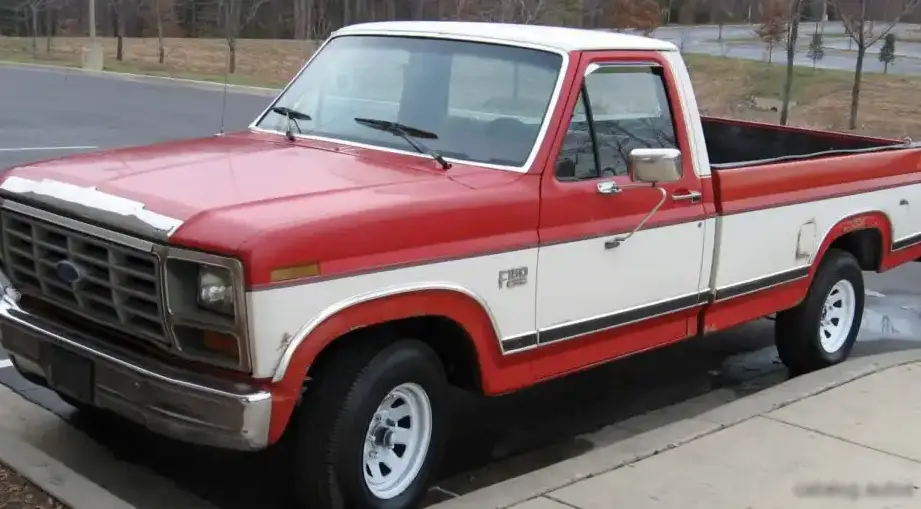
The Ford F-Series F-150 VII Regular Cab, equipped with the 4.9-liter inline-six engine producing 125 horsepower, represents a significant workhorse offering from Ford during the 1981-1986 model years. This variant occupied the entry-level position within the seventh generation F-Series lineup, appealing to buyers prioritizing affordability and durability over outright performance. It was a mainstay for farmers, ranchers, and tradespeople needing a reliable pickup for everyday tasks. The F-Series as a whole continued its dominance of the American pickup truck market during this period, and the 4.9L engine was a cornerstone of that success, known for its longevity and relatively simple maintenance requirements.
Technical Specifications
| Brand | Ford |
| Model | F-Series F-100/F-150 |
| Generation | F-Series F-150 VII Regular Cab |
| Type (Engine) | 4.9 Six (125 Hp) |
| Start of production | 1981 |
| End of production | 1986 |
| Powertrain Architecture | Internal Combustion engine |
| Body type | Pick-up |
| Seats | 2-3 |
| Doors | 2 |
| Fuel Type | Petrol (Gasoline) |
| Power | 125 Hp |
| Power per litre | 25.4 Hp/l |
| Torque | 339 Nm / 250.03 lb.-ft. |
| Engine layout | Front, Longitudinal |
| Engine displacement | 4916 cm3 / 299.99 cu. in. |
| Number of cylinders | 6 |
| Engine configuration | Inline |
| Fuel injection system | Multi-port manifold injection |
| Engine aspiration | Naturally aspirated engine |
| Max. weight | 2767 kg / 6100.19 lbs. |
| Fuel tank capacity | 62-72 l / 16.38 – 19.02 US gal | 13.64 – 15.84 UK gal |
| Length | 4770-5291 mm / 187.8 – 208.31 in. |
| Width | 1372-1778 mm / 54.02 – 70 in. |
| Height | 1775-1778 mm / 69.88 – 70 in. |
| Wheelbase | 2967-3378 mm / 116.81 – 132.99 in. |
| Wading depth | 726-732 mm / 28.58 – 28.82 in. |
| Drivetrain Architecture | The Internal combustion engine (ICE) drives the rear wheels of the vehicle. |
| Drive wheel | Rear wheel drive |
| Number of gears and type of gearbox | 3 gears, manual transmission |
| Front suspension | Independent coil spring |
| Front brakes | Disc |
| Rear brakes | Drum |
| Power steering | Electric Steering |
| Tires size | 215/75 R15; 235/75 R15 |
| Wheel rims size | 15 |
Powertrain & Engine Architecture
The heart of this F-150 variant was the 4.9-liter (299 cubic inch) inline-six cylinder engine, often referred to as the “300 six” despite its actual displacement. This engine, internally designated as the 302, was a long-stroke design known for its robust bottom end and impressive low-end torque. The 1981-1986 versions utilized a multi-port fuel injection system, a significant upgrade from the carburetors used in earlier iterations, improving fuel efficiency and driveability. The engine featured a cast iron block and head, contributing to its durability. Valve actuation was handled by a conventional pushrod valvetrain. The 3-speed manual transmission was the standard offering, providing a simple and reliable means of transferring power to the rear wheels. While an automatic transmission was available as an option, the manual was favored by those prioritizing fuel economy and direct control.
Driving Characteristics
The 125 horsepower and 250 lb-ft of torque delivered by the 4.9L engine provided adequate, but not exhilarating, performance. Acceleration was modest, and highway passing required careful planning. The strength of this powertrain lay in its ability to handle heavy loads and challenging terrain. The 3-speed manual transmission offered a relatively wide gear spread, allowing the engine to operate efficiently at various speeds. The first gear was geared for hauling, while the higher gears were optimized for cruising. Compared to the available V8 engines, the 4.9L six lacked the top-end power, but it offered a smoother, more manageable power delivery, particularly at lower RPMs. The rear-wheel-drive configuration, combined with the relatively light weight of the regular cab configuration, made it a capable work truck.
Equipment & Trim Levels
The F-150 Regular Cab with the 4.9L engine typically represented the base trim level. Standard features were minimal, focusing on functionality rather than luxury. Typically, it included a basic vinyl bench seat, a simple dashboard with essential gauges, and a standard AM radio. Options were available, including upgraded radios, air conditioning, and a sliding rear window. The interior materials were durable but utilitarian, designed to withstand the rigors of daily work. Exterior features were similarly basic, with minimal chrome trim and standard steel wheels. Buyers could opt for features like a bed liner, towing package, and upgraded tires.
Chassis & Braking
The F-150’s chassis was a traditional body-on-frame construction, providing a robust and durable platform. The front suspension utilized independent coil springs, offering a reasonable ride quality for a truck. The rear suspension employed leaf springs, designed to handle heavy loads. Braking duties were handled by disc brakes at the front and drum brakes at the rear. Power steering was available, making maneuvering easier, especially when carrying a load. Tire sizes typically ranged from 215/75R15 to 235/75R15, providing a balance of traction and ride comfort. The frame itself was heavily reinforced to withstand the stresses of hauling and towing.
Market Reception & Comparison
The 4.9L F-150 was well-received by buyers seeking an affordable and reliable work truck. Critics acknowledged its durability and fuel efficiency, particularly compared to the larger V8 engines. However, it was often criticized for its lack of power and refinement. Compared to the 5.0L and 5.8L V8 options, the 4.9L offered significantly less horsepower and torque. However, it also offered better fuel economy and lower maintenance costs. The 4.9L was a popular choice for those who didn’t require the extra power of a V8 and prioritized long-term reliability. It was often seen as a sensible, no-frills option for those who needed a truck for practical purposes.
Legacy
The 4.9L inline-six engine has earned a reputation as one of the most durable and reliable engines ever produced by Ford. Many examples are still on the road today, a testament to its robust design and simple mechanics. The powertrain, while not particularly powerful by modern standards, remains relatively easy and inexpensive to maintain. In the used car market, these F-150s are often sought after by those looking for a classic American pickup truck that can still be used for work or restoration projects. The 4.9L engine’s simplicity makes it a favorite among mechanics and DIY enthusiasts. Its enduring legacy is a testament to Ford’s commitment to building durable and dependable vehicles.