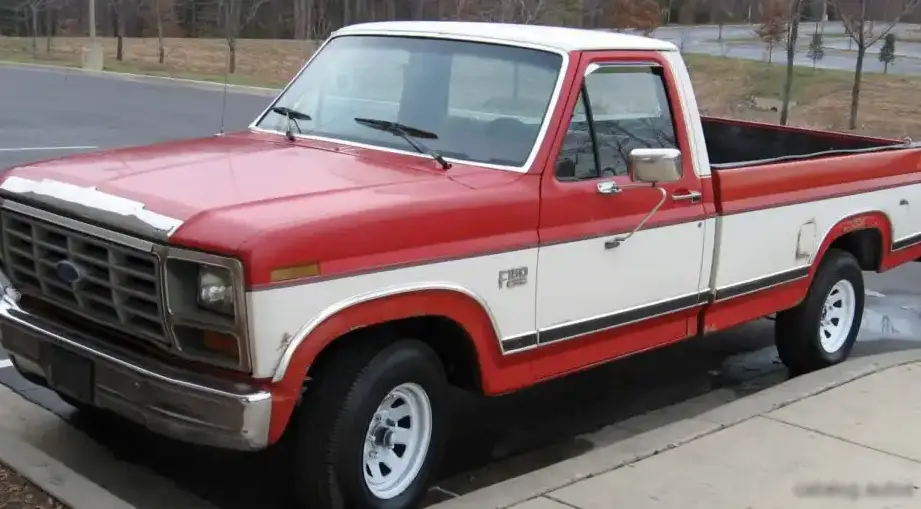
The Ford F-Series F-150 VII Regular Cab, equipped with the 4.9-liter inline-six engine producing 125 horsepower and a four-wheel-drive (4×4) system, was a mainstay of Ford’s truck lineup from 1984 to 1986. This variant represented an entry-level offering within the seventh generation of the F-Series, known internally as the F-100/F-150. It served as a workhorse for those needing a capable pickup without the expense of the larger engines or more luxurious trim packages. This generation marked a significant shift towards more aerodynamic styling and increased fuel efficiency compared to its predecessors, while still maintaining the rugged durability Ford trucks were known for.
Technical Specifications
| Brand | Ford |
| Model | F-Series F-100/F-150 |
| Generation | F-Series F-150 VII Regular Cab |
| Type (Engine) | 4.9 Six (125 Hp) 4×4 |
| Start of production | 1984 |
| End of production | 1986 |
| Powertrain Architecture | Internal Combustion engine |
| Body type | Pick-up |
| Seats | 2-3 |
| Doors | 2 |
| Fuel Type | Petrol (Gasoline) |
| Power | 125 Hp |
| Power per litre | 25.4 Hp/l |
| Torque | 339 Nm / 250.03 lb.-ft. |
| Engine layout | Front, Longitudinal |
| Engine displacement | 4916 cm3 / 299.99 cu. in. |
| Number of cylinders | 6 |
| Engine configuration | Inline |
| Fuel injection system | Multi-port manifold injection |
| Engine aspiration | Naturally aspirated engine |
| Max. weight | 2835 kg / 6250.11 lbs. |
| Fuel tank capacity | 62-72 l / 16.38 – 19.02 US gal | 13.64 – 15.84 UK gal |
| Length | 4808-5291 mm / 189.29 – 208.31 in. |
| Width | 1372-1778 mm / 54.02 – 70 in. |
| Height | 1857-1864 mm / 73.11 – 73.39 in. |
| Wheelbase | 2967-3378 mm / 116.81 – 132.99 in. |
| Wading depth | 777-780 mm / 30.59 – 30.71 in. |
| Drivetrain Architecture | The Internal combustion engine (ICE) drives the rear wheels permanently, and the front wheels are driven through an electrically or mechanically operated clutch if necessary. |
| Drive wheel | All wheel drive (4×4) |
| Number of gears and type of gearbox | 3 gears, manual transmission |
| Front suspension | Independent coil spring |
| Front brakes | Disc |
| Rear brakes | Drum |
| Power steering | Electric Steering |
| Tires size | 235/75 R15 |
| Wheel rims size | 15 |
Powertrain & Engine Architecture
The heart of this F-150 variant was the 4.9-liter (299 cubic inch) inline-six cylinder engine. Commonly referred to as the “300 six” due to its earlier 4.9-liter predecessor, this engine was known for its durability and low-end torque. The 1984-1986 version featured multi-port fuel injection, a significant upgrade from the carburetor systems used in earlier models, improving fuel efficiency and responsiveness. The engine utilized a cast iron block and head, contributing to its longevity. While 125 horsepower wasn’t a particularly high output, the engine produced a respectable 250 lb-ft of torque, making it well-suited for hauling and towing. The three-speed manual transmission was standard, providing a direct connection to the engine’s power. The 4×4 system employed a transfer case allowing the driver to switch between two-wheel drive and four-wheel drive, with a low-range gear for increased traction in challenging conditions.
Driving Characteristics
The 4.9-liter engine and three-speed manual transmission combination delivered a utilitarian driving experience. Acceleration was modest, and the truck wasn’t designed for speed. However, the engine’s torque allowed for confident hauling and towing capabilities. The manual transmission provided a more engaging driving experience than an automatic, giving the driver greater control over gear selection. The 4×4 system, when engaged, provided enhanced traction on slippery surfaces, making it a capable off-road vehicle for light to moderate terrain. Compared to the V8 options available in the F-150 lineup, this 4.9-liter version prioritized fuel economy and durability over outright performance. The gear ratios were optimized for work, rather than speed, with a focus on providing sufficient power at lower RPMs.
Equipment & Trim Levels
The Regular Cab F-150 with the 4.9-liter engine typically represented the base trim level. Standard features were relatively sparse, reflecting its position as an affordable work truck. It generally included a basic vinyl bench seat, a simple dashboard with minimal instrumentation, and manual windows and locks. Options were available, such as an upgraded radio, air conditioning, and a sliding rear window. The interior was designed for practicality and ease of cleaning, rather than luxury. Exterior features were similarly basic, with steel wheels, black bumpers, and minimal chrome trim. The focus was on providing a functional and durable vehicle at an accessible price point.
Chassis & Braking
The F-150’s chassis was a traditional body-on-frame construction, providing a robust and durable platform. The front suspension utilized independent coil springs, offering a relatively comfortable ride for a truck. The rear suspension employed leaf springs, which were well-suited for carrying heavy loads. Braking duties were handled by disc brakes in the front and drum brakes in the rear. Power steering was standard, making the truck easier to maneuver, especially at low speeds. The tires, typically 235/75R15, were chosen for a balance of on-road comfort and off-road traction. The frame itself was heavily reinforced to withstand the rigors of work and off-road use.
Market Reception & Comparison
The 4.9-liter F-150 4×4 was well-received by buyers who prioritized affordability and durability over performance. Critics acknowledged its capable engine and robust construction, but noted its lack of refinement compared to the V8-powered models. Fuel economy was a strong point, particularly compared to the larger engines. In terms of reliability, the 4.9-liter engine was considered exceptionally durable, with many examples exceeding 200,000 miles with proper maintenance. Compared to the 5.0-liter V8, the 4.9-liter offered lower initial cost and better fuel economy, but significantly less power. The 6.9-liter diesel, while offering even more torque, was considerably more expensive and required more specialized maintenance.
Legacy
The 4.9-liter inline-six engine became legendary for its longevity and simplicity. Many examples of these engines are still in service today, a testament to their robust design. The F-150 VII generation, and this variant in particular, established a reputation for reliability that continues to define the Ford F-Series. In the used car market, these trucks are often sought after by those looking for a dependable and affordable work vehicle. While not a collector’s item, a well-maintained example of this F-150 can provide years of reliable service. The simplicity of the engine and drivetrain makes it relatively easy to maintain and repair, further contributing to its enduring appeal. The 4.9L engine is still a favorite among those who appreciate a simple, durable, and reliable powerplant.