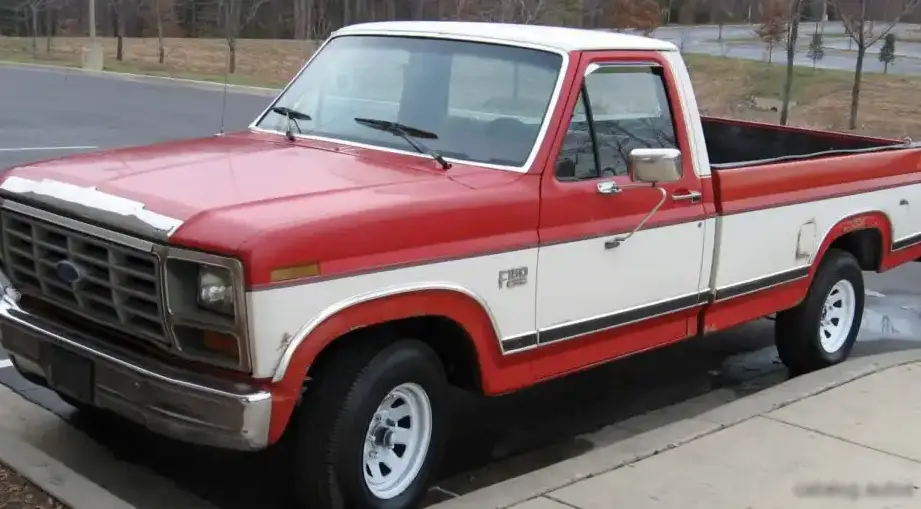
The Ford F-Series F-150 VII Regular Cab, equipped with the 5.0-liter V8 engine producing 133 horsepower and a four-wheel-drive (4×4) system, was a mainstay of Ford’s truck lineup from 1984 to 1985. This variant represented a work-oriented configuration within the broader seventh generation of the F-Series, known internally as the F-100/F-150. It served as a robust, if somewhat underpowered by modern standards, option for buyers needing a capable pickup for hauling and light-duty tasks. This particular configuration occupied the lower end of the performance spectrum for the F-150, positioned below the larger displacement V8 options and the later fuel-injected engines.
Technical Specifications
| Brand | Ford |
| Model | F-Series F-100/F-150 |
| Generation | F-Series F-150 VII Regular Cab |
| Type (Engine) | 5.0 V8 (133 Hp) 4×4 |
| Start of production | 1984 |
| End of production | 1985 |
| Powertrain Architecture | Internal Combustion engine |
| Body type | Pick-up |
| Seats | 2-3 |
| Doors | 2 |
| Fuel Type | Petrol (Gasoline) |
| Power | 133 Hp |
| Power per litre | 26.9 Hp/l |
| Torque | 316 Nm / 233.07 lb.-ft. |
| Engine layout | Front, Longitudinal |
| Engine displacement | 4949 cm3 / 302.01 cu. in. |
| Number of cylinders | 8 |
| Engine configuration | V-engine |
| Fuel injection system | Carburettor |
| Engine aspiration | Naturally aspirated engine |
| Max. weight | 2835 kg / 6250.11 lbs. |
| Fuel tank capacity | 62-72 l / 16.38 – 19.02 US gal | 13.64 – 15.84 UK gal |
| Length | 4808-5291 mm / 189.29 – 208.31 in. |
| Width | 1372-1778 mm / 54.02 – 70 in. |
| Height | 1857-1864 mm / 73.11 – 73.39 in. |
| Wheelbase | 2967-3378 mm / 116.81 – 132.99 in. |
| Wading depth | 777-780 mm / 30.59 – 30.71 in. |
| Drivetrain Architecture | The Internal combustion engine (ICE) drives the rear wheels permanently, and the front wheels are driven through an electrically or mechanically operated clutch if necessary. |
| Drive wheel | All wheel drive (4×4) |
| Number of gears and type of gearbox | 3 gears, manual transmission |
| Front suspension | Independent coil spring |
| Front brakes | Disc |
| Rear brakes | Drum |
| Power steering | Electric Steering |
| Tires size | 235/75 R15 |
| Wheel rims size | 15 |
Powertrain & Engine Architecture
The heart of this F-150 variant was the 302 cubic inch (4.9-liter) Ford Windsor V8 engine. This engine, designated as the 5.0, was a staple of Ford’s lineup for decades, known for its durability and relatively simple design. The 1984-1985 iteration utilized a two-barrel carburetor for fuel delivery, a system that was becoming increasingly outdated as fuel injection gained prominence. The engine featured a cast iron block and cylinder heads, and a hydraulic lifter camshaft. The 133 horsepower output was a result of a relatively conservative compression ratio and carburetor tuning, prioritizing reliability and low-end torque over peak power. The three-speed manual transmission was a standard offering, providing a direct mechanical connection between the engine and the drivetrain. The 4×4 system employed a transfer case allowing the driver to switch between two-wheel drive and four-wheel drive modes, enhancing traction in challenging conditions.
Driving Characteristics
The 5.0L V8 with the three-speed manual transmission in the F-150 offered a utilitarian driving experience. Acceleration was modest, and the engine required downshifting for passing maneuvers or climbing steep hills. The three-speed gearbox, while durable, lacked the versatility of more modern transmissions. The 4×4 system added weight and complexity, slightly impacting fuel economy and on-road handling. However, it provided significant advantages in off-road situations and inclement weather. Compared to the larger 351 Windsor V8 options, this 5.0L version felt noticeably less powerful. The manual transmission provided a more engaging driving experience than the available automatic, offering greater control over gear selection and engine braking.
Equipment & Trim Levels
The Regular Cab F-150 with the 5.0L engine typically represented the base trim level. Standard features were minimal, focusing on functionality rather than luxury. Typically, it included a basic vinyl bench seat, a simple dashboard with essential gauges, and manual windows and locks. Options were available, such as an upgraded radio, air conditioning, and a sliding rear window. The interior trim was generally durable and designed to withstand heavy use. Exterior features included a basic steel front bumper, black plastic side moldings, and standard headlights. The emphasis was on providing a no-frills, work-ready truck.
Chassis & Braking
The F-150’s chassis was a traditional body-on-frame construction, providing a robust and durable platform. The front suspension utilized independent coil springs, offering a reasonable ride quality for a truck of its era. The rear suspension employed leaf springs, which were well-suited for carrying heavy loads. Braking duties were handled by front disc brakes and rear drum brakes. Power steering was standard, making maneuvering the large truck easier. The tires, typically 235/75R15, were designed for a balance of on-road and off-road performance. The frame itself was heavily reinforced to withstand the stresses of hauling and towing.
Market Reception & Comparison
The 1984-1985 F-150 with the 5.0L engine and manual transmission was viewed as a practical and affordable option for buyers needing a basic work truck. Critics acknowledged its durability and capability but noted its lack of refinement and relatively low power output. Compared to the larger engine options, such as the 351 Windsor, it was considered less desirable for heavy-duty applications. However, its lower price point and improved fuel economy made it an attractive choice for those who didn’t require maximum power. Reliability was generally good, although the carburetor required periodic maintenance.
Legacy
The 5.0L Windsor V8 engine continued to be a popular choice in Ford trucks and Mustangs for many years after 1985. While the carburetor was eventually replaced by fuel injection, the basic engine architecture remained largely unchanged. The 1984-1985 F-150 with this engine is now considered a classic truck, and well-maintained examples are sought after by collectors and enthusiasts. The powertrain, while not particularly powerful by modern standards, is known for its durability and relative simplicity, making it a relatively easy engine to maintain and repair. In the used car market today, these trucks are often found in work-truck condition, but increasingly, enthusiasts are restoring them to their original glory.