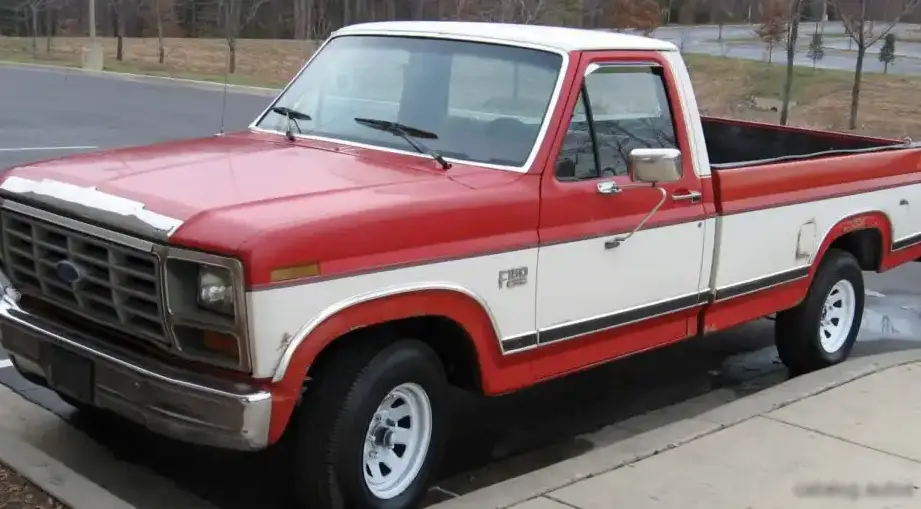
The Ford F-Series F-150 VII Regular Cab, equipped with the 5.0-liter V8 engine producing 133 horsepower and paired with an automatic transmission, represents a significant iteration in Ford’s long-running and immensely popular F-Series pickup truck lineage. Produced from 1979 through 1985, this variant occupied a middle ground within the seventh generation (1973-1979) F-Series lineup, offering a balance between capability and affordability. It was a workhorse aimed at buyers needing a robust truck for everyday tasks, light hauling, and towing, without the expense of the higher-output engine options. This generation saw a substantial increase in size and comfort compared to its predecessors, reflecting the evolving demands of the American truck market.
Technical Specifications
| Brand | Ford |
| Model | F-Series F-100/F-150 |
| Generation | F-Series F-150 VII Regular Cab |
| Type (Engine) | 5.0 V8 (133 Hp) Automatic |
| Start of production | September, 1979 |
| End of production | 1985 |
| Powertrain Architecture | Internal Combustion engine |
| Body type | Pick-up |
| Seats | 2-3 |
| Doors | 2 |
| Fuel Type | Petrol (Gasoline) |
| Power | 133 Hp |
| Power per litre | 26.9 Hp/l |
| Torque | 316 Nm / 233.07 lb.-ft. |
| Engine layout | Front, Longitudinal |
| Engine displacement | 4949 cm3 / 302.01 cu. in. |
| Number of cylinders | 8 |
| Engine configuration | V-engine |
| Fuel injection system | Carburettor |
| Engine aspiration | Naturally aspirated engine |
| Max. weight | 2767 kg / 6100.19 lbs. |
| Fuel tank capacity | 62-72 l / 16.38 – 19.02 US gal | 13.64 – 15.84 UK gal |
| Length | 4770-5291 mm / 187.8 – 208.31 in. |
| Width | 1372-1778 mm / 54.02 – 70 in. |
| Height | 1775-1778 mm / 69.88 – 70 in. |
| Wheelbase | 2967-3378 mm / 116.81 – 132.99 in. |
| Wading depth | 726-732 mm / 28.58 – 28.82 in. |
| Drivetrain Architecture | The Internal combustion engine (ICE) drives the rear wheels of the vehicle. |
| Drive wheel | Rear wheel drive |
| Number of gears and type of gearbox | 4 gears, automatic transmission |
| Front suspension | Independent coil spring |
| Front brakes | Disc |
| Rear brakes | Drum |
| Power steering | Electric Steering |
| Tires size | 215/75 R15; 235/75 R15 |
| Wheel rims size | 15 |
Powertrain & Engine Architecture
The heart of this F-150 variant is Ford’s 302 cubic inch (4.9-liter) 5.0-liter V8 engine. This engine, internally designated as the 302 Windsor, was a mainstay of Ford’s lineup for decades. The 1979-1985 iteration utilized a two-barrel carburetor for fuel delivery, a relatively simple system compared to fuel injection, but one that proved reliable and easy to maintain. The engine featured a cast iron block and cylinder heads, contributing to its durability. The valvetrain employed a hydraulic lifter camshaft, reducing the need for frequent valve adjustments. The automatic transmission was typically a Ford C6 three-speed automatic, known for its robustness and ability to handle the engine’s torque. While not a high-performance transmission, it was well-suited for the truck’s intended purpose.
Driving Characteristics
The 133 horsepower and 233 lb-ft of torque delivered by this combination provided adequate, but not exhilarating, performance. Acceleration was modest, and passing maneuvers required planning. The C6 automatic transmission’s gear ratios were geared towards torque multiplication, prioritizing hauling and towing capability over quick acceleration. Compared to the available 351 Windsor or 460 big-block V8 options, this 302 automatic was noticeably slower. However, it offered a smoother and more relaxed driving experience, particularly in city traffic. The rear-wheel-drive configuration and relatively simple suspension setup provided a traditional truck feel – firm ride quality and predictable handling.
Equipment & Trim Levels
The F-150 Regular Cab with the 5.0L V8 and automatic transmission typically fell into the mid-range of available trim levels. Standard features generally included a basic vinyl bench seat, a simple dashboard with essential gauges, and a basic AM radio. Options included upgraded interior trim, air conditioning, power steering, and a variety of bed configurations. The “Custom” trim level was a popular choice, adding features like chrome exterior trim and upgraded interior appointments. Buyers could also specify different cab configurations, bed lengths, and axle ratios to tailor the truck to their specific needs.
Chassis & Braking
The F-150’s chassis was a traditional body-on-frame construction, providing a robust and durable platform. The front suspension utilized independent coil springs, offering a degree of ride comfort. The rear suspension employed leaf springs, designed to handle heavier loads. Braking was accomplished via disc brakes on the front wheels and drum brakes on the rear. Power steering was often an optional extra, but became increasingly common during this period. Tire sizes typically ranged from 215/75R15 to 235/75R15, providing a balance between ride comfort and load-carrying capacity.
Market Reception & Comparison
The 5.0L V8 automatic F-150 was generally well-received by buyers seeking a dependable and affordable work truck. Critics noted its adequate power and fuel economy (for the time), but also pointed out its lack of refinement compared to some competitors. Compared to the six-cylinder F-150, the V8 offered a significant power boost, making it a better choice for towing and hauling. However, the larger engines provided substantially more performance. Fuel economy was a consideration, with the V8 consuming more gasoline than the smaller engines. Reliability was generally good, although carburetor maintenance was a recurring task.
Legacy
The 1979-1985 Ford F-150 with the 5.0L V8 and automatic transmission remains a popular choice among classic truck enthusiasts and those seeking a simple, reliable work vehicle. The 302 Windsor engine is known for its durability and readily available parts. While not the fastest or most luxurious F-150 variant, it represents a sweet spot in the lineup, offering a good balance of capability, affordability, and ease of maintenance. Today, well-maintained examples command reasonable prices in the used car market, and the truck’s enduring popularity ensures a continued supply of parts and support. The simplicity of the powertrain makes it a relatively easy vehicle to work on for those with mechanical aptitude, contributing to its lasting appeal.