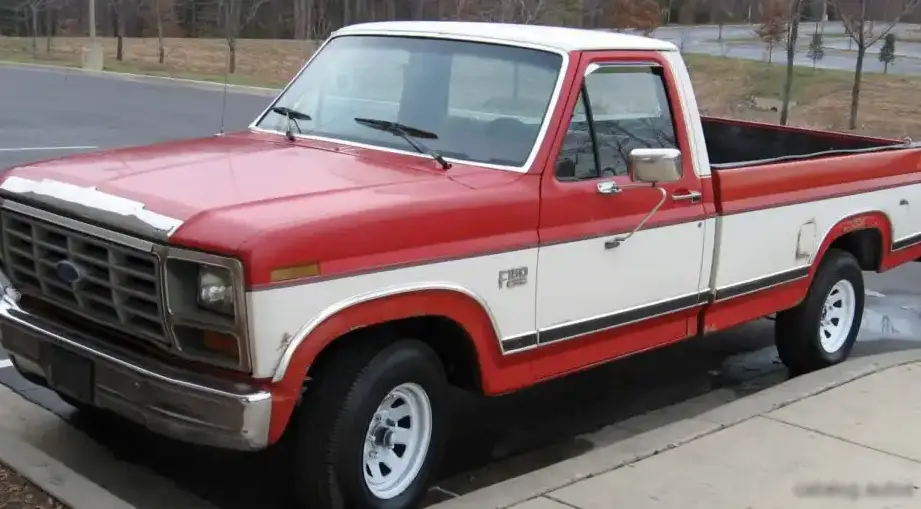
The Ford F-Series F-150 VII Regular Cab, equipped with the 5.8-liter V8 engine producing 150 horsepower, represents a significant iteration in the long and storied history of Ford’s full-size pickup trucks. Produced from 1983 to 1985, this variant occupied a crucial position in the F-Series lineup, offering a balance between affordability and capability for buyers needing a robust work vehicle. It falls within the seventh generation of the F-Series (1980-1986), a period marked by increased refinement and a focus on fuel efficiency compared to earlier, more utilitarian models. This particular configuration, with its relatively modest power output, was aimed at buyers who prioritized durability and lower running costs over outright performance.
Technical Specifications
| Brand | Ford |
| Model | F-Series F-100/F-150 |
| Generation | F-Series F-150 VII Regular Cab |
| Type (Engine) | 5.8 V8 (150 Hp) |
| Start of production | 1983 |
| End of production | 1985 |
| Powertrain Architecture | Internal Combustion engine |
| Body type | Pick-up |
| Seats | 2-3 |
| Doors | 2 |
| Fuel Type | Petrol (Gasoline) |
| Power | 150 Hp |
| Power per litre | 26.1 Hp/l |
| Torque | 380 Nm / 280.27 lb.-ft. |
| Engine layout | Front, Longitudinal |
| Engine displacement | 5752 cm3 / 351.01 cu. in. |
| Number of cylinders | 8 |
| Engine configuration | V-engine |
| Fuel injection system | Multi-port manifold injection |
| Engine aspiration | Naturally aspirated engine |
| Max. weight | 2767 kg / 6100.19 lbs. |
| Fuel tank capacity | 62-72 l / 16.38 – 19.02 US gal | 13.64 – 15.84 UK gal |
| Length | 4770-5291 mm / 187.8 – 208.31 in. |
| Width | 1372-1778 mm / 54.02 – 70 in. |
| Height | 1775-1778 mm / 69.88 – 70 in. |
| Wheelbase | 2967-3378 mm / 116.81 – 132.99 in. |
| Wading depth | 726-732 mm / 28.58 – 28.82 in. |
| Drivetrain Architecture | The Internal combustion engine (ICE) drives the rear wheels of the vehicle. |
| Drive wheel | Rear wheel drive |
| Number of gears and type of gearbox | 3 gears, manual transmission |
| Front suspension | Independent coil spring |
| Front brakes | Disc |
| Rear brakes | Drum |
| Power steering | Electric Steering |
| Tires size | 215/75 R15; 235/75 R15 |
| Wheel rims size | 15 |
Powertrain & Engine Architecture
The heart of this F-150 variant is the 5.8-liter (351 cubic inch) Ford Windsor V8 engine. This engine, a mainstay of Ford’s truck and car lines for decades, is a pushrod engine with a cast iron block and cylinder heads. The 150 horsepower output was achieved through a two-barrel carburetor and multi-port fuel injection, a relatively modern feature for the time that improved fuel efficiency and throttle response compared to earlier carbureted designs. The engine’s valvetrain utilizes a hydraulic lifter camshaft, reducing the need for frequent valve adjustments. The three-speed manual transmission was a common pairing for this engine, offering a direct and relatively simple drivetrain. While not known for blistering acceleration, the combination provided adequate power for typical hauling and towing tasks.
Driving Characteristics
Behind the wheel, the 1983-1985 F-150 with the 5.8L V8 and manual transmission delivers a distinctly analog driving experience. The engine produces a usable amount of torque, making it suitable for work applications, but it’s not a high-revving powerplant. Acceleration is modest, and the three-speed manual transmission requires deliberate shifting to keep the engine in its optimal power band. Compared to the available six-cylinder engines, the V8 offered a noticeable increase in power and towing capacity. However, it fell short of the performance offered by the larger 6.9L diesel or the more powerful V8 options. The truck’s suspension, while comfortable for everyday driving, is tuned for load-carrying, resulting in a somewhat firm ride when unladen.
Equipment & Trim Levels
The F-150 Regular Cab in this configuration typically represented a base or mid-range trim level. Standard features included a basic vinyl interior, a simple dashboard layout with analog gauges, and a manually adjustable steering column. Options included upgraded interior trim, air conditioning, a radio, and various towing packages. The Regular Cab configuration offered a bench seat capable of seating up to three occupants, although the center seat was often less comfortable for extended journeys. The exterior trim was relatively minimal, with basic chrome bumpers and a black grille. The focus was on functionality and durability rather than luxury.
Chassis & Braking
The F-150’s chassis is a traditional body-on-frame construction, providing a robust and durable platform for heavy-duty use. The front suspension utilizes independent coil springs, offering a reasonable level of ride comfort and handling. The rear suspension employs leaf springs, which are well-suited for supporting heavy loads. Braking duties are handled by disc brakes at the front and drum brakes at the rear. Power steering was standard, making the truck easier to maneuver, especially at low speeds. Tire sizes typically ranged from 215/75R15 to 235/75R15, providing a good balance between ride comfort and load-carrying capacity.
Market Reception & Comparison
The 1983-1985 F-150 with the 5.8L V8 and manual transmission was generally well-received by buyers seeking a reliable and affordable work truck. Critics noted its durability and relatively low operating costs, but also pointed out its modest performance compared to some competitors. Compared to the Chevrolet C/K series and the Dodge Ram, the F-150 offered a competitive combination of features and price. The V8 engine provided a significant advantage over the base six-cylinder options in terms of towing capacity and overall power, making it a popular choice for buyers who needed to haul heavy loads. Fuel economy, however, was not a strong point, typical for a full-size V8 truck of that era.
Legacy
The 5.8L Windsor V8 engine, in this application, has proven to be remarkably durable over the long term. Many examples are still on the road today, a testament to its robust construction and relatively simple design. While maintenance costs can increase with age, parts availability remains good. The F-150 from this generation has gained a following among classic truck enthusiasts, who appreciate its straightforward design and rugged character. In the used car market, these trucks are often sought after for restoration projects or as reliable work vehicles. The combination of the 5.8L V8 and manual transmission is considered by some to be a sweet spot in the lineup, offering a good balance between power, durability, and affordability.