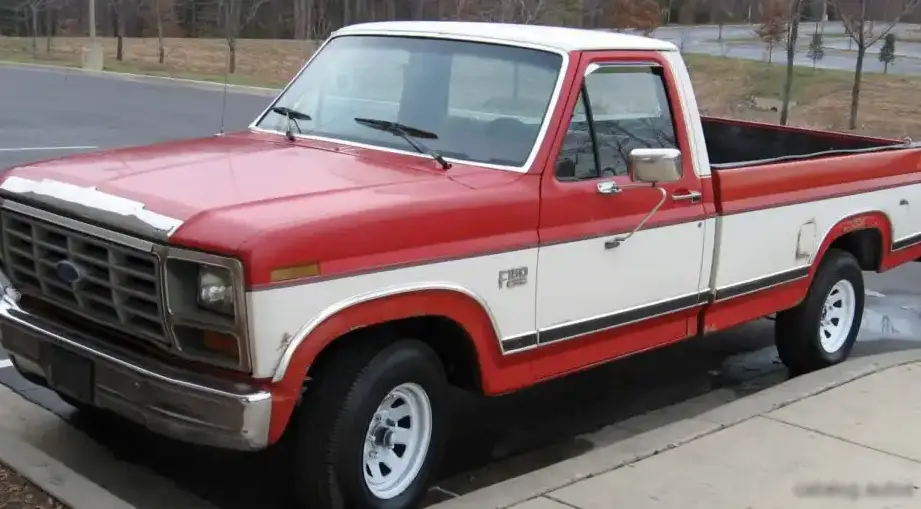
The Ford F-Series F-150 VII Regular Cab, equipped with the 5.8-liter V8 engine producing 150 horsepower and paired with a four-speed automatic transmission and four-wheel drive, represents a significant iteration in Ford’s long-running and immensely popular F-Series pickup truck lineage. Produced from 1984 to 1985, this configuration occupied a middle ground within the seventh generation (1980-1986) F-Series lineup, offering a balance between capability and affordability. It was positioned below the higher-output engine options, like the 6.9L diesel, but provided a step up in power and refinement compared to the smaller inline-six engines.
Technical Specifications
| Brand | Ford |
| Model | F-Series F-100/F-150 |
| Generation | F-Series F-150 VII Regular Cab |
| Type (Engine) | 5.8 V8 (150 Hp) 4×4 Automatic |
| Start of production | 1984 |
| End of production | 1985 |
| Powertrain Architecture | Internal Combustion engine |
| Body type | Pick-up |
| Seats | 2-3 |
| Doors | 2 |
| Fuel Type | Petrol (Gasoline) |
| Power | 150 Hp |
| Power per litre | 26.1 Hp/l |
| Torque | 380 Nm / 280.27 lb.-ft. |
| Engine layout | Front, Longitudinal |
| Engine displacement | 5752 cm3 / 351.01 cu. in. |
| Number of cylinders | 8 |
| Engine configuration | V-engine |
| Fuel injection system | Multi-port manifold injection |
| Engine aspiration | Naturally aspirated engine |
| Max. weight | 2835 kg / 6250.11 lbs. |
| Fuel tank capacity | 62-72 l / 16.38 – 19.02 US gal | 13.64 – 15.84 UK gal |
| Length | 4808-5291 mm / 189.29 – 208.31 in. |
| Width | 1372-1778 mm / 54.02 – 70 in. |
| Height | 1857-1864 mm / 73.11 – 73.39 in. |
| Wheelbase | 2967-3378 mm / 116.81 – 132.99 in. |
| Wading depth | 777-780 mm / 30.59 – 30.71 in. |
| Drivetrain Architecture | The Internal combustion engine (ICE) drives the rear wheels permanently, and the front wheels are driven through an electrically or mechanically operated clutch if necessary. |
| Drive wheel | All wheel drive (4×4) |
| Number of gears and type of gearbox | 4 gears, automatic transmission |
| Front suspension | Independent coil spring |
| Front brakes | Disc |
| Rear brakes | Drum |
| Power steering | Electric Steering |
| Tires size | 235/75 R15 |
| Wheel rims size | 15 |
Powertrain & Engine Architecture
The heart of this F-150 variant is the 5.8-liter (351 cubic inch) Ford Windsor V8 engine. This engine, designated as the 351W, was a mainstay of Ford’s truck and performance vehicle lineups for decades. The 1984-1985 iteration utilized a multi-port fuel injection system, a significant upgrade from the carburetors used in earlier models, improving fuel efficiency and throttle response. The engine featured a cast iron block and cylinder heads, and a two-barrel carburetor. The valvetrain employed a hydraulic lifter camshaft, contributing to quieter operation and reduced maintenance. The four-speed automatic transmission, typically the C6, was a robust and reliable unit designed to handle the engine’s torque output. It was a traditional torque converter automatic, known for its durability rather than outright performance. The transmission’s gear ratios were geared towards providing adequate pulling power for work applications, rather than quick acceleration.
Driving Characteristics
The 150 horsepower and 280 lb-ft of torque delivered by the 5.8L V8 and automatic transmission combination provided adequate, but not exceptional, performance. Acceleration was modest, and passing maneuvers required planning. The automatic transmission, while smooth, lacked the responsiveness of a manual transmission. The 4×4 system, engaged via a transfer case, provided enhanced traction in off-road or inclement weather conditions. The truck’s ride quality, typical of body-on-frame construction, was firm but acceptable for everyday use. Compared to the manual transmission versions of the same engine, the automatic resulted in a noticeable decrease in fuel economy and a slight reduction in overall responsiveness. The higher-output engine options, such as the 6.9L diesel, offered significantly more torque for heavy-duty tasks, while the smaller inline-six engines were more fuel-efficient but lacked the V8’s power.
Equipment & Trim Levels
The F-150 Regular Cab with the 5.8L V8 and automatic transmission typically came standard with basic features. These included a vinyl bench seat, a simple dashboard with analog gauges, and a basic AM radio. Options included upgraded interior trim, air conditioning, a tilt steering wheel, and a more powerful audio system. The exterior typically featured minimal chrome trim, with black plastic bumpers and side moldings. The trim level largely depended on the specific package selected by the buyer, ranging from a basic work truck configuration to a more comfort-oriented setup.
Chassis & Braking
The F-150 VII utilized a traditional body-on-frame construction, providing a robust and durable platform. The front suspension consisted of independent coil springs, while the rear suspension employed leaf springs. This setup was designed to handle heavy loads and provide a comfortable ride. The braking system featured disc brakes on the front wheels and drum brakes on the rear. Power steering was standard, making maneuvering the large truck easier. The tires, typically 235/75R15, were chosen for a balance of on-road comfort and off-road traction.
Market Reception & Comparison
The 5.8L V8/automatic combination was generally well-received as a capable and reliable work truck. Critics noted its adequate power and smooth automatic transmission, but also pointed out its relatively low fuel economy compared to the smaller engines. Compared to the 302 cubic inch V8, the 351W offered more torque, making it better suited for towing and hauling. The 6.9L diesel was favored by those needing maximum towing capacity, while the inline-six engines appealed to buyers prioritizing fuel efficiency. The F-150, as a whole, continued to dominate the pickup truck market during this period, known for its durability and practicality.
Legacy
The 5.8L Windsor V8 engine, in its various iterations, proved to be exceptionally durable and reliable. Many examples of these engines are still in service today, a testament to their robust design and construction. The C6 automatic transmission is also known for its longevity. While not particularly fuel-efficient by modern standards, the 1984-1985 F-150 with this powertrain remains a popular choice among classic truck enthusiasts and those seeking a dependable work vehicle. In the used car market, these trucks are often valued for their simplicity, ease of maintenance, and enduring build quality. Parts availability remains good, ensuring that these vehicles can be kept on the road for years to come.