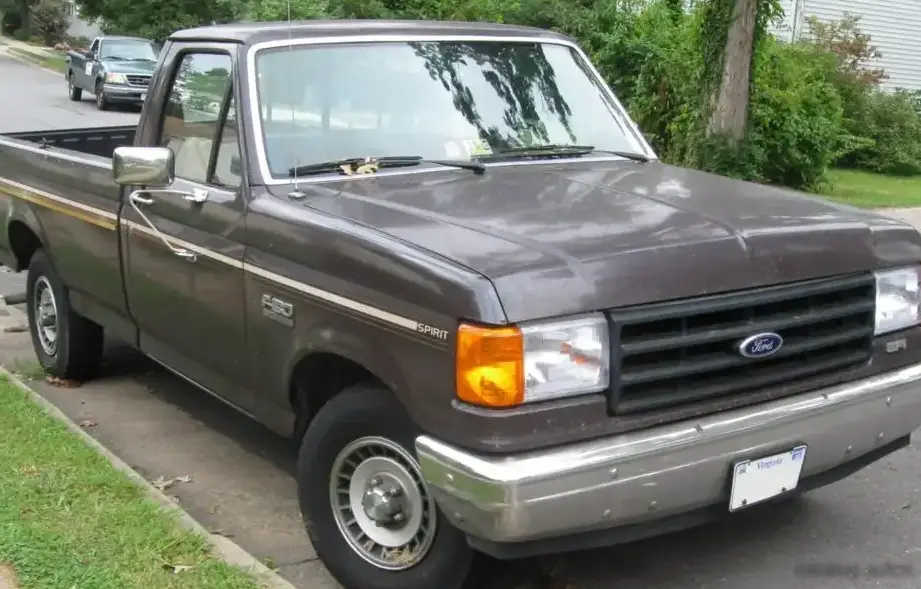
The Ford F-Series F-150 VIII Regular Cab, equipped with the 4.9-liter inline-six engine producing 145 horsepower and a four-wheel-drive system, was a mainstay of the American pickup truck market from 1986 to 1991. This variant represented a work-oriented, value-focused option within the eighth generation (1987-1991) of the F-Series, known internally as the F-100/F-150. It served as a durable and capable truck for both commercial and personal use, particularly appealing to buyers prioritizing functionality over outright performance. This configuration occupied the entry-level position in the F-150 lineup, offering a more affordable alternative to the V8-powered models.
Technical Specifications
| Brand | Ford |
| Model | F-Series F-100/F-150 |
| Generation | F-Series F-150 VIII Regular Cab |
| Type (Engine) | 4.9 300 Six (145 Hp) 4×4 |
| Start of production | 1986 |
| End of production | 1991 |
| Powertrain Architecture | Internal Combustion engine |
| Body type | Pick-up |
| Seats | 3 |
| Doors | 2 |
| Fuel Type | Petrol (Gasoline) |
| Power | 145 Hp |
| Power per litre | 29.5 Hp/l |
| Torque | 359 Nm / 264.78 lb.-ft. |
| Engine layout | Front, Longitudinal |
| Engine displacement | 4916 cm3 / 299.99 cu. in. |
| Number of cylinders | 6 |
| Engine configuration | Inline |
| Fuel injection system | Multi-port manifold injection |
| Engine aspiration | Naturally aspirated engine |
| Max. weight | 2835 kg / 6250.11 lbs. |
| Fuel tank capacity | 62-72 l / 16.38 – 19.02 US gal | 13.64 – 15.84 UK gal |
| Length | 4917-5339 mm / 193.58 – 210.2 in. |
| Height | 1859-1875 mm / 73.19 – 73.82 in. |
| Wheelbase | 2967-3378 mm / 116.81 – 132.99 in. |
| Wading depth | 833-846 mm / 32.8 – 33.31 in. |
| Drivetrain Architecture | The Internal combustion engine (ICE) drives the rear wheels permanently, and the front wheels are driven through an electrically or mechanically operated clutch if necessary. |
| Drive wheel | All wheel drive (4×4) |
| Number of gears and type of gearbox | 4 gears, manual transmission |
| Front suspension | Independent coil spring |
| Rear suspension | Leaf spring |
| Front brakes | Disc |
| Rear brakes | Drum |
| Power steering | Electric Steering |
| Tires size | 235/75 R15 |
| Wheel rims size | 6J x 15 |
Powertrain & Engine Architecture
The heart of this F-150 variant was the 4.9-liter (299 cubic inch) inline-six engine, commonly known as the “300 Six.” This engine, a Ford mainstay for decades, was renowned for its durability and low-end torque. The 1986-1991 version utilized multi-port fuel injection, a significant upgrade from the carburetor systems of earlier iterations, improving fuel efficiency and responsiveness. The engine featured a cast iron block and head, contributing to its robust nature. While not a high-revving engine, the 300 Six delivered a consistent 145 horsepower and 265 lb-ft of torque. The four-speed manual transmission was standard, providing a direct connection to the engine’s power. The transmission’s gear ratios were optimized for hauling and towing, prioritizing usability over sporty acceleration.
Driving Characteristics
The 4.9-liter F-150 4×4 wasn’t designed for speed. Acceleration was modest, and the truck felt most comfortable at lower speeds. The manual transmission allowed for good control, but required frequent shifting, especially when loaded. The 4×4 system, typically engaged via a floor-mounted lever, provided enhanced traction in off-road conditions or slippery surfaces. Compared to the V8-powered F-150s, this variant offered significantly less horsepower and quicker acceleration. However, the 300 Six’s torque advantage at low RPMs made it a capable work truck, able to handle moderate towing and hauling tasks. The ride quality, typical of body-on-frame trucks of the era, was firm, and the leaf spring rear suspension could be bouncy when unloaded.
Equipment & Trim Levels
The Regular Cab F-150 with the 300 Six engine was generally offered in a base trim level, focusing on essential features. Standard equipment typically included a basic vinyl bench seat, a simple dashboard with analog gauges, and manual windows and locks. Air conditioning and an AM radio were often optional extras. The interior was utilitarian in design, prioritizing durability and ease of cleaning. Higher trim levels, such as the XL and XLT, were available with upgrades like cloth upholstery, more comprehensive instrumentation, and additional convenience features, but these were typically paired with the V8 engine options.
Chassis & Braking
The F-150 VIII utilized a traditional body-on-frame construction, providing a robust and durable platform. The front suspension consisted of independent coil springs, offering a degree of ride comfort. The rear suspension employed leaf springs, designed to handle heavy loads. Braking duties were handled by disc brakes at the front and drum brakes at the rear. Power steering was standard, making maneuvering the large truck easier. The 4×4 system featured a solid front axle and a rear axle, providing good off-road capability. Tire size was typically 235/75R15, offering a balance of on-road comfort and off-road traction.
Market Reception & Comparison
The 4.9-liter F-150 4×4 was well-received by buyers seeking a dependable and affordable work truck. Critics acknowledged its durability and low-end torque, but noted its lack of refinement and modest performance compared to V8-powered competitors. Fuel economy was reasonable for a full-size pickup of the era, but not exceptional. Compared to the 5.0-liter V8, the 300 Six offered lower horsepower but comparable torque, and generally better fuel economy. The 300 Six was also considered more reliable and less prone to major mechanical issues than the V8 engines of the time.
Legacy
The 4.9-liter inline-six engine gained a legendary reputation for its longevity and simplicity. Many examples of this engine are still in service today, a testament to its robust design. The 1986-1991 F-150 with the 300 Six remains a popular choice among enthusiasts and those seeking a classic American pickup truck. While not a collector’s item in the same vein as some of the more powerful or rare F-150 variants, it represents a significant piece of Ford’s history and a reliable workhorse from a bygone era. In the used car market, these trucks are often valued for their simplicity, affordability, and potential for restoration or continued use as a practical vehicle.